NSR-WORLD.COM

NSR-WORLD.COM
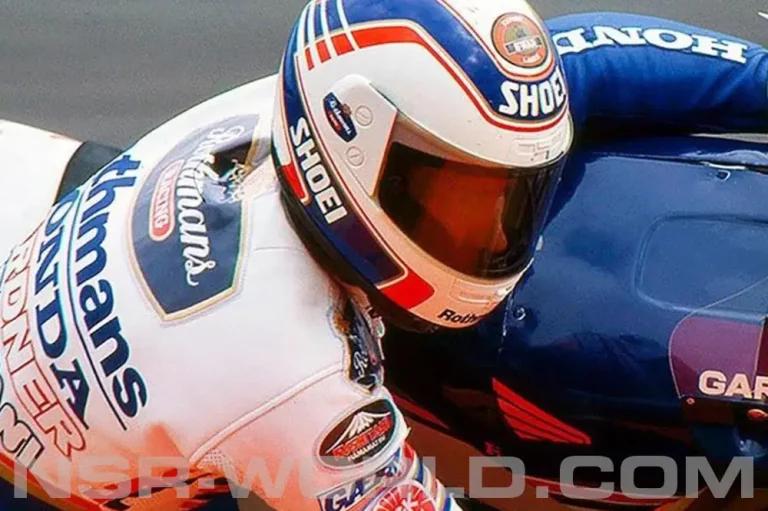
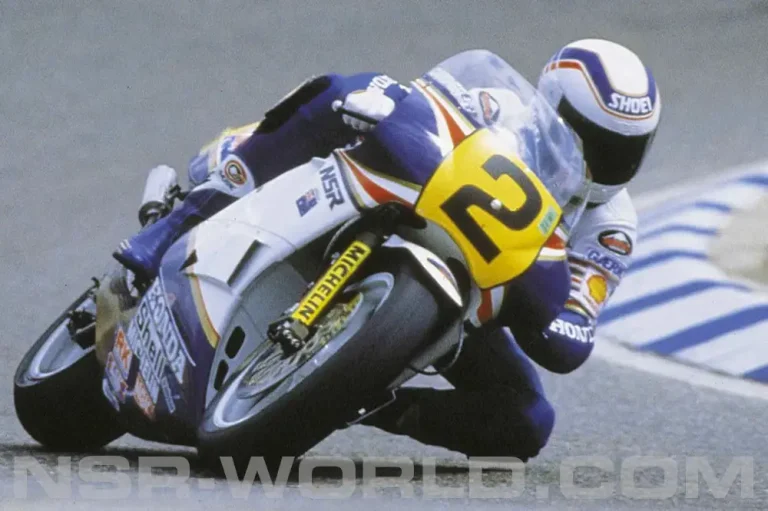
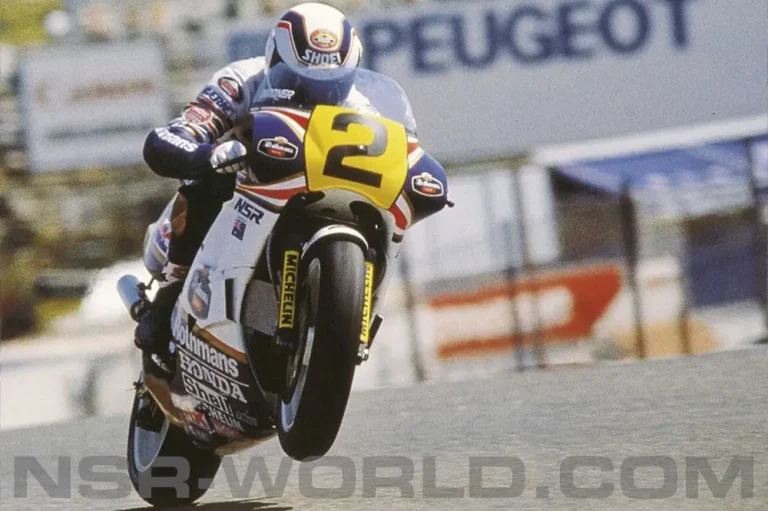
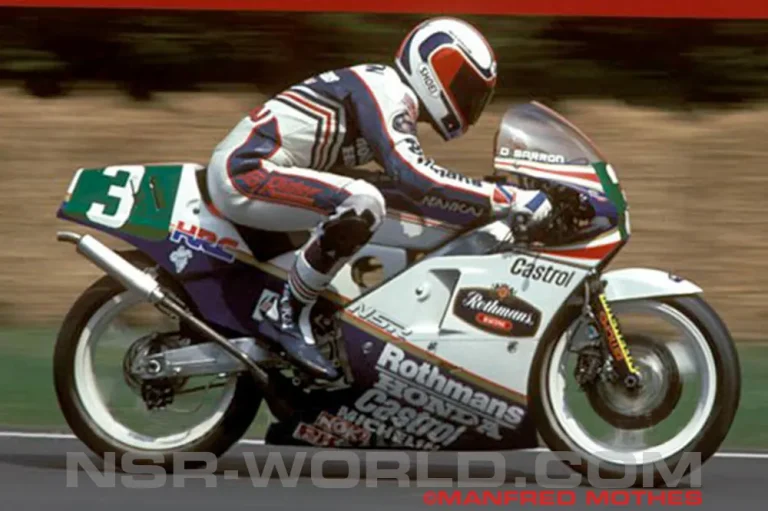
Wayne Gardner became Australia's first ever 500cc GP world champion in 1987.
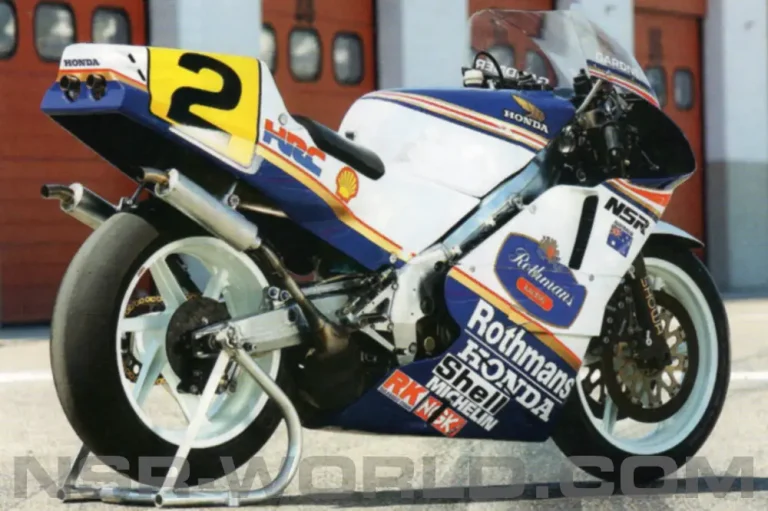
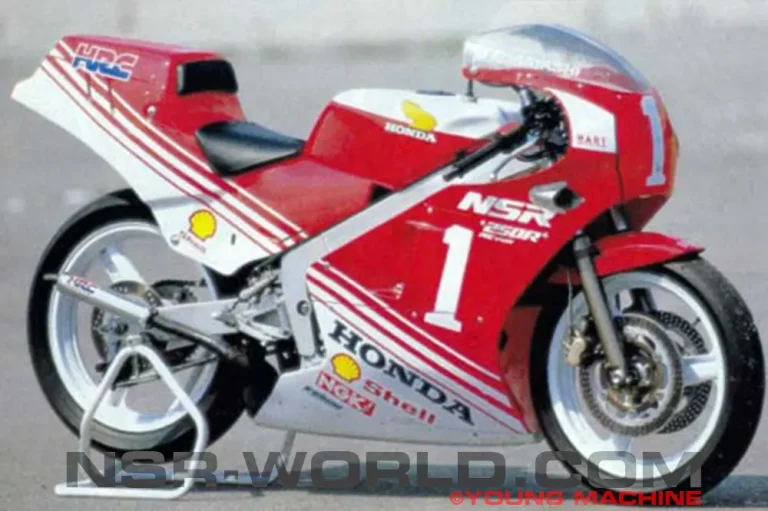
With 7 wins and 10 pole positions, Gardner dominated the premier class on the 1987 NSR500 NV0D.
1987 NSR500 [NV0D]
Wayne debuted in 500cc GP racing in 1983 on board a Honda Britain NS500, but success didn’t come until 1984, where he won the British 500cc Championship.
His consistent results in the British Championship secured him five World Grand Prix rides that season, all of which he scored points in, and also took a podium finish in the Swedish TT.
In 1985 he managed 4th in the championship, finishing a point ahead of HRC’s Randy Mamola, which lead to him landing his own factory ride with Rothmans Honda in 1986, alongside Freddie Spencer. He finished the season in second place, behind Eddie Lawson on the YZR500, but everything was falling in place for an assault on the championship in ’87.
Gardner took the 1987 crown 20 points clear of Eddie Lawson, with Randy Mamola just one more point adrift in third, both on YZR500s. Despite his exceptional performance though, the NSR500 wasn’t without its problems, and it seemed that only Wayne was capable of really taming the Honda V4 2-stroke.
While Gardner dominated the season on the NV0D, sadly, despite a couple of comeback attempts, 1987 was effectively the end of Freddie Spencer’s Grand Prix career.
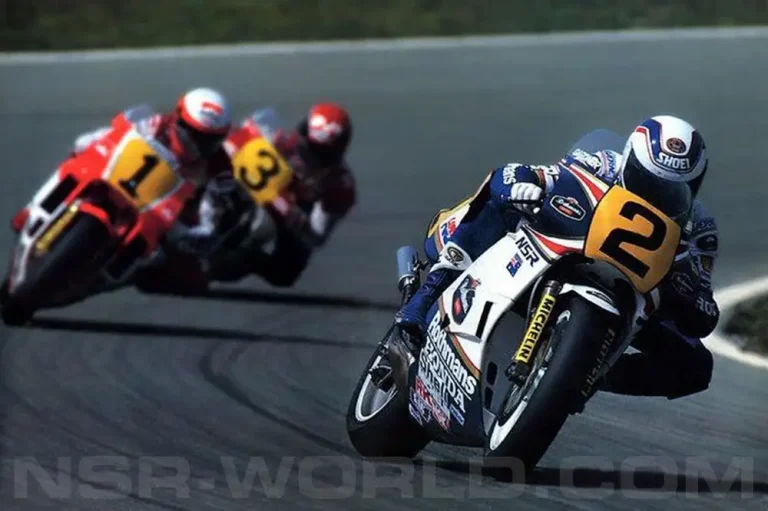
![1987 NSR500 [NV0D]](https://nsr-world.com/wp-content/uploads/2024/04/1987-nsr500-nv0d-hrc-rothmans-.webp "1987 NSR500 [NV0D]")
1987 NSR500 [NV0D]
The NSR500 motor received substantial configuration changes in 1987.
The V-angle was opened up from 90° to 112°, and for the first time, forward facing carburettors fed into the cases between the “vee”. The crank was still phased at 90°, but a countershaft, driven off the right of the crank, now doubled as a balance shaft and enabled the motor to once again run clockwise. The top two barrels were reversed, and the expansion chambers routed out of the rear barrels and up under the seat.
The increased space under the motor gave the engineers more freedom for expansion chamber design, and coupled with RC Valve technology from mid-way through the ’86 season, they not only gained a substantial amount of mid-range, but also increased peak power to just over 160hp @12,000rpm.
It would ultimately be the layout that would see the NSR500 to the end of its lifecycle, but not after many years of constant refining, right up until the first year of MotoGP in 2002, when the 2-strokes and 4-strokes of the new class were allowed to run side-by-side.
The V-angle was opened up from 90° to 112°, and for the first time, forward facing carburettors fed into the cases between the “vee”. The crank was still phased at 90°, but a countershaft, driven off the right of the crank, now doubled as a balance shaft and enabled the motor to once again run clockwise. The top two barrels were reversed, and the expansion chambers routed out of the rear barrels and up under the seat.
The increased space under the motor gave the engineers more freedom for expansion chamber design, and coupled with RC Valve technology from mid-way through the ’86 season, they not only gained a substantial amount of mid-range, but also increased peak power to just over 160hp @12,000rpm.
It would ultimately be the layout that would see the NSR500 to the end of its lifecycle, but not after many years of constant refining, right up until the first year of MotoGP in 2002, when the 2-strokes and 4-strokes of the new class were allowed to run side-by-side.
While three more NSR500s made it into the top ten, Yamaha were hot on Honda's heels with the YZR, and secured 2nd and 3rd places.
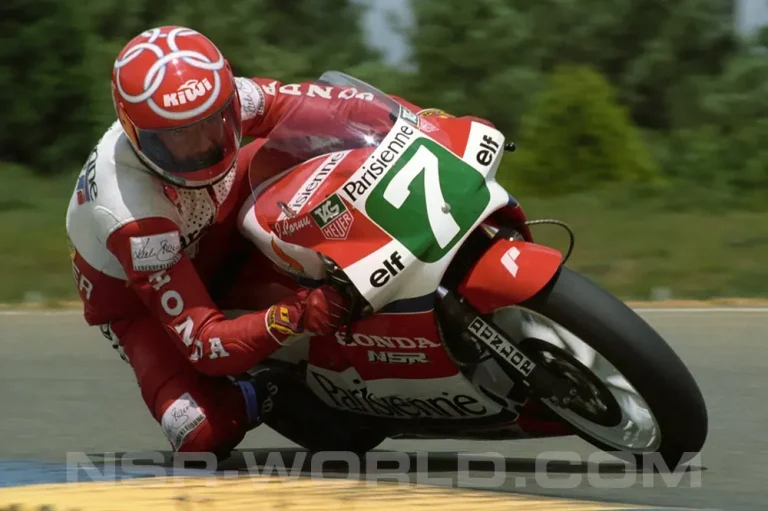
Ron Haslam secured 4th place in the 1987 World Championship on the NSR-engined Elf4, beating all of the remaining NV0Ds.
Niall Mackenzie, Pierfrancesco Chili, and Shunji Yatsushiro placed 5th, 8th, and 9th respectively, on NSR500 NV0Ds.
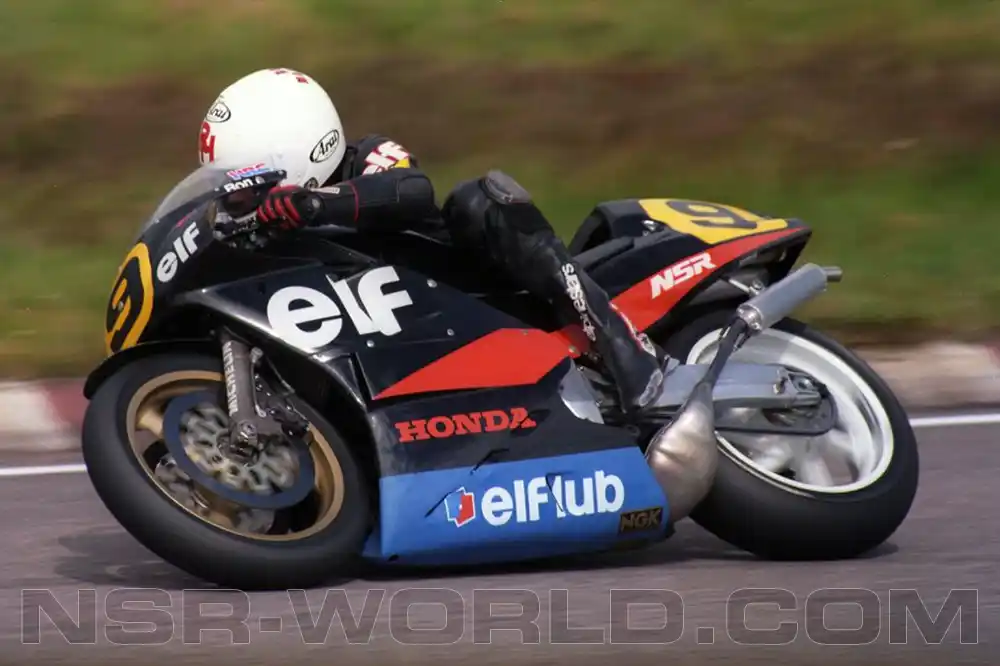
SPEC: 1987
NSR500 [NV0D]
Power: 163PS @12,000rpm
Torque: 9.73kgm @12,000rpm
Weight: 121.5kg
1987 NSR250 [NV1C]
1987 was a whole different story for the NSR250, which dominated both World Grand Prix and the All Japan domestic GP250 series.
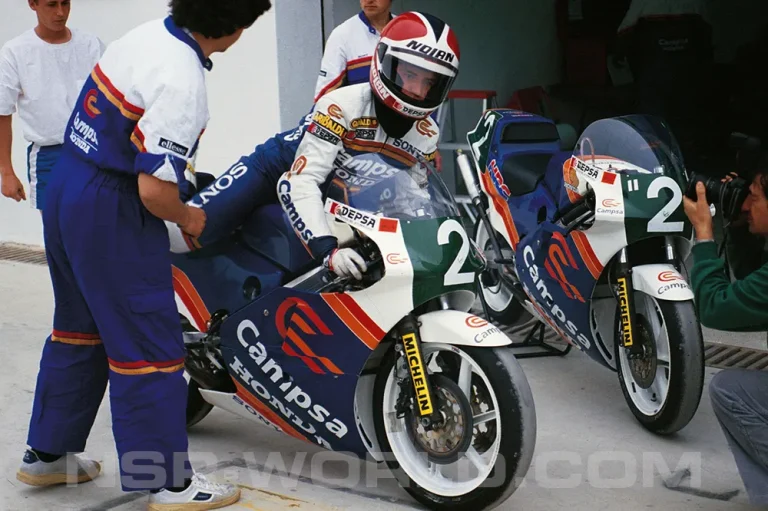
The NSR250 NV1C secured the top five places in the 250cc World Championship, with the crown going to Anton Mang on the Factory Rothmans machine.
Background image
© Mario Böttger
The NV1C took first and second in the All Japan Road Racing Championship with a clean sweep by Team AJINOMOTO Honda Racing. Masahiro Shimizu claimed the top spot, with team mate Masaru Kobayashi runner-up.
![1987 NSR250 NV1C Team Ajinomoto [Click to enlarge]](https://nsr-world.com/wp-content/uploads/2024/02/1987-nsr250-nv1c-ajinomoto.webp "1987 NSR250 NV1C Team Ajinomoto [Click to enlarge]")
1987 NSR250 [NV1C]
Although finishing strongly in 1986, with five NSRs and an RS finishing in the top ten in WGP, Yamaha’s championship victory with the YZR250 spurred HRC into yet more radical development of the NV1C.
With the introduction of RC Valve mid-season in ’86, the NSR250 motor was already regarded as powerful by HRC, so their focus was on improving the handling to compete with the YZR in the low and mid-speed turns.
The motor was shifted forward in the frame, and the swingarm extended 15mm. Wheels became 17″ as standard.
As understanding of torsional stiffness was becoming more measurable and understood, the frame cross-section was changed to a 5-sided extrusion from
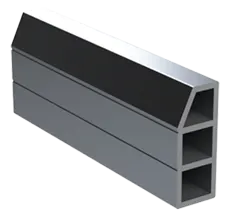
the original ULF’s square section. Small changes to the angled section then allowed engineers to fine tune the stiffness of the frame.
In the production-based Japanese Formula 3 [TT-F3] series the HRC RVF400, ridden by Masashi Taguchi, was in a class of its own, but all five MC16-RKs that were entered into the championship scored points in the NSR250R’s maiden season.
1987 was a pivotal year in Honda’s 250cc 2-stroke development cycle. The NSR250R MC16 production bike, that replaced the previous NS250 MC11, was released a full year ahead of a comparable HRC RS250R, featuring technology implemented on the factory NSR250 and NSR500 GP bikes!
The NSR250R shared the same crankcase reed valve induction layout as the RS250RW, complete with cassette transmission, and just as with the RS250RW, was fitted with a compound assembly of twin Keihin carbs. The NSR250R items however, were 28mm TA10 flat-slides, similar, although slightly larger, to those fitted to the NS250R.
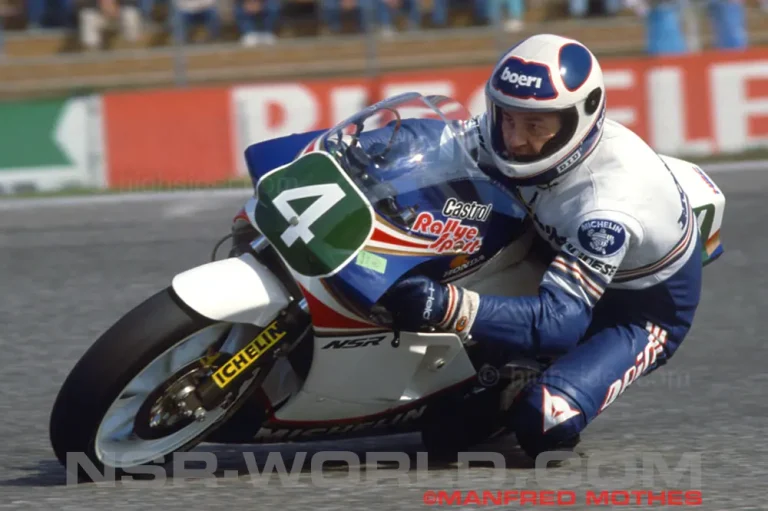

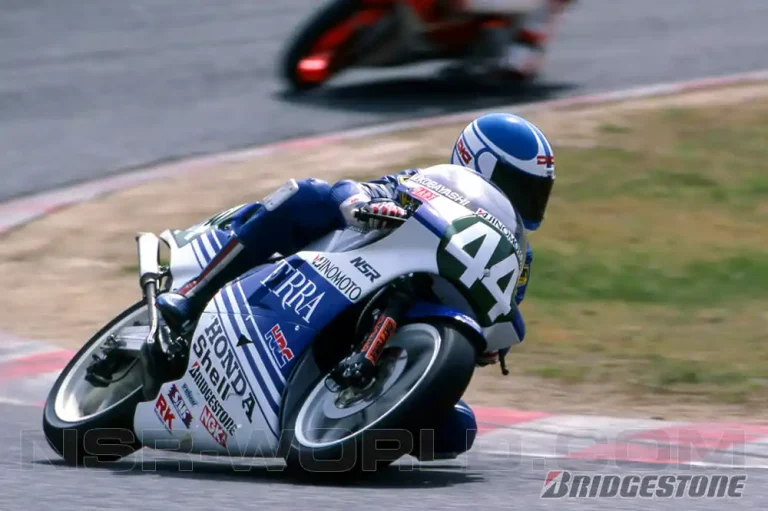
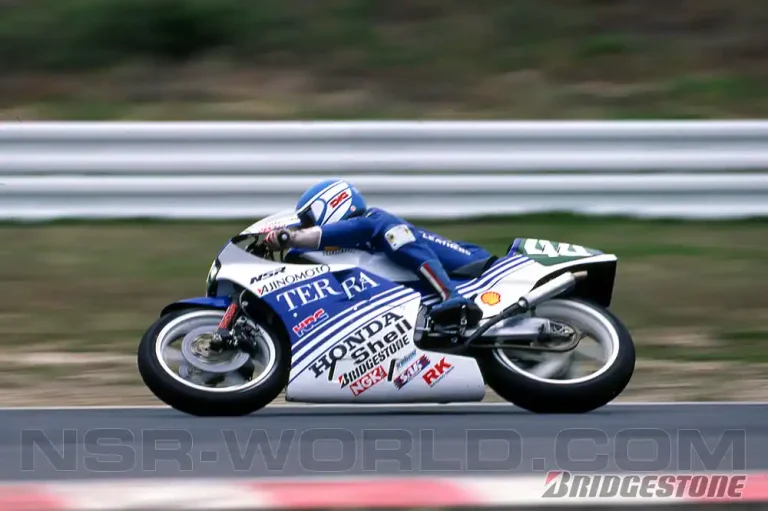
As a wildcard in 1987, Masaru Kobayashi not only won his home GP in Suzuka, but also claimed Bridgestone's first ever win in World GP.
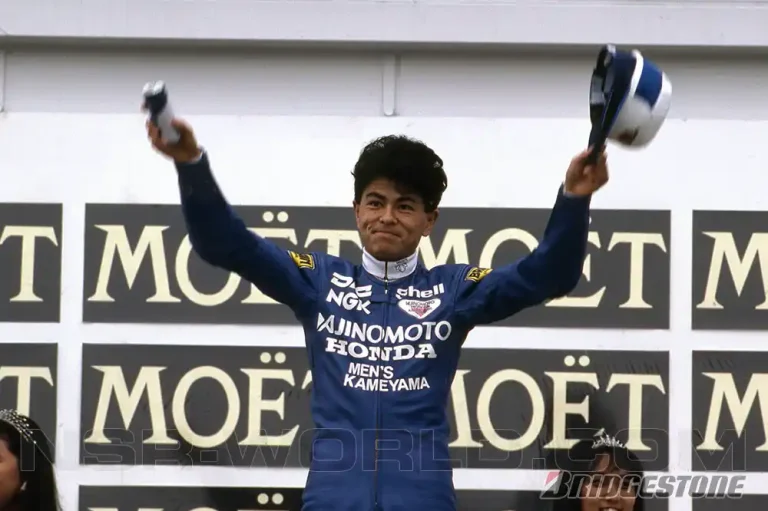
Founded in 1931 by Shojiro Ishibashi in Japan, Bridgestone has gone on to become the world’s largest tyre manufacturer.
From the mid-50s Bridgestone were supplying tyres to Honda, Yamaha and Suzuki, but it wasn’t until the early 80s that the company started to invest heavily in motorsport applications.
Being the only domestic tyre manufacturer, their popularity amongst Japanese teams soon flourished, and in 1987 wildcard Masaru Kobayashi won the season opening Grand Prix at Suzuka, finally giving Bridgestone their first ever WGP win.

SPEC: 1987
NSR250 [NV1C]
Power: 83.5PS @12,500rpm
Torque: 4.82kgm @12,000rpm
Weight: 93kg
1987 RS250R [NF5A]
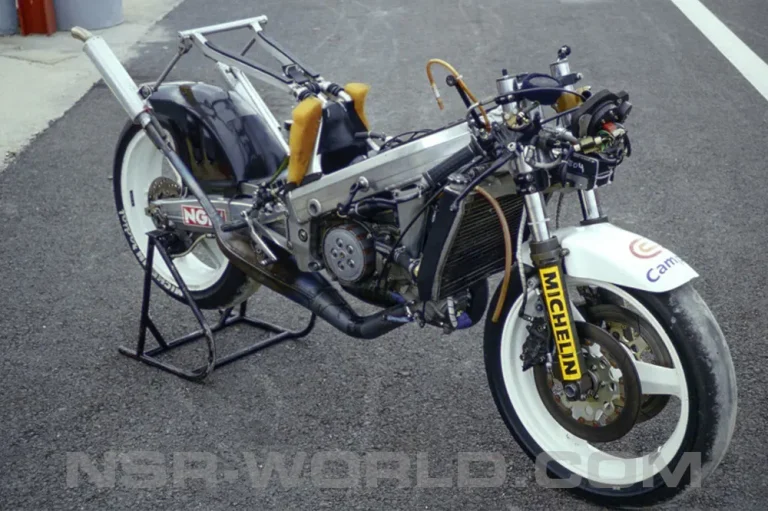
The first of the "next-generation" RS250R models was released in 1987, designated as the RS250R NF5A.
Mimicking the development of the original RS250R ND5A in 1984, the new NF5A borrowed extensively from the NSR250R MC16 production bike.
Background image
©Honda Motor Company
Unlike the 1984 ND5A however, which was based on a pure production street bike, with nothing more than the moniker NS in common with a race bike, the 1987 RS250R NF5 would have direct ancestral lineage with the 1985 NSR250 NV1A due to its links with the NSR250R MC16.
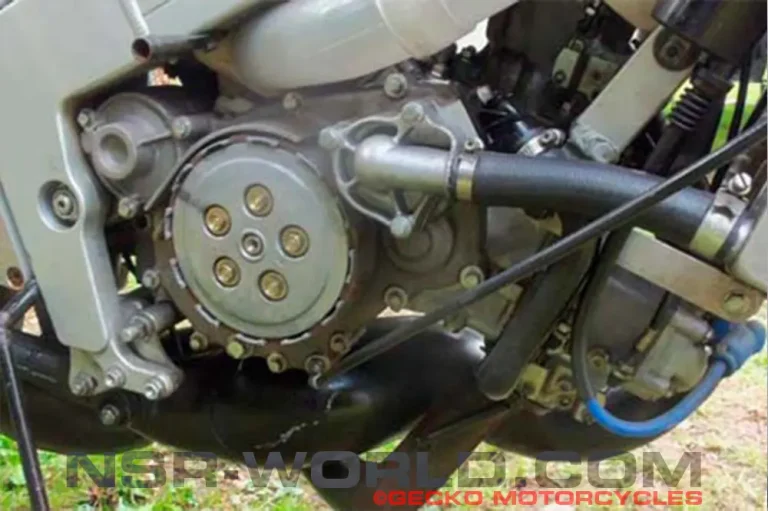
The new RS250R NF5 motor finally featured crankcase reed valve induction, utilising modified NSR250R MC16 crankcase castings, and the NSR’s 54×54.5mm bore & stroke. However, it still retained the ATAC (Automatic Torque Amplification Chamber) system from the ND5, driven mechanically from a housing on the RHS clutch cover. The new NF5 however now featured an ATAC chamber on each exhaust manifold as standard, as per the works bikes in previous years.
The customer chassis gained the iconic 6-spoke Magtek magnesium wheels, first seen in 1986 on the factory NSR250s, with the front wheel diameter increased to 17″ as standard. The exhaust system featured a twin-stack silencer layout on the right hand side, which was unique to the 1987 model. (A similar setup was also used on the 1987 NSR250R MC16 TT-F3.) The oval-slide slide Keihin PJ type carburettors were increased in size to 38mm for the first time, and the cassette transmission was a modified NSR250R MC16 unit with straight-cut primary gears replacing the NSR250R’s helical cut items.
The RS250R and NSR250R TT-F3 shared the same crankshaft, pistons, & ignition, and a lightweight dry clutch setup similar to that first seen on the RS250R ND5B and NSR250 NV1B.
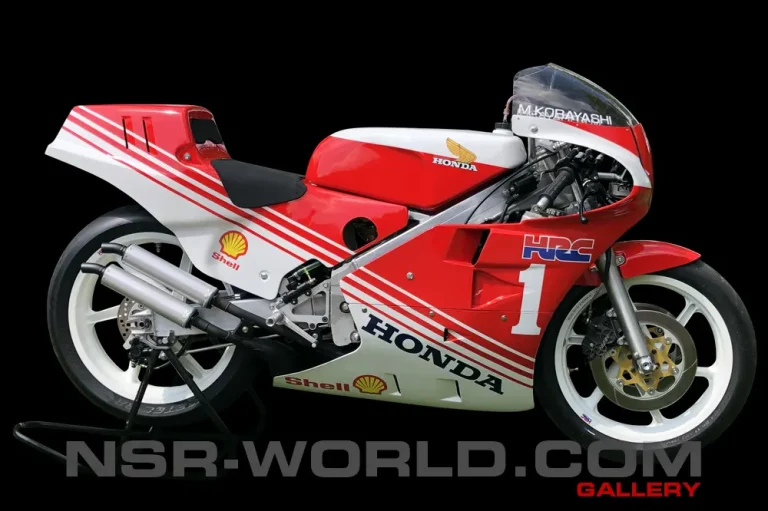
1987 RS250R [NF5A]
In 1987, the new generation RS250R NF5A bore a striking resemblance to the 1986 NSR250 NV1B, however, that resemblance was mostly cosmetic.
The NF5 motor utilised the NSR250R MC16E crankcase castings though, finally giving the consumer racer the same layout as the factory bikes, with crankcase reed valve induction, a cassette transmission, and the 84mm “square” bore/stroke, although it still utilised the outdated and inefficient ATAC exhaust valves.
The NF5 motor utilised the NSR250R MC16E crankcase castings though, finally giving the consumer racer the same layout as the factory bikes, with crankcase reed valve induction, a cassette transmission, and the 84mm “square” bore/stroke, although it still utilised the outdated and inefficient ATAC exhaust valves.
SPEC: 1987
RS250R [NF5A] ATAC
Power: 68PS @12,000rpm
Torque: N/A
Weight: 100kg
NSR-WORLD measured rwhp
1987 NSR250R [MC16]
Conceived as a "complete replica" of Freddie Spencer's 1985 championship winning RS250RW, the NSR250R MC16 was not only the genesis of arguably the greatest Sports Production "race replica" 250cc motorcycle, it also spawned the hugely successful RS250R NF5 series of Grand Prix racers.
Translated from the following 1987 NSR250R MC16 sales brochure…
Racing technology has created the latest 2-stroke machine.
“Honda considers racing to be a laboratory, and victory proves the validity of the experiment, and the technology gained therein is directly applied to the production motorcycle model NSR250R.
The basic design is completely the same as the NSR250 that won the World GP, and it is a 2-cycle Super Sports motorcycle developed based on the works machine. The recent trend among road racers is to pursue not only speed but also controllability, and this character also provides performance suitable for street machines.
The NSR250R is a machine that is the very essence of racing technology, with basic design done by HRC and refinements made by Honda. In order to achieve works-level quality, each bike is painstakingly manufactured, so to speak, and is considered a hand-built machine. From the design philosophy to the fine details, this is what it’s all about. It’s Honda Racing. It’s the real thing.”
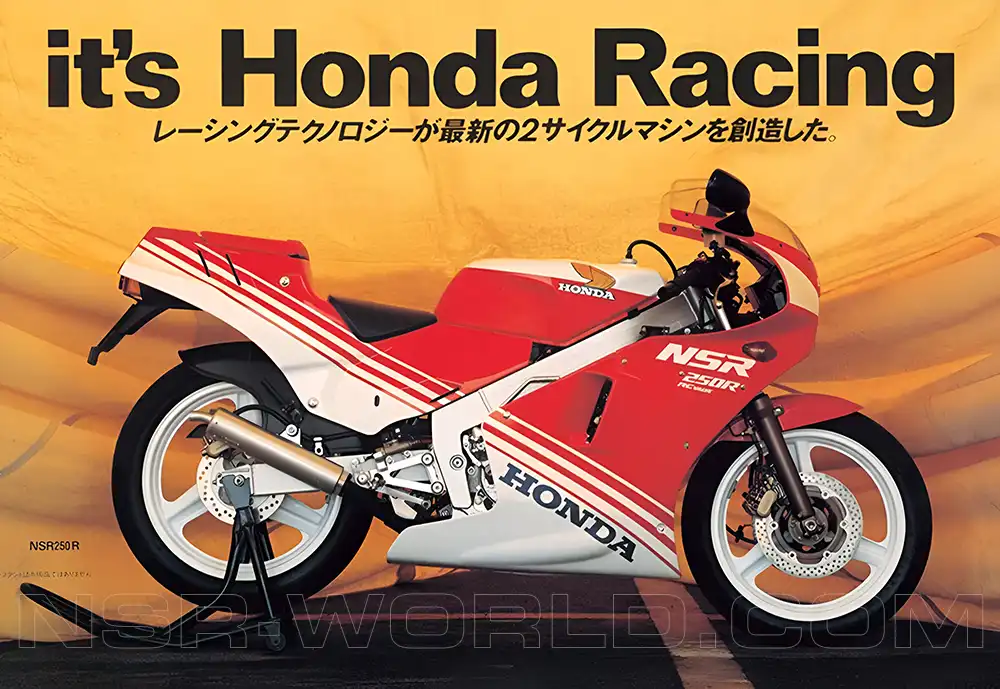


1987 NSR250R [MC16]
1987 NSR250R motor with RC Valve.
The NSR250R motor was a replica of Freddie Spencer’s 1985 RS250RW NV1A, even mimicking the works hexagonal shaped barrels and heads. However, unlike the ATAC equipped GP bikes at the time, the NSR250R featured brand new “Revolutionary Controlled” exhaust valves.
The MC16E cases saw only one major casting change in the NSR250Rs 10-year production run, changing from the MC16s solid engine mounts, to rubber items for the 1988 R2/4J model onwards.
1987 RS250R [NF5A]
1987 RS250R NF5A motor based on the NSR250R MC16E crankcases still utilised the outdated and inefficient ATAC exhaust valves.
The NF5s crankcases remained largely unchanged from 1987 until 1993, when the 75° NX5 model was introduced. Displaying the blanked off 2T oil pump mount thoughout its entire generation, the major differences during the crankcase’s lifecycle were predominently within the crankshaft cavity, and towards the end of its life, enlarged inlet tracts for bigger reed cages.
The NSR250R derived NF5 motor enjoyed a 6-year run in GPs, demonstrating just how good the initial design was.
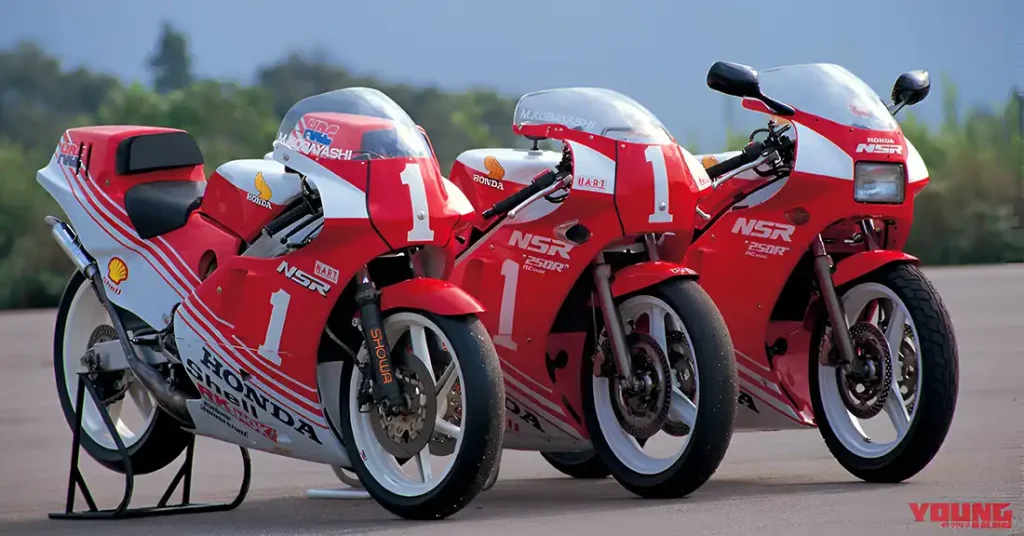
SPEC: 1987
NSR250 [NV1C]
RC VALVE
Power: 83.5PS @12,500rpm
Torque: 4.82kgm @12,000rpm
Weight: 93kg
RS250R [NF5A]
ATAC
Power: 68PS @12,000rpm
Torque: N/A
Weight: 100kg
NSR-WORLD measured rwhp
NSR250R [NH3A]
RC VALVE
Power: 65PS @11,500rpm
Torque: 4.2kgm @11,500rpm
Weight: 110kg est.
1987 Model Overview
500cc

250cc

250cc

NSR500 [NV0D]
NSR250 NV1C
RS250R [NF5A]
NSR250RK [NH3A]
NSR250R [MC16]