NSR-WORLD.COM

NSR-WORLD.COM
MC16's, MC18's and MC21's come fitted with Keihin TA series carburettors, and the MC28's use the TB variant.
Although perfect for the stock application, once the NSR is tuned, upgrading of the carburettor internals is essential not only for performance, but for reliability too!
HRC Jet Kit
An HRC jet kit, or equivalent, is necessary to attain the full potential of any NSR250R.
Simply changing the main jets can be enough for basic modifications such as delimiting, but as each model evolved, the carburetion – or more accurately, the air correction – became more and more sophisticated. The HRC jet kit accounts for differing fuelling requirements when more extensive modifications are made. Kit emulsion tubes assist fuel atomisation at different throttle postions and engine speeds, alternative air jets compensate for changes in fuelling when the powerjets and/or airbox are removed etc., and different needles are available for different fuels and atmospheric conditions.
The HRC kits come up from time-to-time on Yahoo! Auctions and eBay, but command a premium. However, reproduction kits for the MC21 and MC28 are available new from T2Racing in Japan. Many parts of the MC21 kit can also be used for the MC18, some even for the MC16.
These kits generally consist of :-
- Adjustable needles, clips and holders
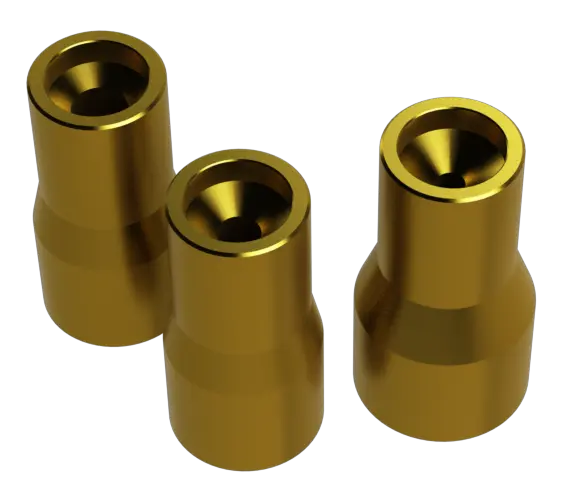
- Emulsion tubes (Main Jet holders)
- A range of Slow Jets (SJ)
- A range of Main Jets (MJ)
- Alternative X and Y-pieces for the air correction circuit

The following table shows jet kit part numbers applicable to each model, should they appear on one of the auction sites.
Model
HRC
Jha
T2Racing
MC21 R/SE/SP
16020-NKD-840
3502
MC28 R/SE/SP
16020-NKD-970
3543
Info:
Main jet part numbers follow this pattern: 99101-393-xxx0 (where xxx is the jet size required). For example, a 185 main jet has a part number of 99101-393-1850. This system can be used for EVERY NSR250R; MC16 through to MC28.
Always use genuine Keihin jets either direct from Honda, or an approved Keihin dealer.
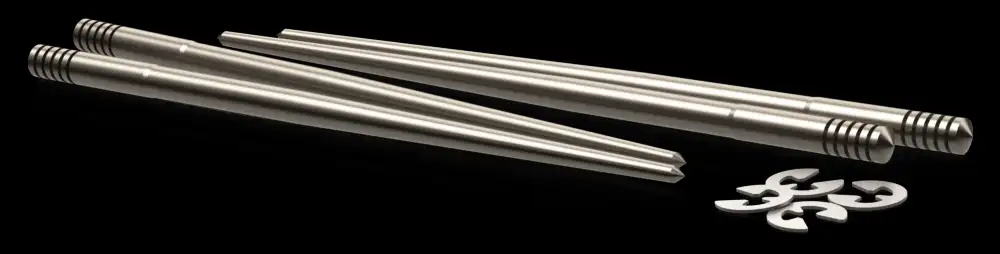
HRC Adjustable needles
There are 3 different grades of needle, A, B, and C. Each kit “B” needle has a profile similar to the standard non-adjustable needle found in the equivalent stock model. HRC needle IDs can be found in the HRC Base Settings at the bottom of this page.
“A” needles are the slimmest/richest profile, and “C” needles the leanest.
Note:
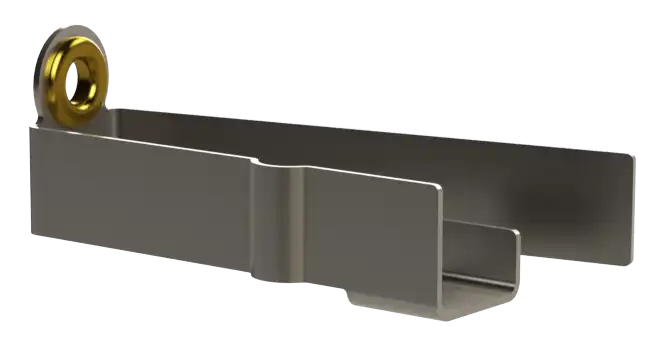
The kit needle holder [HRC# 16186-NH3-911] for the adjustable needles is different from the standard holder and must be used to prevent needle float.
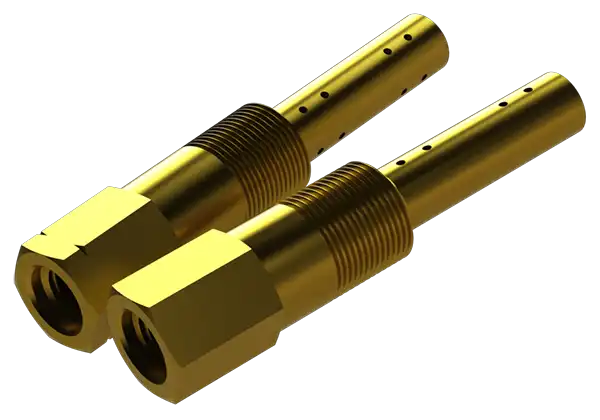
When using the adjustable needles, the ‘kit’ emulsion tubes [HRC# 16165-NH3-911] must be used. The HRC emulsion tubes are easily identified by the small nicks cut into the hex head.
Tip:
If HRC emulstion tubes are unavailable, a 2mm spacer can be used between the emulsion tube and main jet. It should be noted though, that the kit MC21 emulsion tubes are richer than the standard items. A workaround is to use the MC18 emulsion tubes+spacers to give the same effect as the kit parts.
Air correction
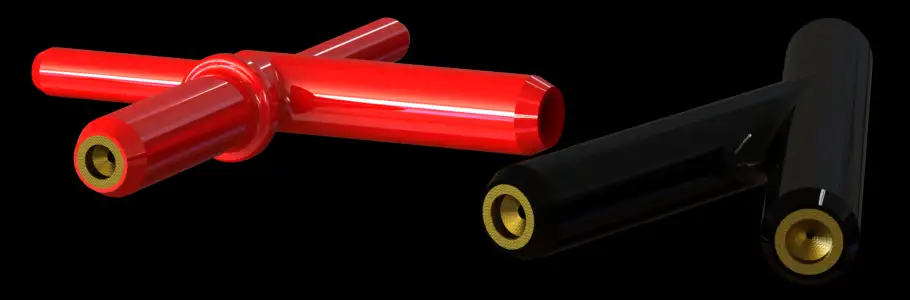
The HRC NKD SP jet kits for the MC21 and MC28 come with replacement X and Y-pieces to help manage the PGM air correction.
Note:
T2Racing in Japan can supply a set of replacement X and Y-piece jet inserts suitable for the the standard MC21 and MC28 parts and unleaded fuel.
More information on the T2Racing website »
Jet Kit setting
There are no official "full power" settings for the NSR250R.
As all NSR250Rs were only ever destined to be JDM (Japanese Domestic Market) models, there are only “restricted” carburettor settings officially available as per our Honda approved English NSR250R Service Manuals.
WARNING!
Re-jetting needs to be performed after ANY modification, no matter how small. The best case scenario of not re-jetting is missing out on a possible performance gain, the worst case scenario is seizure!
Use the following information at your own risk. NSR-WORLD.COM accepts no liability for any mechanical damage, personal injury, or legal consequences arising from using these guides.
NSR-WORLD.COM Jetting Terminology
- AS – Air Screw
- SJ – Slow Jet
- MJ – Main Jet
- PWJ – Power Jet
- JN – Jet Needle (or simply, needle)
- WOT – Wide Open Throttle
Base Setting
A base setting is usually supplied by an after market parts supplier. The problem here is that this setting is often based on a standard machine fitted with their item only. For example, when Ethos supply an exhaust system, they also supply 2 MJ’s to suit. This may be fine if you are replacing your stock chambers only.
Undoubtedly, a basic understanding of what’s going on inside your combustion chamber, and of how each component interacts with the next is very important!
Where to start
Start by noting down your current settings! If everything “goes to pot” you can always revert to your initial setting and start again!! As mentioned in the carburation section, NSR’s came from the factory with a variety of configurations, probably due to both model evolution and climatic conditions. (Areas of Japan are very mountainous and because of this, bikes sold at higher altitudes could’ve come fitted with adjustable needles etc.)
The three main areas to cover when jetting are the idle and slow running, the progression, and top end, and each is as important as the next. Without all three areas being optimised, you will never begin to appreciate the full “fun” potential of the NSR!
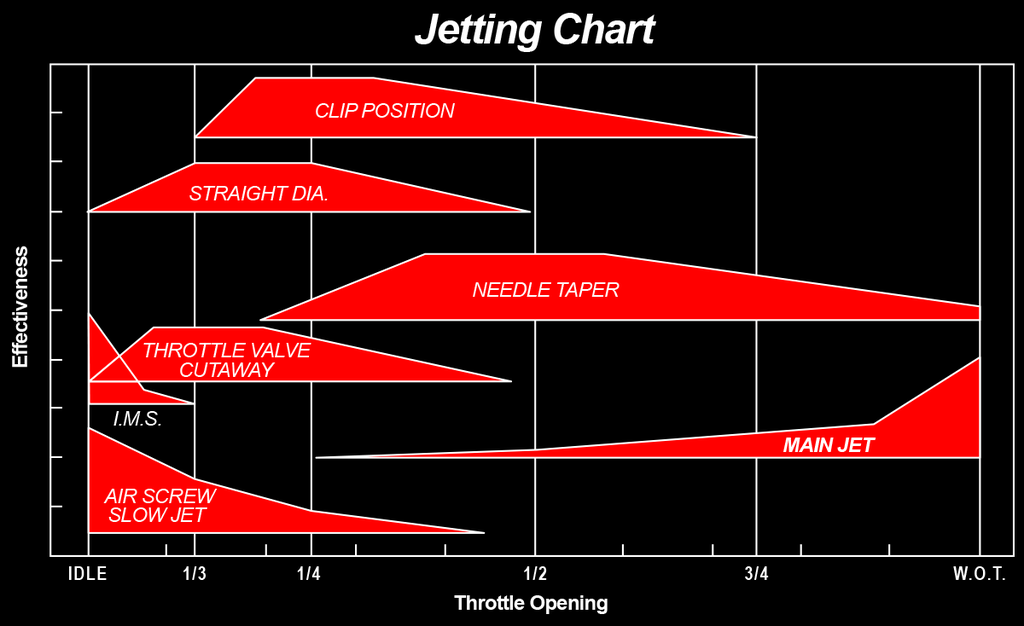
The slow running is metered by the SJ and AS, the progression by the needle, and the top end is governed by the MJ (and PWJ if used).
The following diagram shows which system is in operation at each throttle position.
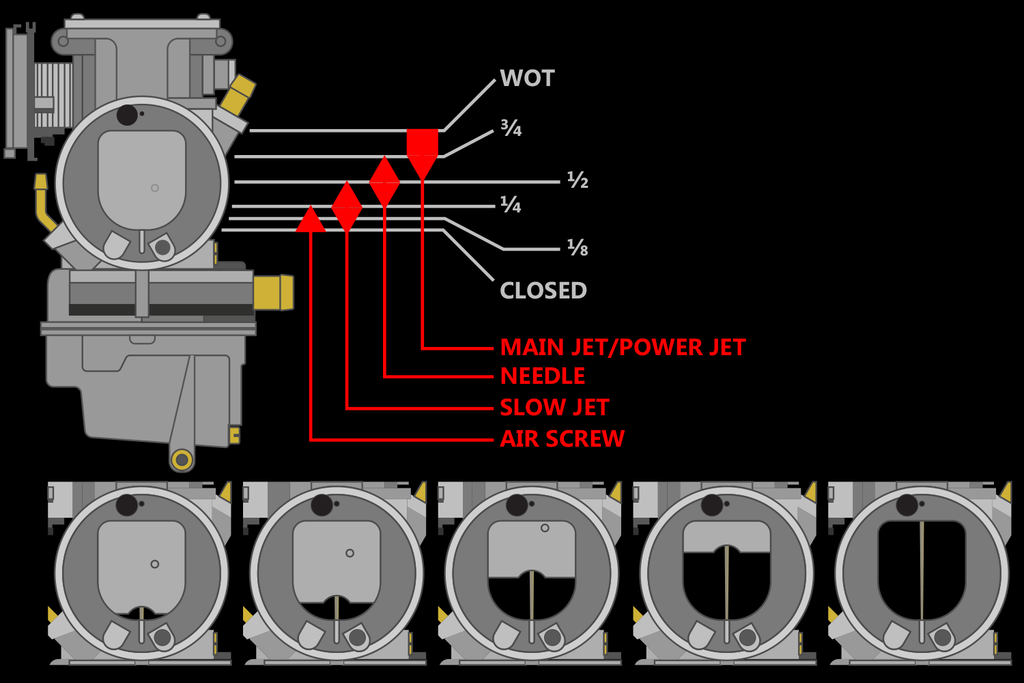
The slide governs the primary airflow through the carb into the crankcase, and is directly proportional to the throttle grip position.
Main Jet
[99101-393-xxx0]
The MJ is usually the first item set.
If you estimate an MJ setting and it’s even only vaguely close, you could ride around town all day without the engine going bang! In fact, as mentioned right at the beginning of this guide, you will only encounter problems at this stage if you get carried away thinking all is well, and blast off into the distance on your favourite stretch of road without extensive refining!
Don’t let this detract from the overall importance of the MJ though, or the first straight you come to, with the throttle wide open in any gear, the engine will seize quicker than you can say, “new pistons, please”!
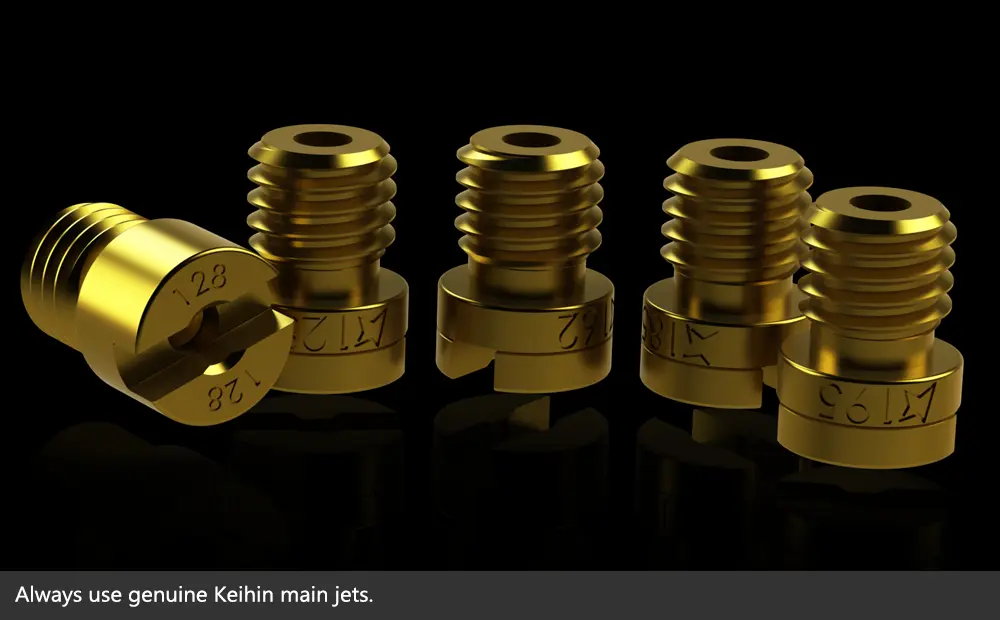
Two things to understand about the MJ are first, fuel is ‘sucked’ through it, and second, bigger is not always better!
Air is drawn through the carb by the vacuum in the crankcase created by the upward motion of the piston. As this air passes over the top of the emulsion tube, fuel is “sucked” from the float chamber up through the MJ, into the emulsion tube where it starts to atomise with the airflow, this ‘mixture’ is then drawn into the crankcase.
CAUTION!
Keihin | DynoJet
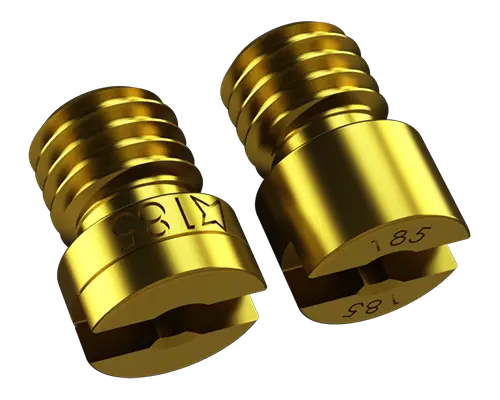
Always use genuine Keihin main jets, purchased directly from Honda or an official Keihin dealer, as both non-OEM jets and pattern/counterfeit jets can be known to have both different flow rates and flow patterns to genuine Keihin jets.
Mixing of genuine Keihin and alternative main jets can be particularly hazardous too, as the differential between them can be unpredictable.
The illustration shows the physical difference between a Keihin and DynoJet main jet, which can produce measurabel differences on the dyno.
Slow Jet
[99103-MA4-0xx0]
The slow running and progression are a lot more complicated than you may think, with a number of variables to account for.
As the throttle is opened, the slide is lifted, and as the slide raises, more air is allowed to flow, ‘sucking’ on the SJ. (The straight section of the needle effectively blocks off the MJ at minimal throttle.)
Along with the raising slide, small pre-drilled passageways within the carb body, called galleries, assist the SJ in metering fuel from idle to 1/2 throttle.
Air screw
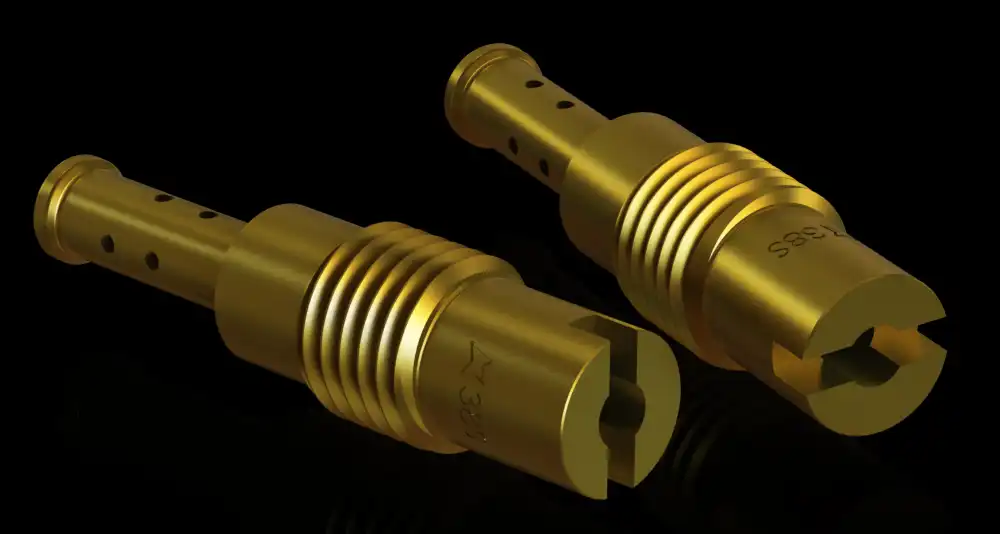
Air screws are the final element of the idle and slow running circuits, they are often referred to as idle mixture adjusters.
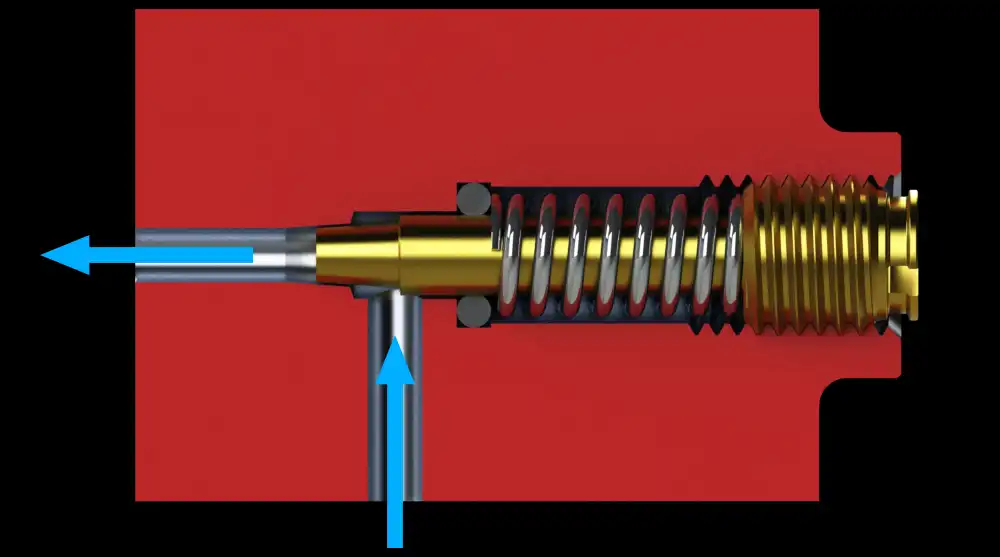
Due to the limited sizes available for the SJ’s, some form of finer adjustment is needed, and this is where the AS’s come into play. The AS’s are a tapered, well, er, screw! As shown in the accompanying diagram, an auxiliary air gallery is drilled into each carburettor body, and the taper on the screw, depending on its position, controls supplemental air to bypass the opening created by the slide, weakening or richening the mixture.
Needle
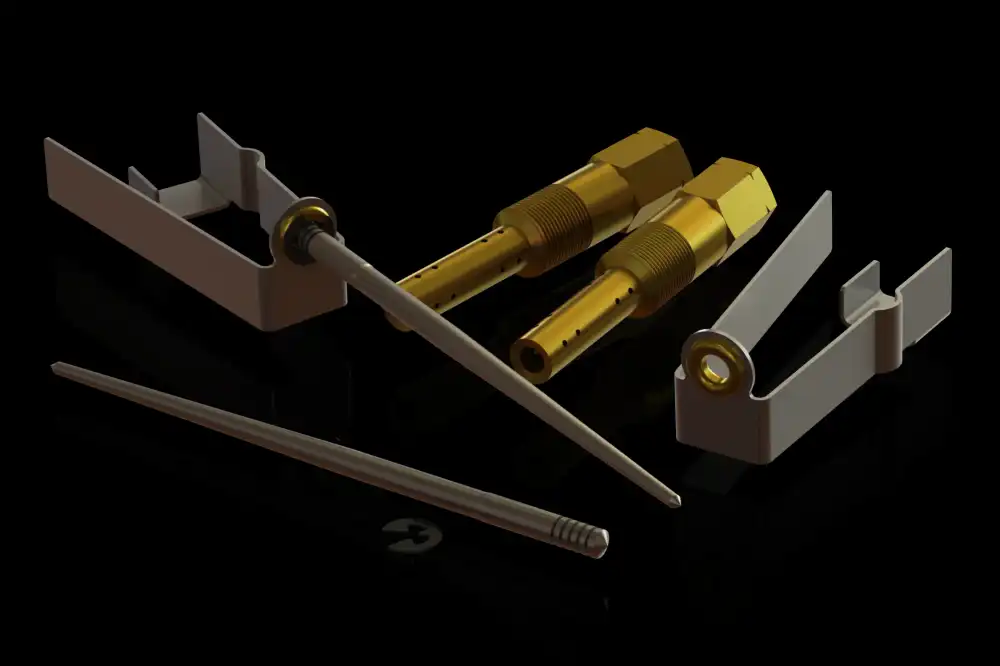
The needles, in conjunction with the emulsion tubes (sometimes referred to as needle jet/main jet holders), take care of the “progression” phase. The progression phase is the transition from the slow running circuit and 1/4 throttle, to the MJ (and PWJ if used) and full throttle.
HRC/aftermarket needles are available in different grades, usually denoted as A, B, and C type, with profiles suitable for both leaded and unleaded fuels. In the NSR’s case, the A type is the richest, i.e., the slimmest profile, allowing the greatest flow of fuel, and the C type is the leanest. As mentioned before, B needles have an extremely similar, if not identical profile, to the non-adjustable needles found in the stock carburettors, and are usually suitable for most applications.
Fuels
Often overlooked, the type of fuel used can directly effect the jetting process, particularly on a 2-stroke engine.
Japanese sports bikes have been designed to run on unleaded fuel since the mid ’80’s, and a stock NSR will happily run all day long on it without any adjustment, however NSR-WORLD.COM strongly advises the use of 97 octane or higher wherever posible.
JHA and HRC advise the use of 100+ octane race fuel with their kits, which accounts for, in part, for their choice of base setting of the MJ’s, SJ’s, and pre-mix ratio. Even higher (than regular) octane fuel such as Super Unleaded can adversely effect the jetting on a modified motor, and will often necessitate the richening of the mixture.
You will not necessarily notice a difference in feel when using the higher octane fuels, especially on a stock motor, and consequently wonder if it’s worth the extra expense over regular leaded fuel, but a higher octane will allow you to run both more compression and more ignition advance over stock without as much fear of detonation. This is a point worth noting when an HRC or equivalent ignition delimiter is used on an MC21, or the HRC harness, card, and flywheel conversion, is used on the MC28.
Note:
NSR-WORLD.COM recommends the use of 97+RON Super Unleaded by virtue of it’s increased detonation prevention characteristics, as a general precaution against premature piston and cylinder failure.
WARNING!
NOTE: DETONATION CAUSED BY HIGH COMPRESSION/HIGH IGNITION ADVANCE & LOW OCTANE FUEL HAS TO BE RATED AS ONE OF THE QUICKEST, IF NOT THE QUICKEST KILLERS OF A 2-STROKE ENGINE… BE WARNED!!!
Finally, also consider the fact that as Super Plus unleaded is more highly refined than regular unleaded, it is therefore cleaner. This can only be a bonus as you are less likely to encounter blocked jets, especially the small PJ’s, another 2-stroke killer.
Note:
Using the higher octane fuels can make reading a “plug chop” harder, as the fuel burns more fiercely and less residue is left on the electrode.
Jetting Guide
Quick Reference
Quick Jetting Guide
1) IDLE: Set idle speed to proper r.p.m. by adjusting the IDLE SPEED SCREW. Turn the IDLE MIXTURE SCREW or AIR SCREW to achieve highest speed and best response. After adjustment has been made reset IDLE SPEED SCREW to proper r.p.m.
2) OFF IDLE to 1/4 THROTTLE: The SLOW JET and SLOW AIR JET are most effective in this range. When you want a richer mixture in this range use a larger SLOW JET or a smaller SLOW AIR JET*. The opposite holds true for a leaner mixture.
3) 1/4 TO 3/4 THROTTLE: The JET NEEDLE is the most effective component in this range. Raising the needle by lowering the clip position at the top of the needle will richen the mixture. Lowering the needle will lean the mixture
4) WIDE OPEN THROTTLE: Changing the MAIN JET effects this range. Select the size which offers the best W.O.T. performance, then install one size larger MAIN JET for ideal engine durability.
Note:
*The HRC kit X-piece and Y-piece in the NSR250R’s case would be the equivalent of the SLOW AIR JET in Aktive’s guide.
Inlet modifications
A number of modifications can be made to improve the efficiency of the NSR250R inlet.
The ’89-’96 NSRs were both increasingly restricted, yet progressively improved over the years. All models however, can be improved upon very easily, and with relatively little cost.
Airbox
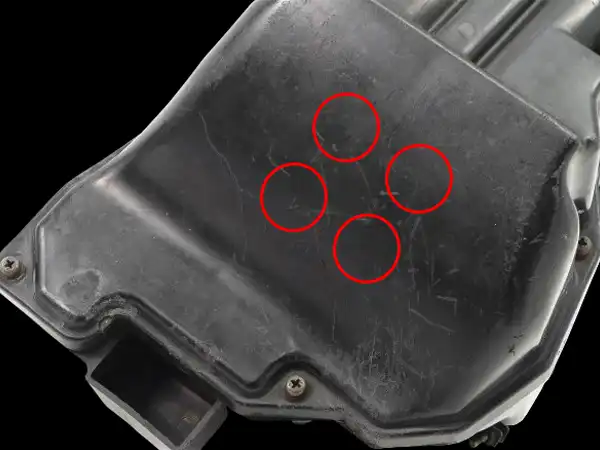
All NSR250R airboxes can be derestricted by drilling 4x Ø20mm holes in the forward slope of the lid as illustrated. This modification is dyno proven by NSR-WORLD.COM, and in our opinion, gives the best balance of performance and longevity for street use by retaining the OEM Honda air filter element and optimised airbox capacity whilst letting the motor breath more efficiently.
Do not be tempted to open up the airbox any more than recommended, as it can negatively impact performance. It is imperative you check the jetting after modifying the airbox.
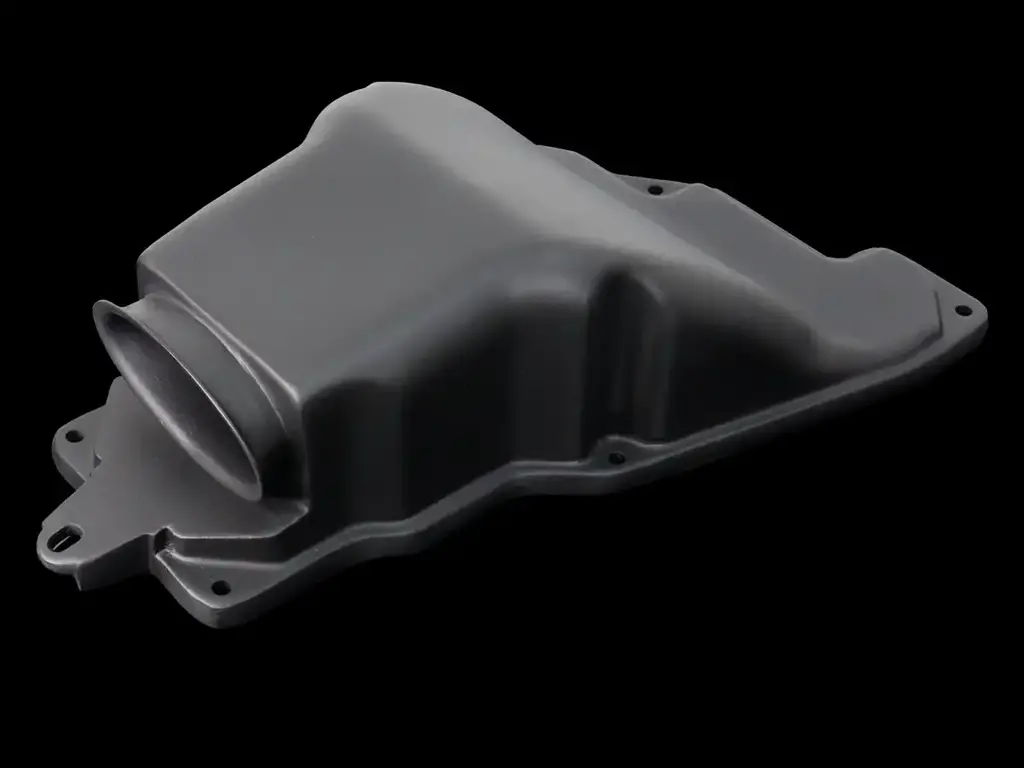
TYGA Performance make a replacement lid for the MC21 and MC28, if you prefer not to modify the OEM part for the sake of retaining original parts.
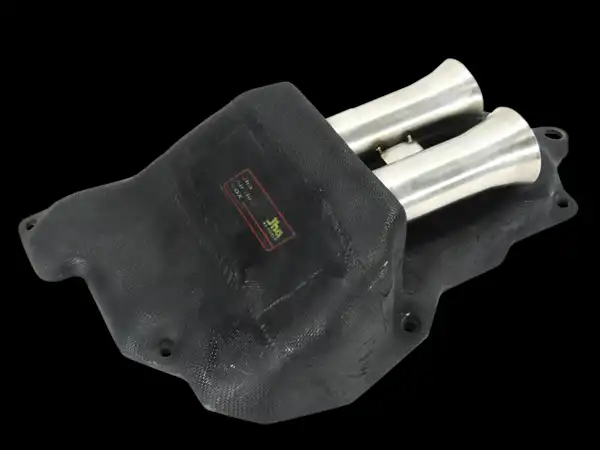
Jha also made a carbon fibre airbox lid suitable for the MC21 and MC28, which can sometimes be found on Yahoo! Auctions.
HRC produced an open carburettor shield for use in the Formula 3 and SS/SP race series, for use with open carbs, which is ultimately the best setup for maximum power. Open carbs however, are totally impractical for anything other than track use. Open (unfiltered) inlets allow the ingress of dirt and foreign objects directly into the crankcases, dramatically shortening service life of both the bottom-end and top-end.
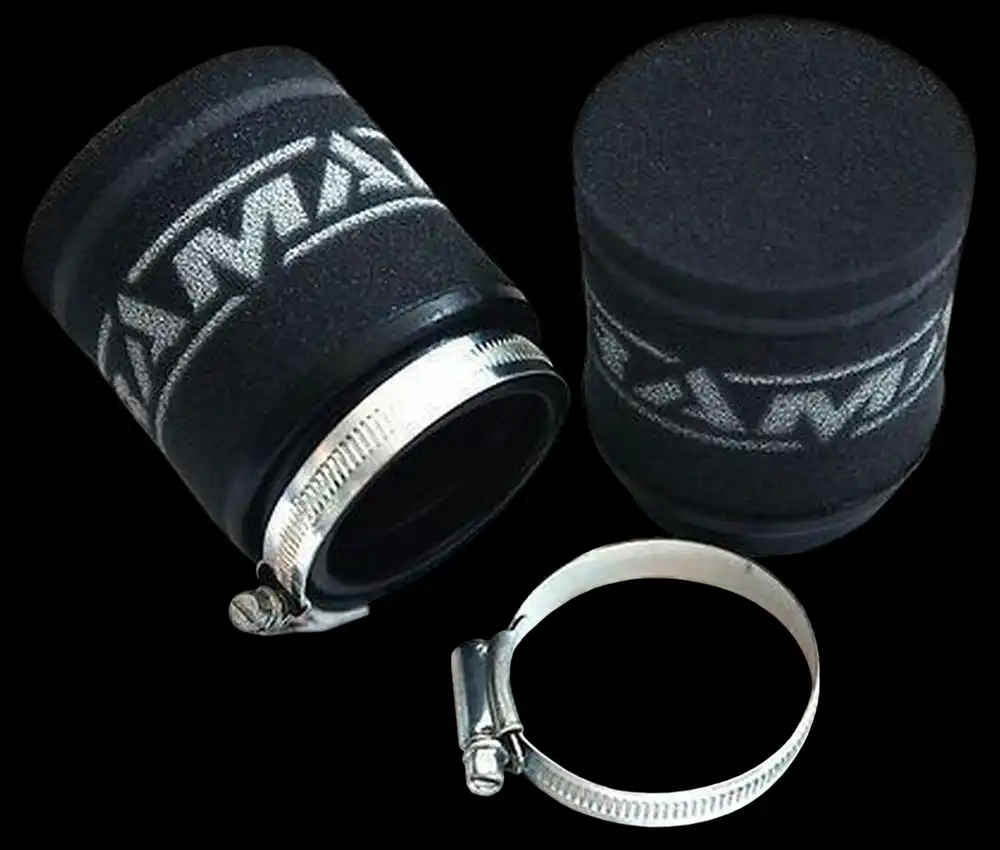
NSR-WORLD.COM recommends the use of foam Ramair pod filters as the best compromise between open carbs and unrestricted airbox.
Note:
Use ONLY the full foam version of the Ramair pod filters, and use the longest filters you can fit within the confines of the frame.
DO NOT use the version with the chrome end cap, as this causes issues with reflected pressure waves within the inlet tract, affecting power.
HRC Rectifiers [NKD SP]
HRC Rectifiers
[NKD SP]
HRC developed reshaped intake rectifiers in 1994 for the SP racers. The improved shape helps improve flow of the intake charge into the crankcases.
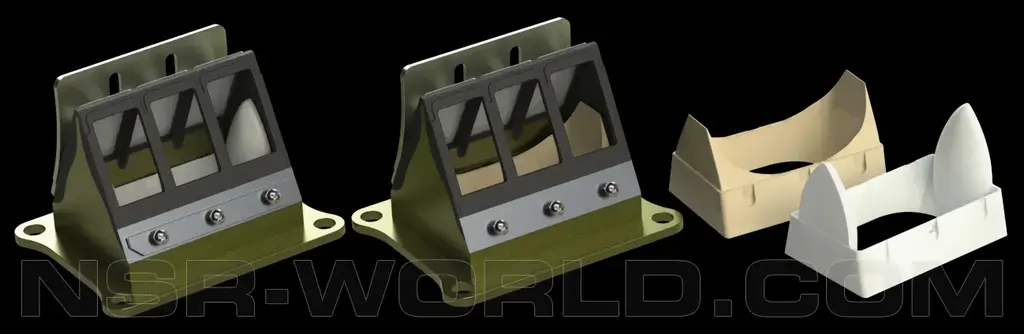
The HRC rectifiers can also be used on earlier models, however both the MC16 and MC18 models have rectifiers moulded into the inlet manifolds, so these will either need to be cut off, or a later MC21 or MC28 manifold acquired.
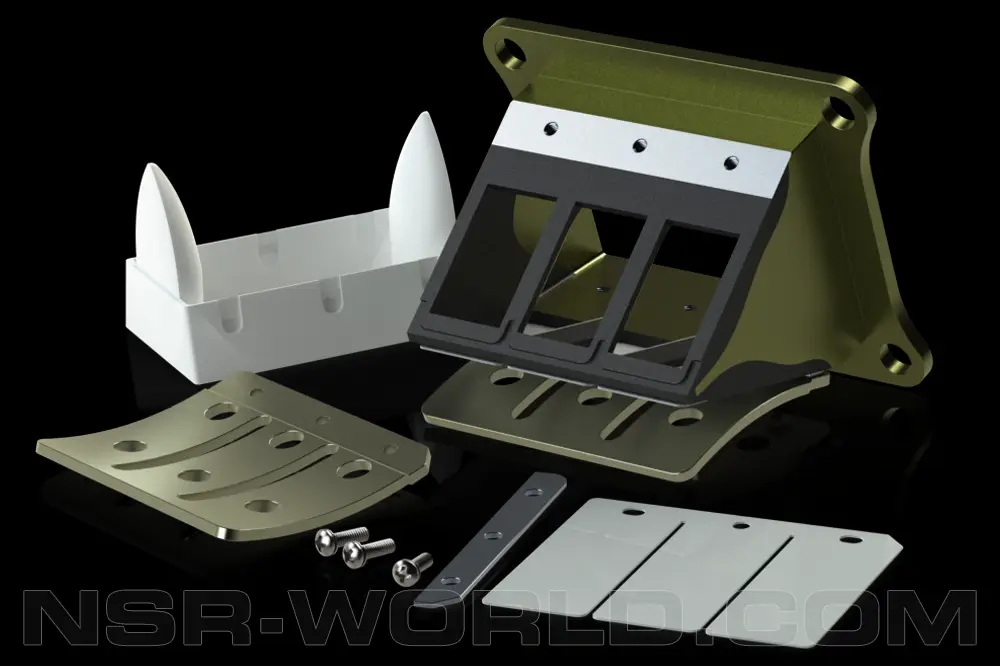
Info:
The HRC rectifiers can even be used with the TT-FIII reed cages, however the nylon rectifiers will need trimming slightly to give the small screws securing the reeds a little clearance.
The TT F-III kit calls for the use of the MC18 inlet manifold, so again, either use an MC21/MC28 manifold, or remove the mouldings from the MC18 part.
HRC Base Settings
All HRC settings are for premixed fuels, and assume the removal of the 2T oil pump. While by no means unreliable, and there is absolutely no problem using the oil pump on track, removing it saves weight [approximately 1.5kg with the pump, reservoir/hoses, and a full tank of oil] and unnecessary clutter from a race bike. It is also difficult to precisely meter the fuel mix when using the pump, which can be more critical in race conditions, where frequent carburetion setups occur. Finally, no matter how small, another consequence of running the oil pump on track is mechanical drag. While in itself it may be virtually unmeasurable, when all the tiny gains are added up, every little counts!
WARNING!
The HRC settings are BASELINE settings to work from. They should in no way be taken as definitive full-power settings. In fact, they are often vastly different to what’s actually required!
ALL HRC BASE SETTINGS ARE FOR USE WITH PREMIXED RACE FUELS.
Use the following information at your own risk. NSR-WORLD.COM accepts no liability for any mechanical damage, personal injury, or legal consequences arising from using these guides.
1987 NSR250RK NH3 TT-FIII/SP
Remove the standard 2T oil pump. Fuels should be premixed.
Petrol
Specified oils
Mixing ratio
:
:
:
Gasoline 100 octane and higher
Shell Sport SX
Castrol A747
30:1
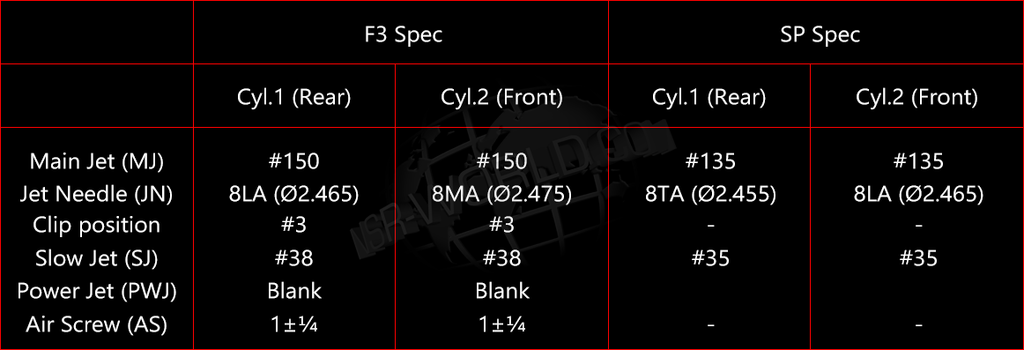
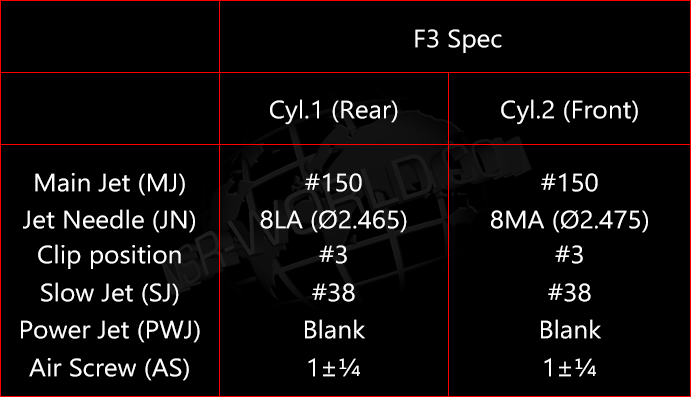
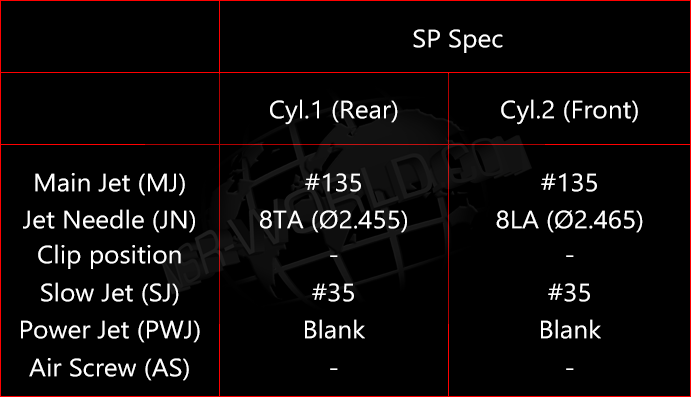
| F3 Spec | SP Spec | |||
| Cyl.1 (Rear) | Cyl.2 (Front) | Cyl.1 (Rear) | Cyl.2 (Front) | |
| Main Jet Jet Needle Slow Jet Power Jet |
#150 8LA (Ø2.465) Rank #4 #40 Blank |
#150 8MA (Ø2.475) Rank #4 #40 Blank |
#135 8TA (Ø2.455) #35 Blank |
#135 8LA (Ø2.465) #35 Blank |
1988 NSR250RK NH3 TT-FIII
Remove the standard 2T oil pump. Fuels should be premixed.
Petrol
Specified oils
Mixing ratio
:
:
:
Gasoline 100 octane and higher
Shell Sport SX
Castrol A747
30:1
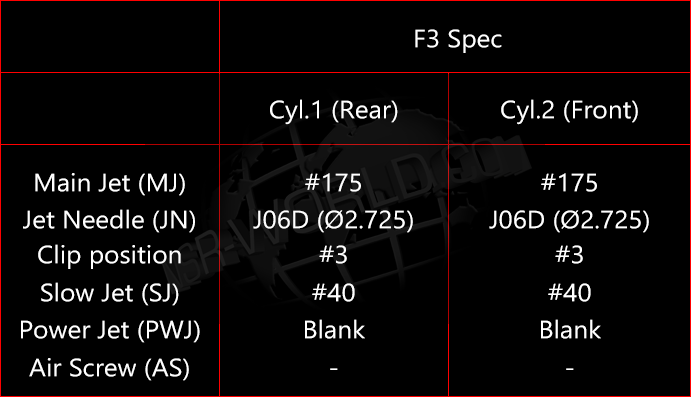
1989 NSR250RK NH3 TT-FIII
Remove the standard 2T oil pump. Fuels should be premixed.
Petrol
Specified oils
Mixing ratio
:
:
:
Gasoline 100 octane and higher
Shell Sport SX
Castrol A747
30:1
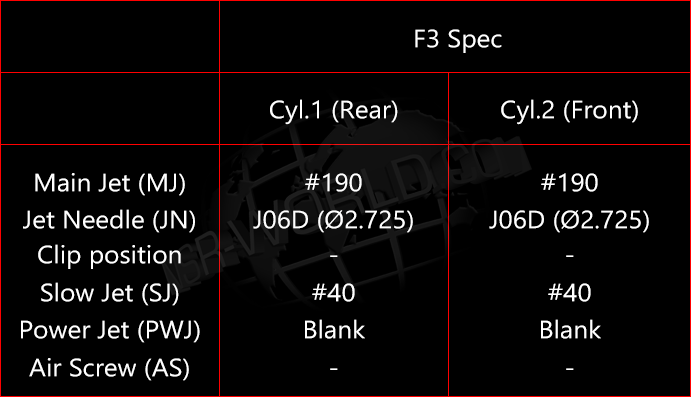
1990 NSR250RK NH3 TT-FIII
Remove the standard 2T oil pump. Fuels should be premixed.
Petrol
Specified oils
Mixing ratio
:
:
:
Gasoline 100 octane and higher
Shell Sport SX
Castrol A747
30:1
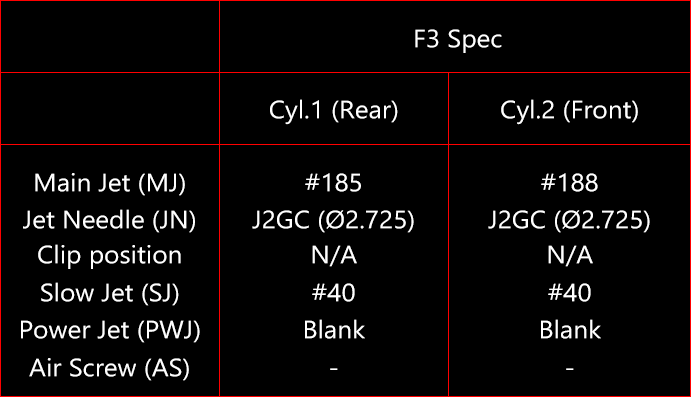
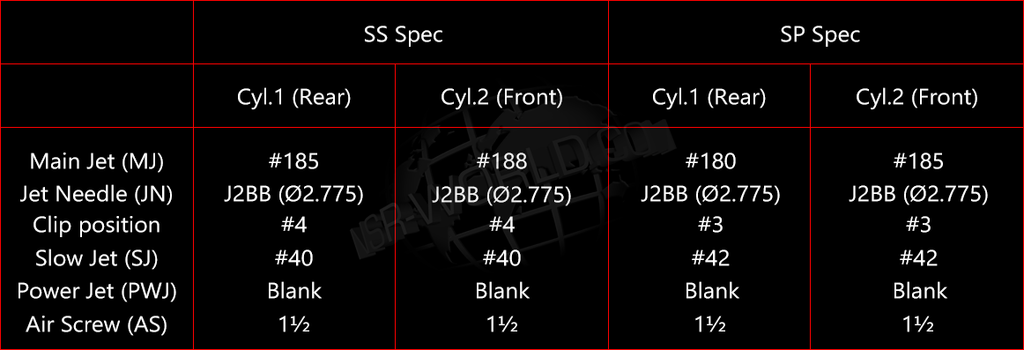
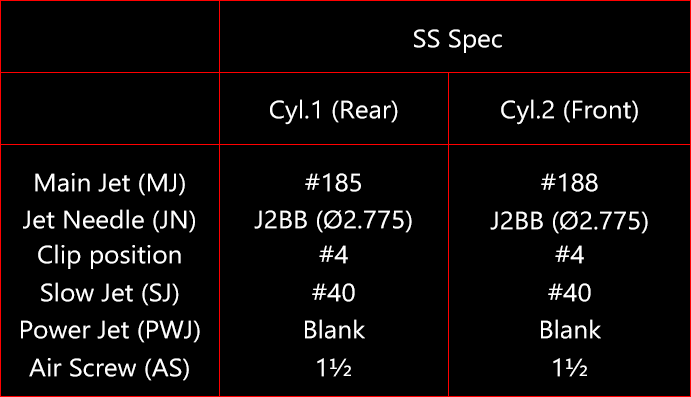
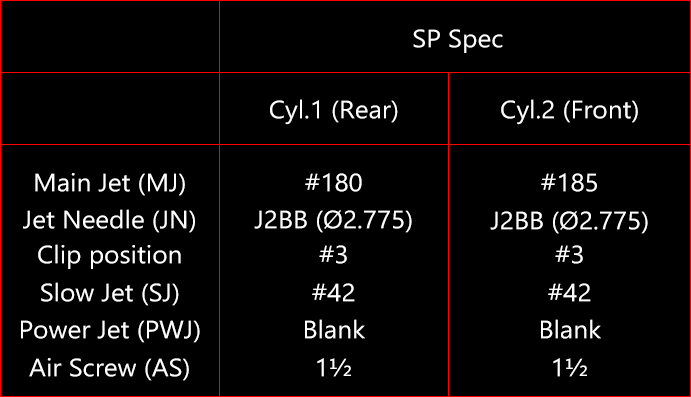
1992 NSR250R NKD [AVGAS]
Remove the standard 2T oil pump. Fuels should be premixed.
Petrol
Specified oils
Mixing ratio
:
:
:
Gasoline 100 octane and higher
Shell Sport SX
Castrol A747
30:1
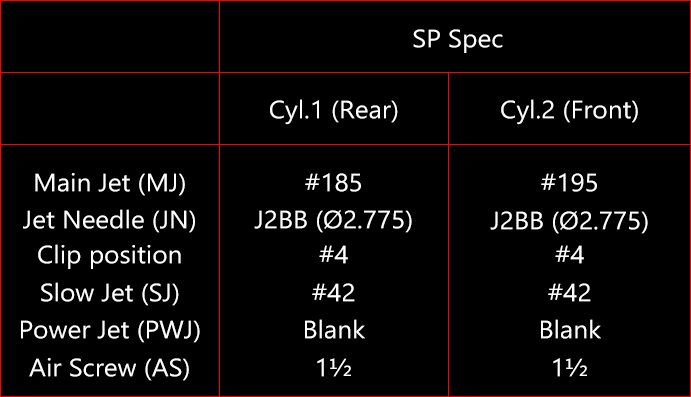
'90-'93 NSR250R NKD [U/L]
Remove the standard 2T oil pump. Fuels should be premixed.
Petrol
Specified oils
Mixing ratio
:
:
:
Gasoline 100 octane and higher
Shell Sport SX
Castrol A747
30:1
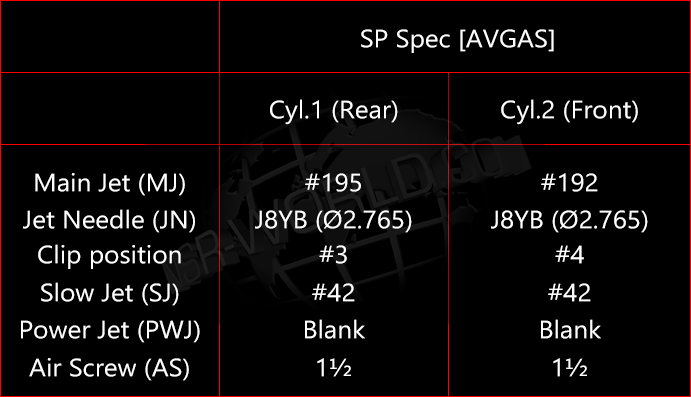
1994 NSR250R NKD [AVGAS]
Remove the standard 2T oil pump. Fuels should be premixed.
Petrol
Specified oils
Mixing ratio
:
:
:
AVGAS
(Aviation Fuel No.3 equivalent)
Elf HTX 975
Elf HTX 976
Castrol A747
30:1
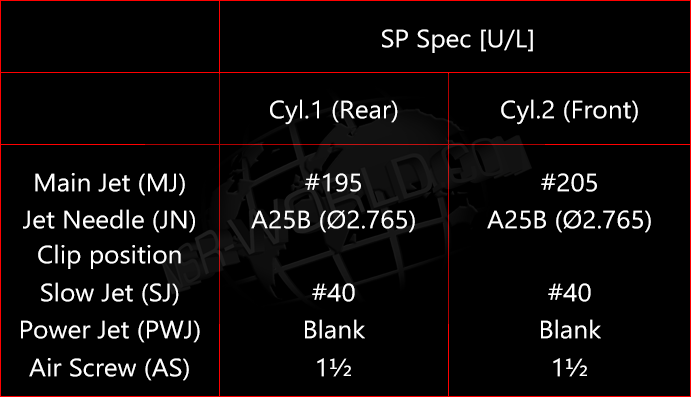
1994 NSR250R NKD [U/L]
Remove the standard 2T oil pump. Fuels should be premixed.
Petrol
Specified oils
Mixing ratio
:
:
:
Gasoline 100 octane and higher
Elf HTX 975
Elf HTX 976
Castrol A747
30:1
Info:
For additional setup data, you can find the Pro Spec Complete Data Book on our Manuals page.