
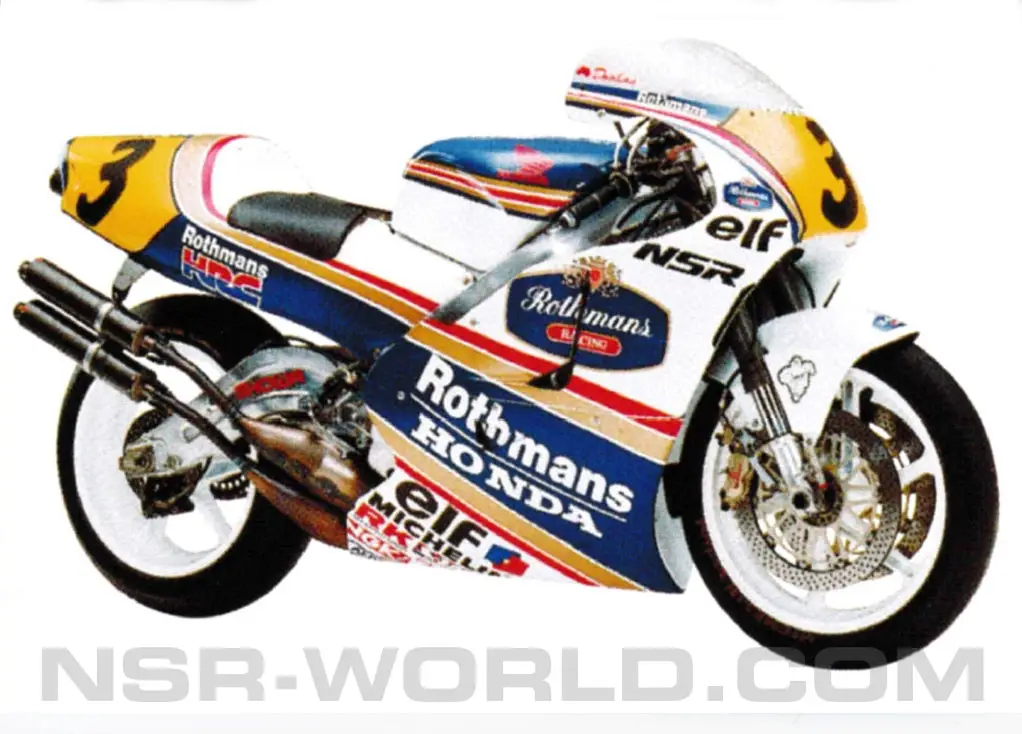
In 1991 the FIM increased the minimum weight for the 500 class to 130kg. The basic layout of the NSR500 remained largely unchanged, however fine fettling did see a marginal increase in power from the NV0Ks 112° V4 motor.

1991 NSR500 [NV0K]

Mick Doohan was the only Honda rider to take the top step of the podium in 1991, and in an extremely hard fought battle with Wayne Rainey and Kevin Schwantz, he finished 2nd in the championship, just 9 points short of Rainey.

During the off-season Gardner and Doohan were testing in Japan. At the end of the test, Doohan was asked to stay on, and did some extra chassis development, moving the engine around. He settled on the higher position from the final rounds of the 1990 season, but while initially accepting of the layout, Gardner was struggling with the new geometry in race conditions.

The Michelin tyres supplied at the beginning of the season didn’t suit the heavier NSR, and Doohan complained that due to poor feedback and them taking too long to warm up, the extra weight was both making the bike harder to stop, and also pushing it wide in the corners, exaggerated by his high corner speed riding style. Added to these issues, trying to launch the additional weight out of the corners would often induce wheelspin. It took Michelin months to develop a tyre really suitable for the heavier bikes, and took until round 4 at Jerez for HRC to nail down the handling issues both riders were battling. For Doohan, it was just the tyres, but for Gardner is was a combination of the tyres and chassis geometry. From round 8 [Jarama] a new frame was prepared for him, lowering the motor back down once again, and his results picked back up. He was still unable to take a win, but his performance improved noticeably. However, having two different chassis specifications was something HRC were unhappy about, as it divided development.

Around 15kg had been added to the engine’s mass to increase reliability and help bring the bike’s overall weight up to regulation, but it caused a bit of a headache for the chassis designers. The basic geometry [and general appearance] remained from late 1990, but the chassis needed to differ significanty to maintain the 1990 CoG.

1991 NSR500 [NV0K]

The FIM weight limit was increased in 1991 to 130kg, so a number of changes were made to the NV0K to meet the new requirement.

The most notable difference between the 1991 NSR500 motor and previous incarnations was the use of aluminium alloy crankcasess instead of the more common magnesium.

Aluminimium alloy was also substituted in other components such as the calipers and rear shock absorber, to ensure the package met the FIM limit.
SPEC: 1991

NSR250 [NV0K]

Power: 180PS @12,500rpm
Torque: 10.33kg-m
Weight: 130.7kg

1991 NSR250 [NV1J]

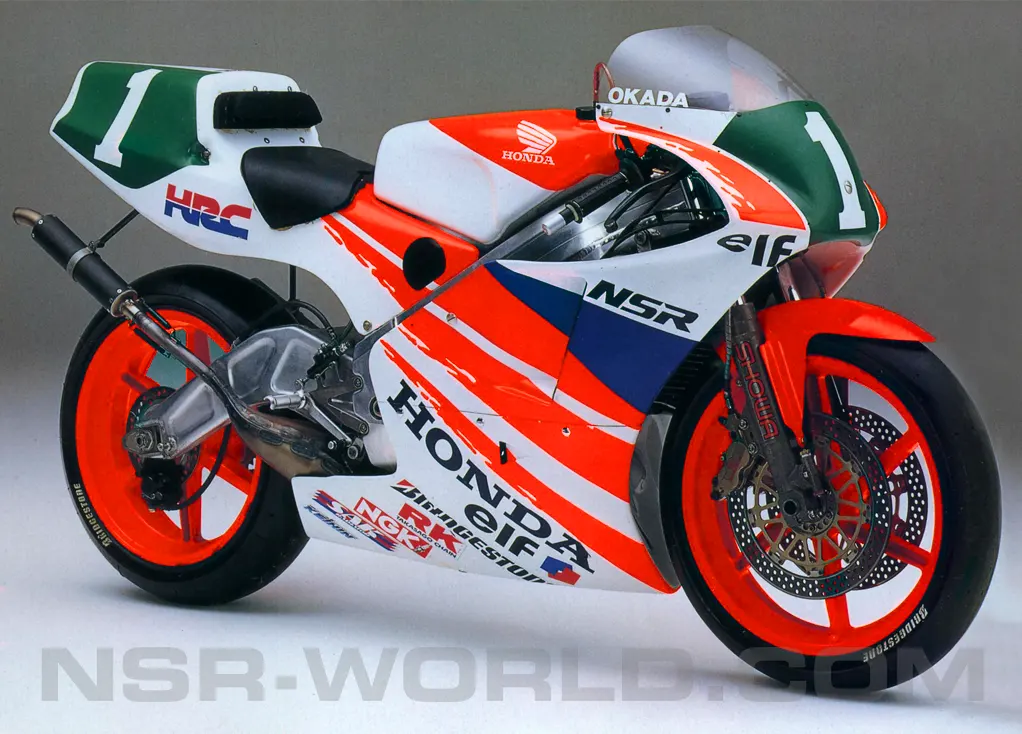
In 1991 Honda and the NSR250 were once again back on top form, with the NV1J taking the top 5 positions in the world championship.

1991 NSR250 [NV1J]

Tadayuki Okada won the All-Japan 250cc Road Racing championship on the NV1J, beating Tetsuya Harada on the Yamaha by 25 points.

The NV1J was the final year of the 90° engine configuration for the works bikes, and towards the end of the season Okada was seen riding the NV2 prototype for the first time.

Luca Cadalora claimed his first 250cc world championship with Erv Kanemoto's factory backed Rothmans team, taking the top step 5 times.

Jochen Schmid, HRC’s RS development rider, finished the season in 8th position on an A-kit RS250R NF5E, making it a 60% sweep of the top ten for Honda. He also won the German national championship.

HRC optimised the NV1J mid-range during the off-season, sacrificing a couple hundred RPM of over-rev, but with Kocinski switching the to 500 class there was no-one capable of riding the YZR competitively, and Reggiani & Chili only managing a handful of podiums [and an inspired win by Chili at the final round at Assen], there was nothing to stop the NSRs dominance.

Erv Kanemoto bored Cadalora’s carburettors to 39mm, and eventually to 40mm, and insulated the expansion chambers to regain the lost RPM. By the end of its development the Rothmans-Kanemoto NSR250 NV1J would rev through to 14,000rpm, 1000rpm higher than the standard bike.

1991 All-Japan Road Racing Championship

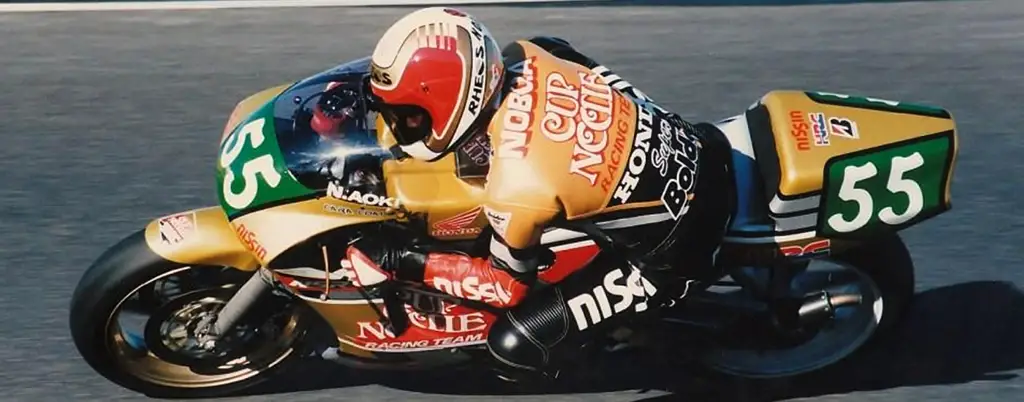
Okada took his third successive All-Japan 250cc Roadracing Championship on the NSR250 in 1991, with Nobuatsu Aoki on the iconic Ajinomoto "Cup Noodle" machine finishing 3rd.

1991 NSR250 NV1J Cup Noodle

SPEC: 1991

NSR250 [NV1J]

Power: 88.5PS @12,500rpm*
Torque: N/A
Weight: N/A

*Estimated

1991 Model Overview

250cc

1991 250cc GP champion - Luca Cadalora

250cc

1991 All Japan champion - Tadayuki Okada

NSR500 [NV0K]

NSR250 NV1J

RS250R [NF5E]

NSR250R-SP [NKD]

NSR250R [MC21]

Leave a Reply

Your email address will not be published. Required fields are marked *