NSR-WORLD.COM

NSR-WORLD.COM
In 1990 the NSR500 retained the NV0H designation, but there was little to tie it to the previous incarnation.
After just one season with Honda, Eddie Lawson returned to Yamaha, leaving the Works HRC door open for a rising star....
1990 NSR500 [NV0H]
In a concerted effort to get the bike down the the FIM minimum of 115kg, the outcome was the lightest NSR500 ever produced, weighing in at just over 117kg.
Using lessons learned from the previous season regarding the stiffness, or rather the lack of stiffness in the chassis, and the enhancements made by Kanemoto, HRC were able to more accurately map the rigidity of the 1990 frame, which was eventually pared down to just 7.35kg. A carbon fibre frame was also considered for increased stiffness and even lower weight, but the idea was droped as it would’ve been too complicated, time-consuming, and expensive to make changes.
Widespread use of exotic alloys such as magnesium and titanium were used throughout the engine to further reduce weight, but the overall chassis design remained largely unchanged. The resulting package however saw the 1990 NSR500 NV0H the lightest of any NSR500, and was highly regarded by all riders.
Outwardly, the 1990 NV0H looked like a sleeker, streamlined version of Wayne Gardner’s 1989 bike, and while under the bodywork things appeared quite similar, many of the underlying components differed significantly. There were no big visual changes in 1990, like the NV0D’s change from 90° V-angle to 112°, or the ’89 NV0H’s implementation of the Gull-Arm; the 1990 model was more of an evolution model, further refining what had been developed by Eddie Lawson and Erv Kanemoto the previous season.

1990 NSR500 [NV0H]
The lightest NSR500 ever produced, the NV0H weighed in at 117.3kg, just 2.3kg over the minimum weight at the time, a saving of 9% over Eddie Lawson’s 1989 bike.
Weight savings were made by widespread use of exotic materials such as titanium, magnesium, and carbon fibre. Even the 1990 NV0H inner fork stanchions were made of carbon fibre, skinned with a nitrided alloy.
A 17″ front wheel, generally preferred by Lawson in ’89, was now standard equipment.
Weight savings were made by widespread use of exotic materials such as titanium, magnesium, and carbon fibre. Even the 1990 NV0H inner fork stanchions were made of carbon fibre, skinned with a nitrided alloy.
A 17″ front wheel, generally preferred by Lawson in ’89, was now standard equipment.
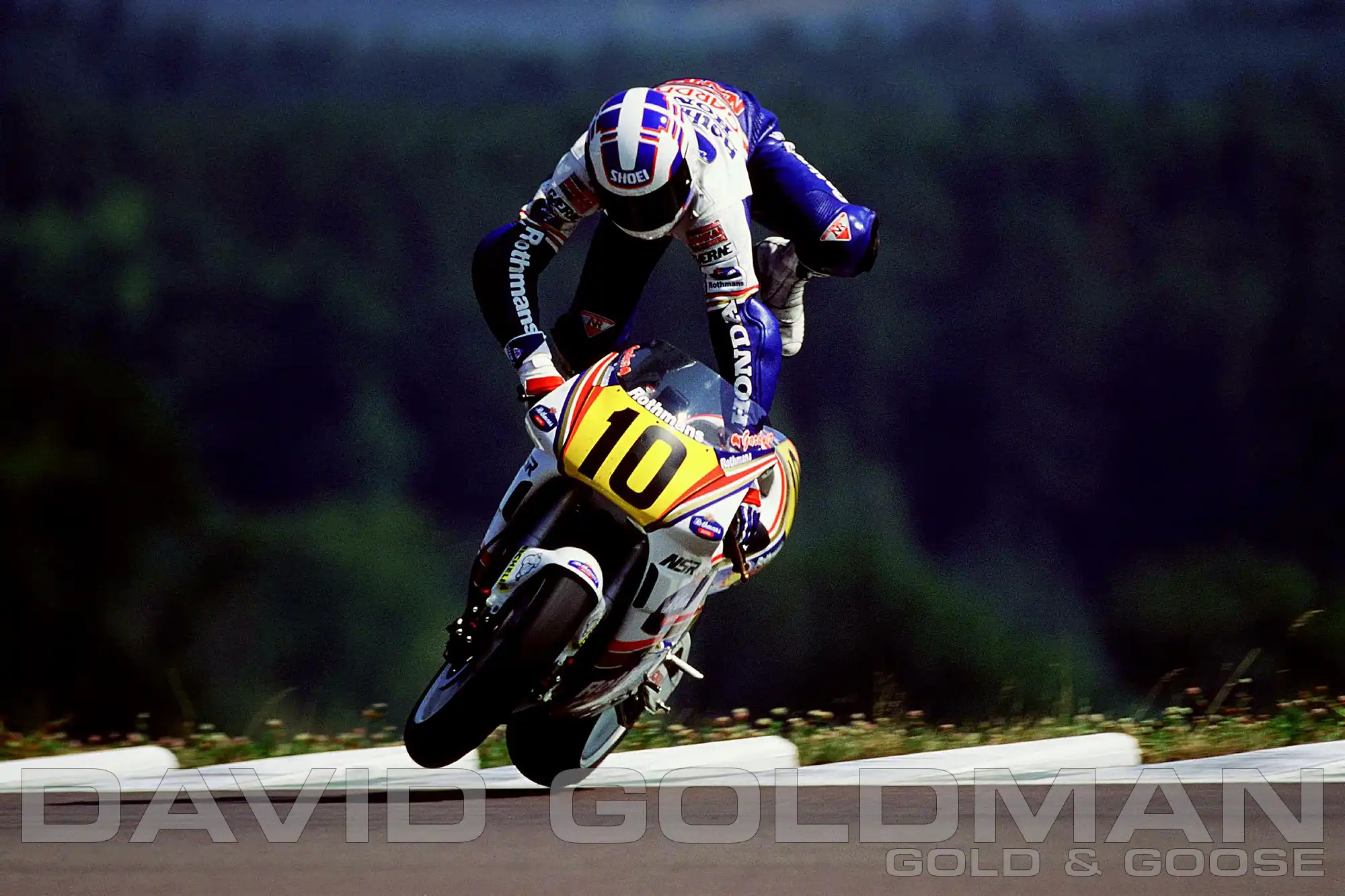
1990 Brno
Possibly the most iconic photo of the 500 Grand Prix era was of Wayne Gardner during practice at Brno, taken by David Goldman, of Gold & Goose Photography.
The highside captured during practice was a reminder of the sheer brutality of a 117kg 2-stroke producing 174PS, with zero rider aids.
@Gold and Goose
While the 1990 NSR500 NV0H is regarded by many as the best NSR500, given its sheer power-to-weight ratio coupled to an excellent chassis, the season was quite catastrophic for Honda, with only three NSRs finishing in the top ten.
During the 5th round in Germany, Gardner crashed and suffered a broken leg. At the time, he was still HRC’s #1 rider, and development had naturally centred around him.
With Gardner out of the running, the title challenge was now placed on the shoulders of the newly signed Works rider Mick Doohan, however, a crash in pre-season testing at Suzuka in December ’89 meant he hadn’t been able to contribute to development. Doohan’s riding style differed greatly to Gardner’s, so unfortunately he was unable to demonstrate his full capabilities on a chassis built around Wayne’s favoured geometry. Doohan still managed to finish the season a close third, just nine points adrift Schwantz in only his second season, and secured his position within the team going forward.
Sito Pons rounded off the top-ten with 76 points out of just 8 finishes.
With 174hp and weighing in at just 117kg, the 1990 NV0H was a savage beast on track. HRC attempted to improve drivability by increasing the mass of the crank by 15% over the ’89 NV0G, and changed the RC Valve mapping from purely RPM based to a system that measured both throttle position & RPM. The changes helped smooth the power delivery slightly, but due the sheer power-to-weight ratio, there was no fundamental overal improvement. The riders had to just grit their teeth and get on with it!
Mick Doohan finally took his first Grand Prix win at the penultimate round of the 1990 season in Hungary.
For the Hungarian round, HRC had finally prepared a new chassis for Doohan, raising the motor 15mm, which greatly suited his riding style. The revised geometry lead to a dramatice improvement in Doohan’s pace, and in addition to the win in Hungary, he also came a close second to Gardner at the closing round at Phillip Island, making it an Aussie one-two at their home GP.
The new geometry would become the basis of the NSR500 chassis for the following 5 years, signifying HRC’s move to focus on Doohan as their primary rider, despite their claims publicly otherwise.
1990 NSR500 "Big Bang"
Since its inception, the NSR500 motor had a 90 degree firing order, commonly refered to as a "screamer". But late in 1989 season covert development had been underway in Japan.
Since the early ’80s, upon Honda’s re-entry into the world of 2-stroke Grand Prix machines, HRC had been using the domestic All Japan Road Racing Championship as a testing ground for WGP. Towards the end of 1989 HRC tried out an all-new engine configuration for the very first time at the Sugo round of the All Japan championship, and in 1990, the NSR500 “Big Bang” was finally wheeled out onto the world stage.
Outwardly, Shunji Yatsushiro’s “Big Bang” looked no different to the other NSRs in the pit lane, and therefore naturally went unnoticed at first. Its first droning pass of the home straight however, soon saw a flurry of activity on the pit wall, as rival engineers looked on to see the source of the “new” engine sound.
The Big Bang utilised the same engine cases as the conventional 90° “screamer” NSR, but featured a new crankshaft and ignition, firing the left bank cylinders [#1 & #2] together, then the right bank together, in a 180° configuration. This gave a power output more akin to that of a V-twin, helping to increase drive out of the turns, but also reducing load on the rear tyre.
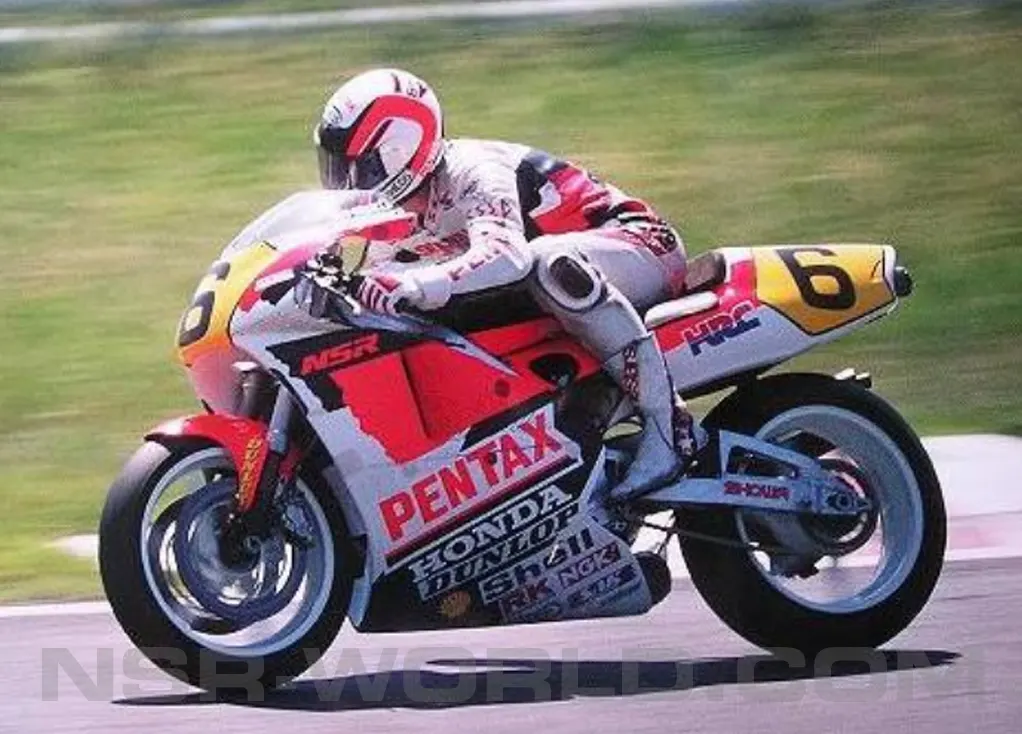
Shinichi Ito
Honda fared better in the 1990 All Japan 500cc Road Racing Championship, with Shinichi Ito claiming the top spot over the previous season’s Yamaha mounted champion, Fujiwara, beating him by just 4 points.
Hikaru Miyagi took third on the Ajinomoto Terra Racing HRC backed machine.
SPEC: 1990
NSR500 [NV0H]
Power: 174.0PS @12,500rpm
Torque: 10.15kgm @12,000rpm
Weight: 117.3kg
Background image
© Shigeo Kibiki
1990 NSR250 [NV1H]
Seven Hondas finished in the top ten in 1990, but the Team Roberts Marlboro Yamaha YZR250 of John Kocinski took the top step.
Spain's Carlos Cardús finished as best Honda, in second position.
While the world watched the epic world championship battles, towards the end of 1989 and throughout 1990 in the All-Japan domestic series, HRC were running Takehiko Kurokawa’s NSR250 NV1H with fuel injection, in an attempt to both smooth out the power delivery, and increase peak performance.
The NV1Hs injection system comprised of downdraught manifolds with butterflies to control the air intake, and twin injectors; a configuration that could very well have been inspired by the downdraught carburettors tested by Sito Pons and Masahiro Shimizu the previous season.
Unfortunately, the FIM soon put a dampener on proceedings, stating that the fuel injection must be a direct replacement for carburettors.
The ideal scenario was [direct] fuel injection into the cylinders, but following the FIM technical rules, there was little performance to be gained over conventional carburettors. The placement of the injectors meant the inlet charge was still subject to the same scavenging effect of carburettors, and both contamination by the exhaust gasses and a degree of “blow-back” through the intake ports.
However, more accurate mapping of the fuelling did allow the NSR to carry noticeably less fuel, saving a significant amount of weight. [1 of petrol/gasoline = approx. 0.75kg]
The system was reliable, but no significant gains were really made, and by the end of July, development in the fuel injection on Kurokawa’s NSR250 ceased. HRC would resurrect the project the following year for the NSR500 NV0K though.

1990 NSR250 [NV1H]
HRC had concentrated the majority of their efforts refining the chassis to improve handling and braking for the 1990 NV1H, and although the 250cc championship went to arch rival Yamaha, their work was rewarded with 70% of the final top 10 in the standings.
Several teams experimented with braking components other than the factory supplied NISSIN parts, but each reverted to the HRC supplied setup after finding no benefits. Masahiro Shimizu reportedly tried the downdraught carbs as tested by Sito Pons in ’89, but once again, they provided no additional gains over the flat slides.
Several teams experimented with braking components other than the factory supplied NISSIN parts, but each reverted to the HRC supplied setup after finding no benefits. Masahiro Shimizu reportedly tried the downdraught carbs as tested by Sito Pons in ’89, but once again, they provided no additional gains over the flat slides.
1990 All-Japan Road Racing Championship
Following his success the previous season, Tadayuki Okada once sgain won the All-Japan 250cc Roadracing Championship on the NSR250.
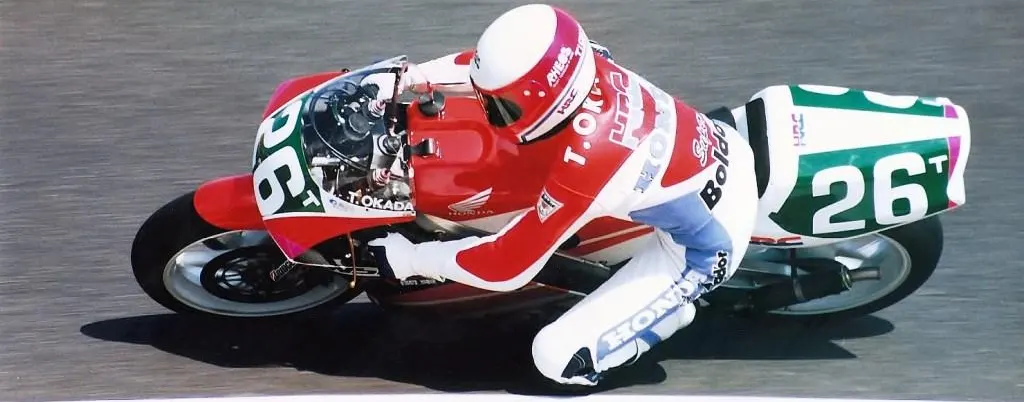
In similar fashion to the 1990 World Grand Prix championship, 7 of the top 10 positions in the All-Japan Championship were taken by Hondas. However, in the domestic championship the top two positions were switched, with the NSR250 NV1H of Okada beating the Yamaha of Harada by 10 points. Unlike WGP though, two of the remaining six top-ten finishers were RS250R NF5Ds.
SPEC: 1990
NSR250 [NV1H]
Power: 87PS @12,500rpm*
Torque: N/A
Weight: N/A
*Estimated
1990 Model Overview
250cc

NSR500 [NV0H]
NSR250 [NV1H]
RS250R [NF5D]
NSR250RK [NH3D]
NSR250R-SP [NKD]
NSR250R [MC21]