NSR-WORLD.COM

NSR-WORLD.COM
Luca Cadalora would retain his world championship crown on the all-new NSR250 NV2B in 1992 in convincing style, but the season's headlines were domintated by the 500 class.
1992 finally saw the divergence of the NSR250 GP & NSR250R production bikes, although the RS250R NF5 would run MC16E crankcases for one last season.
1992 NSR500 [NV0P ]
Mick Doohan was on devastating form in 1992, and almost certain to win his first championship on the NSR500 NV0P.
The NV0P is widely remembered as the “big bang” NSR500, although a big bang configuration actually debuted the All Japan championship in 1990, ridden by Shinichi Ito. There was however, a significant difference between the 1990 and 1992 motors. In 1990, cylinders were ignited evenly in pairs [1&2, then 3&4], 180° apart, whereas the new motor now featured an “uneven, close-proximity” firing order.
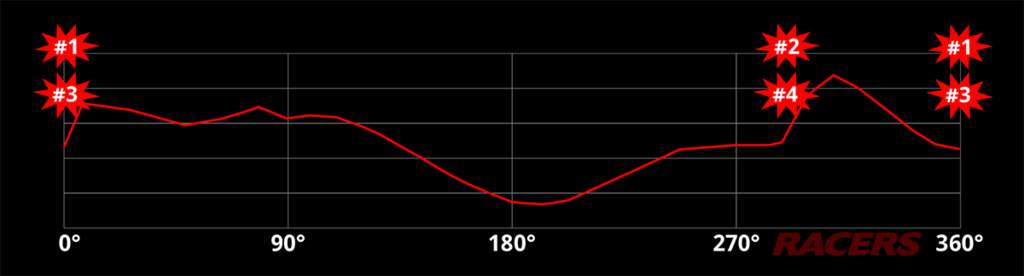
The first pair of cylinders [1&3] would now fire together, but the second pair [2&4] wouldn’t fire for another 292°. However, within just 68° degrees, the first pair of cylinders would fire once again, giving the “close proximity” element of the big bang characterisic.
Externally, the motor was virtually idestinguishable from the 180° configuration, with the changes made by altering the crank pin phasing and ignition timing, however the exhaust sound was noticeably different.
The new 68° motor was no more powerful than the previous motor, but changed the dynamic of the NSR. It became far more manageable through and exiting the turns, giving considerably more controllable drive.
Aside the new motor, the NV0P was recognisable by it’s air intakes in the nose of the fairing, and the raised rear of the seat cowl, both of which would go on to influence the bodywork of the 1994 NSR250R MC28.

1992 NSR500 [NV0P]
Having seen Mick Doohan and Wayne Gardner lap Suzuka during the 8hrs endurance race on the RVF750 at Grand Prix pace, but with less power than the NSR500, HRC’s project leader was convinced rideability was more important than outright power.
The new theory was to make the 2-stroke behave more like a 4-stroke, with a smoother power delivery and increased traction, even if it meant reducing the power. In the end, power remained the same, but the “uneven firing, close proximity” big bang transformed the NV0P.
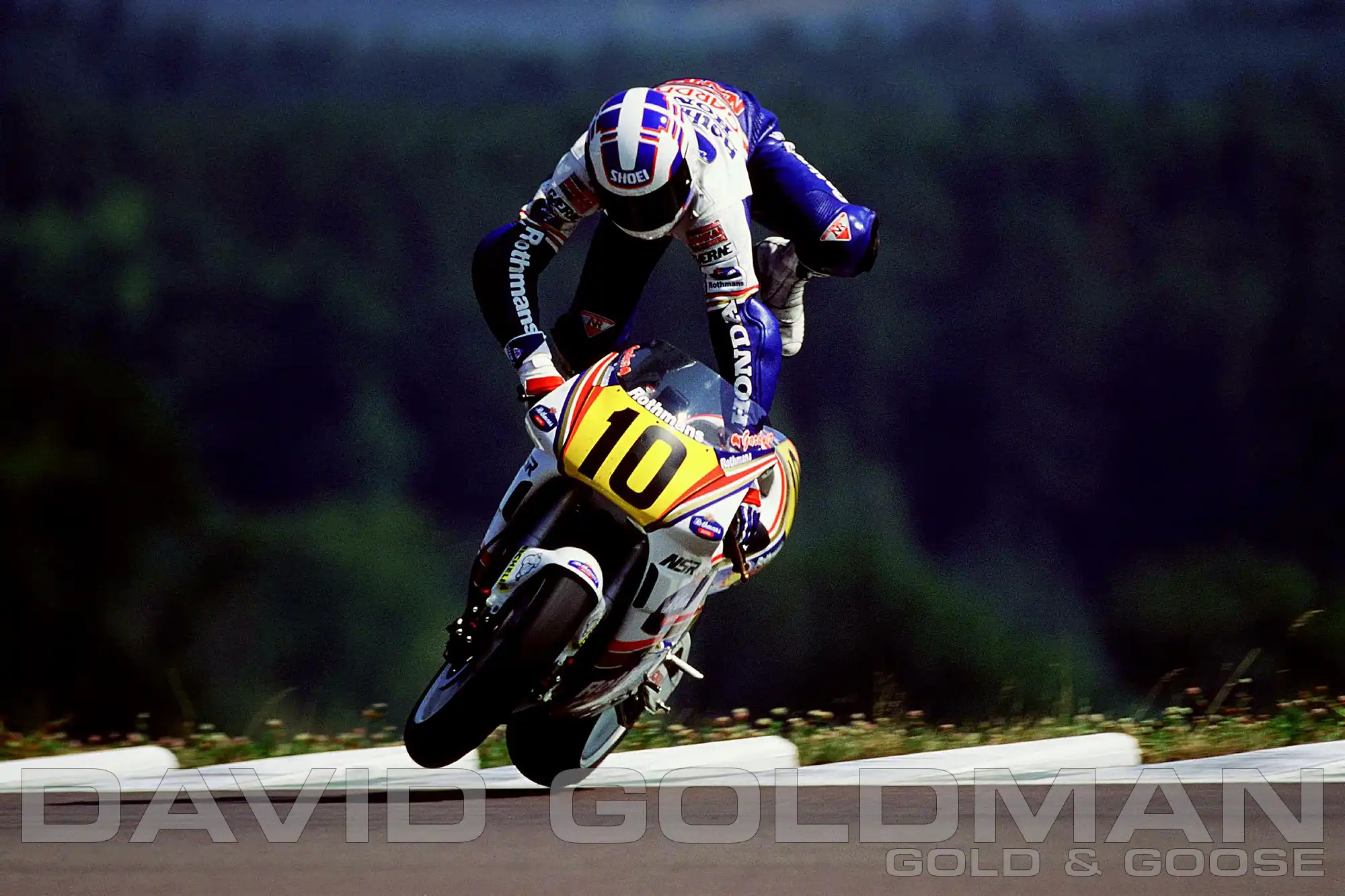
Doohan's recovery
Thanks to the treatment by Dr. Costa and his Clinica Mobile, Mick Doohan’s recovery can only be described as simply miraculous!
Missing just four races after facing possible amputation at one point, he competed in the final two rounds of the championship, finishing just 4 points short of Wayne Rainey.
Albeit arguably the most spectacular comeback in motorsport history, the injury would ultimately end his career when, in 1999, he crashed during a wet practice session in Spain, breaking his already weak right leg again in several places.
1992: Triumph, Tragedy, and Tenacity.
The 1992 500cc Grand Prix season was poised to be Mick Doohan’s crowning moment. In only his third season with Rothmans Honda, Doohan exploded into the season with unparalleled dominance. He won five of the first seven races — Japan, Australia, Spain, Austria, and Italy — and finished second in two others. The 1992 NV0P suited his riding style perfectly, and left his rivals struggling to match his pace. By mid-season, Doohan held a commanding 65-point lead in the championship standings, seemingly on an unstoppable march toward his first world title.
But at the Dutch TT in Assen, disaster struck. During Friday practice, in damp conditions, Doohan suffered an horrific high-speed crash. His right leg was caught under the bike, resulting in compound fractures to the tibia and fibula.
Initial surgery in the Netherlands aimed to stabilize the leg with an external fixator, but complications rapidly escalated. He developed compartment syndrome, a dangerous condition where internal swelling cuts off blood flow. His leg was cut open from behind the knee down to the ankle, and the top of his foot to his toes, to try and relieve pressure and promote circulation. Soon after the wound started to rot, and surgeons recommended amputation. He was evacuated to Dr. Costa’s clinic in Bologna, Italy, where emergency surgery was performed, sewing his right leg to his left leg for 14 days, to promote blood flow to the damaged tissue.
Incredibly, including the Dutch TT round at Assen, Doohan only missed 4 races, and was back on the NSR at round 12 in Brazil. He managed a finishing position of 12th, At the final round in South Africa he finished 6th, and rounded off the championship in second place, just 4 points adrift of Wayne Rainey.
SPEC: 1992
NSR500 [NV0P]
Power: 185PS @12,500rpm
Torque: 10.78kg-m @12,000rpm
Weight: 131.9kg
1992 NSR250 [NV2B]
In 1992, the NSR250 NV2B underwent the most significant mechanical changes since its inception, & with those changes the link to the NSR250R production bike was finally broken.
The immediately noticeable change was the adoption of the Pro-Arm, but far more radical changes were hidden behind the fairings.
The NSR250 had reached the pinacle of its development in its current form by 1991, and HRC needed to find more performance than the 90° motor could produce. In a major departure from the NV1 generation of models, for 1992 onwards. the clutch was moved to the left hand side, and the drive chain moved to the right.
The previous RS250R ND5/NF5 models had all been based upon production models, with the NV1 following the prevailing layout too, albeit essentially based on the NSR500 NV0A, where a clutch on the right hand side wouldn’t be submerged in oil when resting on a side stand. Naturally, this is of no concern with a race bike, and moving the clutch to the left allowed the shift shaft to be shortened, increasing feel and reducing weight.
The cylinder bank angle was reduced from 90° to 75° to minimise the difference in intake lengths between the carburettors and crankcases. To allow for the 75° bank angle, the new crankshaft was re-phased with a 30° offset. The cylinders now fired at 105° and 255°. Due to the change in bank angle, a balance shaft had to be implemented for the first time, however the new configuaration made the motor significantly more compact, allowing greater flexibility for its mounting position within the frame.

1992 NSR250 [NV2B]
Easily distinguished by the adoption of the Elf Pro-Arm, the 1992 NV2B also featured an all-new 75 degree cylinder layout, with the drivetrain swapped from the left hadn side to the right.
The Pro-Arm was used to provide greater clearance for the LHS expansion chamber, allowing a far straighter run and fully circular cross-section, increasing peak engine performance.
SPEC: 1992
NSR250 [NV2B]
Power: 90PS @12,750rpm*
Torque: N/A
Weight: 95kg
*Estimated
1992 RS250R [NF5]
1992 was the final year of the RS250R NF5, and the end of the 90° era. It would be the last race bike based on the 1986 NSR250R MC16's configuration.
The most apparent upgrade in 1992 was the adoption of inverted, or “upside down” front forks. The new forks gave vastly better stability and feedback under braking and cornering.
The brakes remained unchanged from the 1991 model, with 4-piston Nissin calipers and 296mm stainless steel discs, although 296mm cast iron discs were an option. Front wheel size also remained the same as the previous year at 3.5×17, but the front-end was finished off with a sleeker, more aerodynamic fender.
Rear wheel was once again 5.25″, and the overall wheelbase unchanged, at 1330mm. The silhouette was lower however, at just 1035, a reduction in height of almost 50mm over the 1991 bike.

Overall width remained as 1991, but the fuel tank was reshaped, as was the rear seat, allowing more space and freedom of movement for the rider.
Further removing the 1992 NF5 from its NSR250R ancestry, the top crankcase casting was changed to increase the inlet dimensions, and accommodate larger reed valves. The porting was revised, and the crankcase internals further refined, as was the ignition timing and RC Valve control. Claimed power remained unchanged from 1991, however torque was increased; all shifted slightly lower across the rev-range, making the 1992 far less “peaky”, and easier to ride than before.
SPEC: 1992
RS250R [NF5F]
Power: 82PS @12,000rpm*
Torque: 4.95kgf-m @11,000rpm
Weight: 103kg
*Claimed
1992 Model Overview
500cc

250cc

NSR500 [NV0P]
NSR250 NV2B
RS250R [NF5F]
NSR250R-SP [NKD]
NSR250R [MC21]