NSR-WORLD.COM

NSR-WORLD.COM
1988 wasn't the NSR500s finest season, and it struggled against the YZR500, picking up only four wins compared to the Yamaha's seven!
1988 NSR500 [NV0G]
Handling problems plagued the NSR500 throughout the season, and Wayne Gardner was unable to successfully defend his title.
Gardner secured five pole positions in 1988, but not without overcoming some serious handling issues in the early part of the season. Changes to the chassis by inexperienced engineers drafted in to HRC at the end of 1987 caused major handling issues. HRC’s policy was to rotate engineers between different departments, to theoretically bring fresh new ideas into the development cycle.
Due to the 1987 NSR500’s tendency to push the front coming out of slower corners, the engineers came up with the idea of lowering the centre of gravity of the motor, to try and overcome some of its gyroscopic effect. Consequently the swingarm pivot needed to be moved [lower] too, to restore the desired chain run.
However, coupled with the new more powerful motor and 80s tyre technology, the revised rear geometry made the bike “squat” badly out of corners, loading up and overpowering the rear shock, and inducing massive wheelspin very early in the power cycle.
A new engineer from Honda R&D, Heijiro Yoshimura, joined HRC at the beginning of 1988.
While the NSR500 NV0G was already passed as race-ready by the project leader, Yoshimura insisted on riding the bike during testing. He wasn’t satisfied with either the harsh power delivery or the difficult handling, and while it was largely too late to rectify for the 1988 season, his new way of thinking “less power/more handling” would finally start to lead HRC to greater success in following seasons.

1988 NSR500 [NV0G]
During the off-season HRC worked on the 500 V4 motor, making it both more compact, and more powerful. The rev ceiling was increased 1000rpm to 13,000rpm, and output grew another 5hp to over 160hp.
Due to the 1987 NSR500’s tendency to push the front coming out of slower corners, the engineers came up with the idea of lowering the centre of gravity of the motor, to try and overcome some of its gyroscopic effect.
The NV0G was a notoriously difficult chassis to tame, and only 3 NSRs finished in the top ten in 1988.
Due to the 1987 NSR500’s tendency to push the front coming out of slower corners, the engineers came up with the idea of lowering the centre of gravity of the motor, to try and overcome some of its gyroscopic effect.
The NV0G was a notoriously difficult chassis to tame, and only 3 NSRs finished in the top ten in 1988.
Despite Wayne Gardner's five pole positions, four wins, and a string of 2nd place finishes on the NSR500, once again arch rival "Steady" Eddie Lawson took the championship on the more balanced YZR500.
SPEC: 1988
NSR500 [NV0G]
Power: 162.8PS @12,500rpm
Torque: 9.4kgm @12,500rpm
Weight: 127.1kg
1988 NSR250 [NV1D]
Sito Pons took the first of his two world championships on the Campsa-Honda NSR250 NV1D in 1988, making him Spain's first ever 250cc world champion, and the second rider to win the world championship on an NSR250.
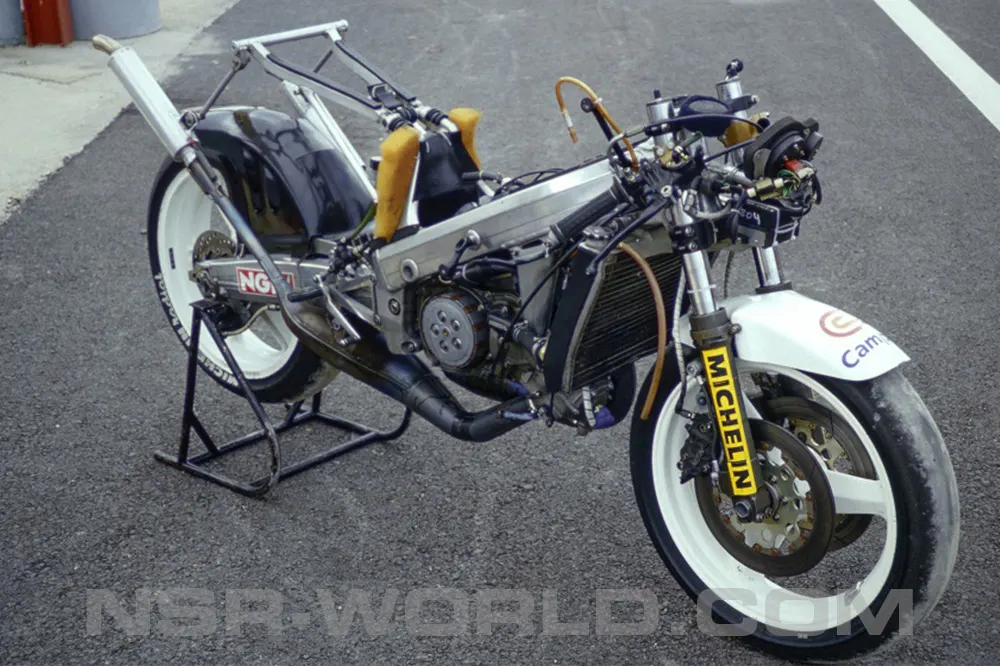
1988 NSR250 [NV1D]
By 1988 the NSR250 had already developed into a model in its own right. No longer was it “just half an NSR500”.
The 1988 motor was both narrower and shorter than the previous model, which allowed it to be positioned further forward in a more compact frame, placing more weight over the front wheel, and the Showa fork stanchion diameter was increased to 43mm to increase stiffness.
The swingarm was lengthened by 20mm, but overall wheelbase was actually 10mm shorter, which resulted in a quicker turning chassis than the ’87 NV1C. It was a chassis that only Sito Pons was really able adapt to, amassing 4 wins and 231 points.
The 1988 motor was both narrower and shorter than the previous model, which allowed it to be positioned further forward in a more compact frame, placing more weight over the front wheel, and the Showa fork stanchion diameter was increased to 43mm to increase stiffness.
The swingarm was lengthened by 20mm, but overall wheelbase was actually 10mm shorter, which resulted in a quicker turning chassis than the ’87 NV1C. It was a chassis that only Sito Pons was really able adapt to, amassing 4 wins and 231 points.
Technical improvements to the 1988 NSR250 NV1D included the use of 38mm carburettors for the first time since the 1985 RS250RW NV1A.
Digital PGM engine management for ignition & RC Valve control, and a TPS [throttle position sensor] also made their first appearance in ’88, on both the NSR250 and NSR250RJ production bike.
The RC Valve operation was dynamically controlled according to engine RPM and throttle position now, rather than just the linear operation of the previous analogue system.
However, unlike the NSR250R, where the T.P.S. was integrated into the carburettor assembly, the sensor on the NSR250 racer was mounted to the frame, and actuated with a secondary cable.
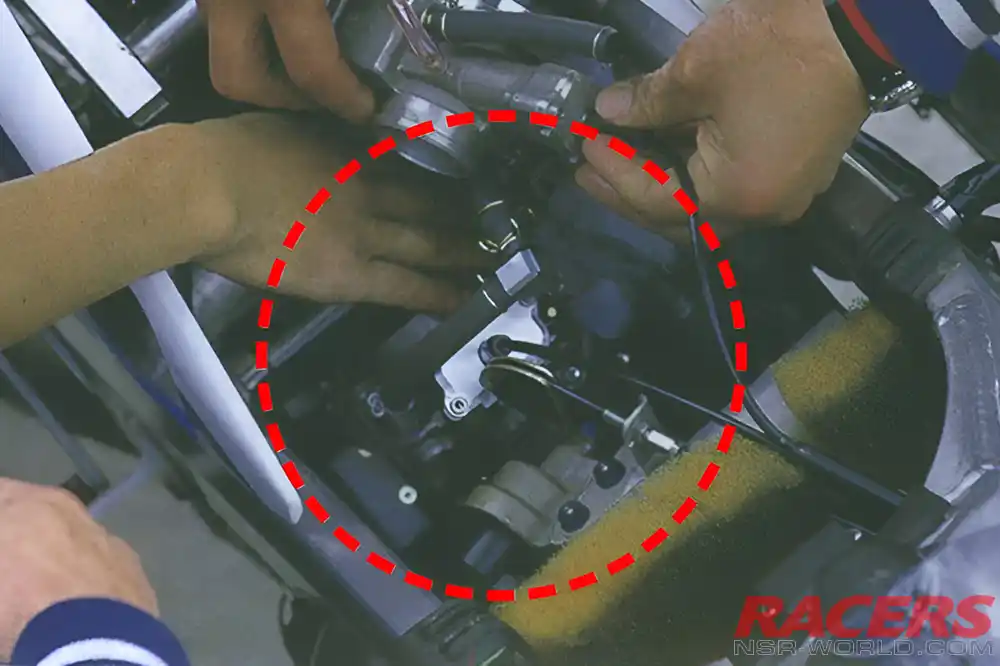
Another first for the 1988 NSR250 was the addition of a curved radiator. This gave both clearance for the front tyre under full suspension compression, and more surface area while maintaining a similar overall width to the previous straight item.
Once again the NSR250 dominated the field, and Sito closed out the season 10 points ahead of fellow countryman Juan Garriga on the YZR250, to win his first 250cc world championship.
The following three riders, Jacques Cornu [Parisienne Elf-Honda], Dominique Sarron [Rothmans-Honda France], and Reinhold Roth [HB Römer-Honda], all competed on NSR250s. Of the top 10 championship finishers in 1988, seven were NSR250s.
Future WGP250 world champion Tadayuki Okada took his Technical Sports Racing [TSR] MC18 NSR250RK NH3B to 5th in the Japanese Formula 3 series in 1988.
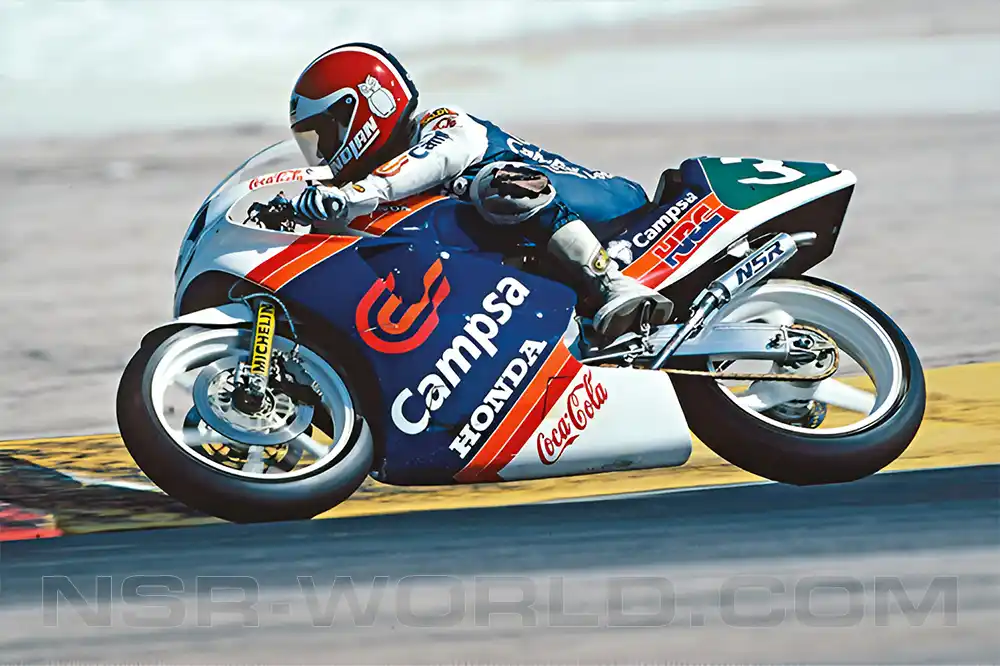
A. Pons
NSR250 [NV1D]
P1
Campsa Honda
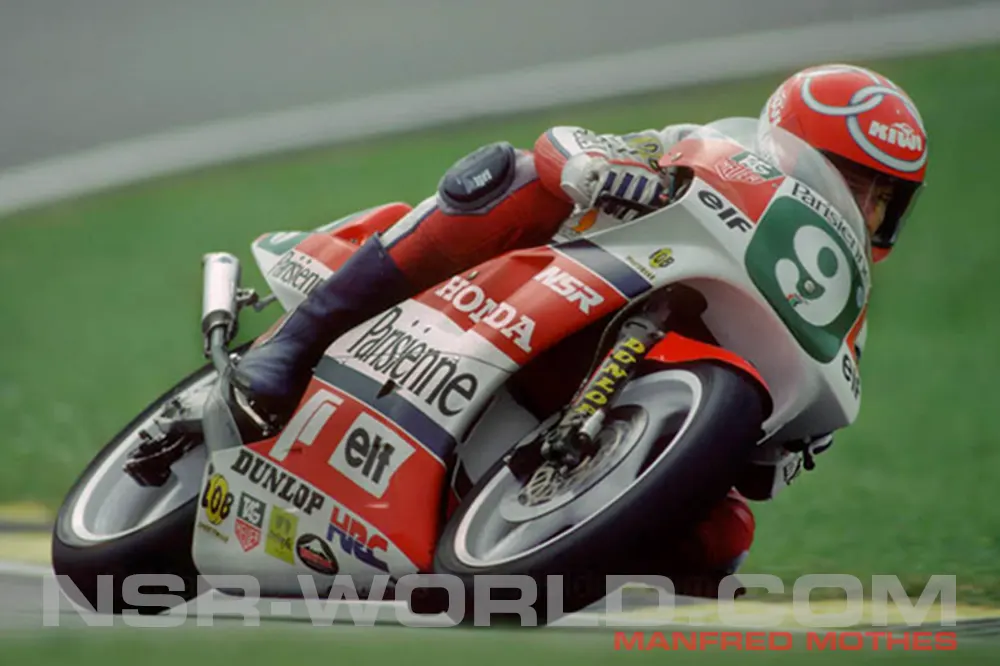
J. Cornu
NSR250 [NV1D]
P3
Parisienna-Elf Honda
© Manfred Mothes
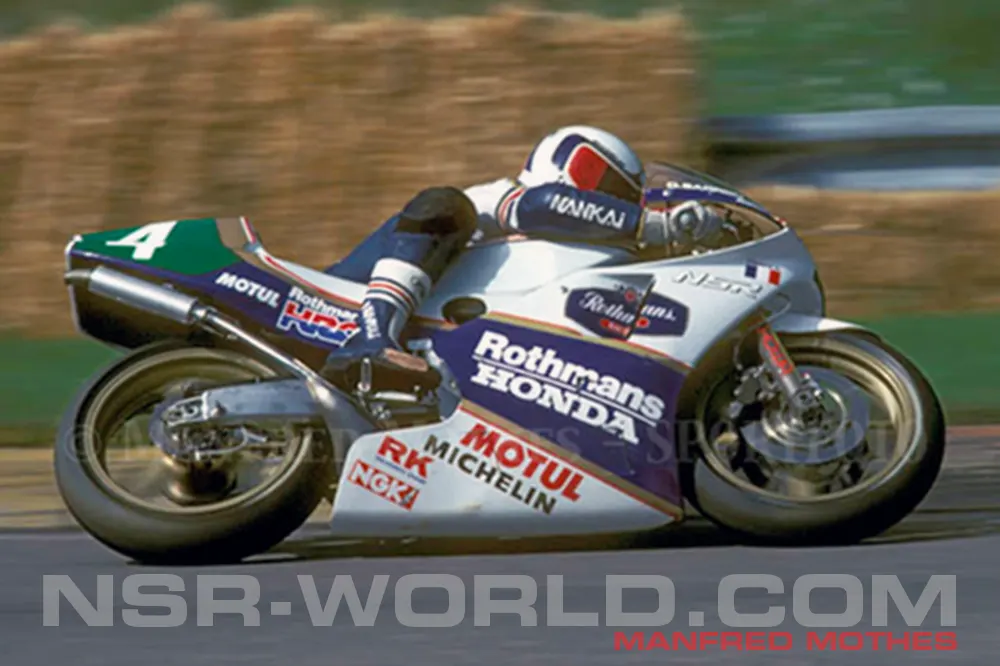
D. Sarron
NSR250 [NV1D]
P4
Rothmans Honda
© Manfred Mothes
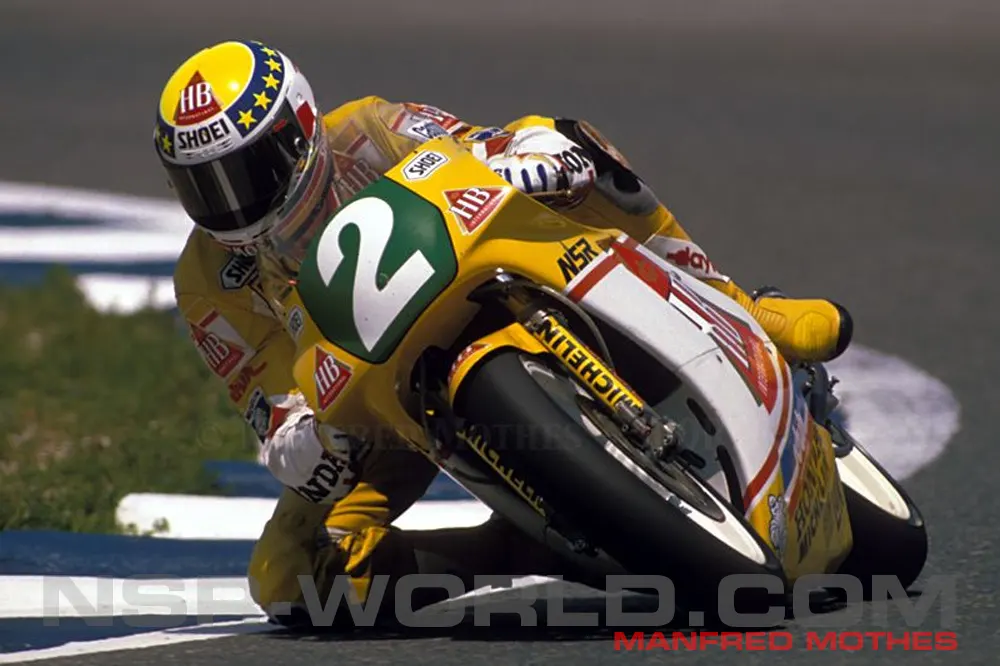
R. Roth
NSR250 [NV1D]
P5
HB Honda Racing
© Manfred Mothes
Sito Pons
NSR250 [NV1D]
P1
Campsa Honda
Jaques Cornu
NSR250 [NV1D]
P3
Parisienne-Elf Honda
© Manfred Mothes
D. Sarron
NSR250 [NV1D]
P4
Rothmans Honda
© Manfred Mothes
Reinhold Roth
NSR250 [NV1D]
P5
HB Honda Racing
© Manfred Mothes
SPEC: 1988
NSR250 [NV1D]
Power: 83.5PS @12,500rpm
Torque: 4.87kgm @12,000rpm
Weight: 93kg
1988 RS250R [NF5B]
The RS250R NF5 finally received RC Valve technology in 1988.
The sole remaining implementation of ATAC on road-racing machines was dropped by Honda in 1988. Along with several additional chassis updates, the RS250R NF5B at last offered consumers a machine equipped with RC Valve.
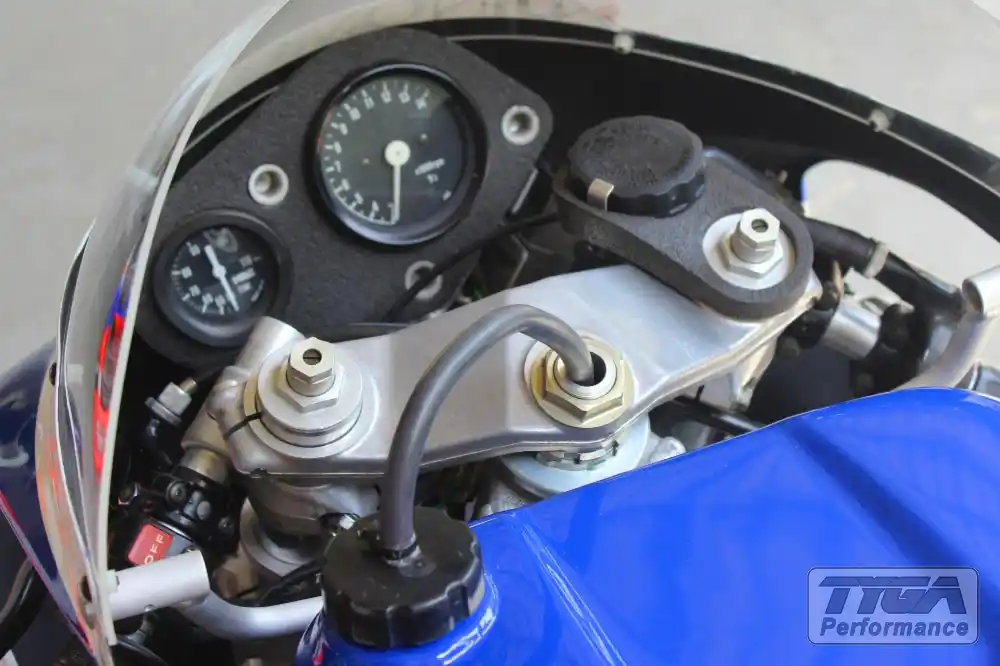
1988 RS250R [NF5B]
While the NF5A was the first of the “next generation” of RS250Rs, the NF5B was really the break-out model.
RC Valve was finally implemented, and the suspension and brakes saw a major overhaul and upgrade.
RC Valve was finally implemented, and the suspension and brakes saw a major overhaul and upgrade.
Image credit: TYGA Performance
Unlike the NSR250 & NSR500 GP bikes and their NSR250R MC18RJ production bike counterpart, the 1988 RS250R NF5B ignition was still a rudimentary analogue system by Kokusan Denki, reminiscent of the very first RS way back in 1984. RC Valve was therefore still a relatively simple RPM-based implementation.
Following complaints of worn and broken piston rings the previous season, the exhaust port bridge was widened on the now RC Valve equipped barrels, and the porting was adjusted to suit the variable height exhaust. The transfer port timing was also revised. The 1987 NF5A “twin stack” exhaust system was replaced by expansion chambers that were routed more conventionally, with one exiting each side of the swingarm, and featured high level silencers similar in appearance to the 1987 factory NSR250 NV1D.
The frame was largely unchanged from the 1987 model, but the forks received quite a substantial overhaul. The TRAC anti-dive was discontinued, and inline with the NSR250R MC18, the fork stanchions increased in diameter from 39mm to 41mm. The new forks featured both preload and rebound adjustment. New forged 4-pot Nissin calipers made their appearance for the first time, similar to those used on the RC30 superbike, but the semi-floating disc diameter remained the same as the NSR250R2J MC18 at 276mm.
Unlike the GP dominating NSR250 NV1D, the RS250R NF5B wasn’t particularly successful, and was overshadowed by the ’88 Yamaha TZ250U “reverse cylinder”, particularly in AMA, where John Kocinski won the title in convincing fashion.
In the European championships, Aprilia were dominant with their AF1, and it was only really the British national championships where the NF5 saw particular success.
In the All Japan Championship the RS250R NF5B of Yohinan Hori finished in 3rd overall, behind the YZR250 of Toshihiko Homma [1st] and NSR250 NV1D of Masaru Kobayashi.
SPEC: 1988
RS250R [NF5B]
Power: Over 70PS @12,500rpm
Torque: N/A
Weight: 100kg
1988 NSR250RK MC18 [NH3B]
Still widely regarded as the purest of the NSR250RKs in Japan, the 1988 NH3B took the Honda production racer to an all-new level.
The MC18 HRC TT-FIII parts list and setup manuals were basically RS250R NF5 manuals with a photo of an NSR250R on the cover!
The 1988 NSR250RK powerplant saw a number of refinements over the 1987 model, and consequently displayed significant improvements.
The most immediate & notable change was the carburettor venturi increase from 28mm to 32mm, but really the whole bike was a ground up redesign. While there is a level of interchangeability between the NH3A and the NH3B, every part of the package bar one, can be regarded as an upgrade.
Arguably, the final drive can be considered a downgrade. The complete MC16RK transmission was lifted straight from the RS250R NF5a, also utilising the NF5’s lightweight clutch, all housed behind a special hybrid HRC transmission cover. However, rule changes for the 1988 season meant the engine cases & transmission cover must remain production items.
While the RKs dry clutch was now a standard SP production item, HRC produced special NH3 mainshafts [incorporating taller 17T & 18T 1st gears], and every other internal part, bar the NSR250R centre shift fork, were still RS250R components.

1988 NSR250RK [NH3B]
The 1988 NH3B was a ground-up reworking for the NSR250RK.
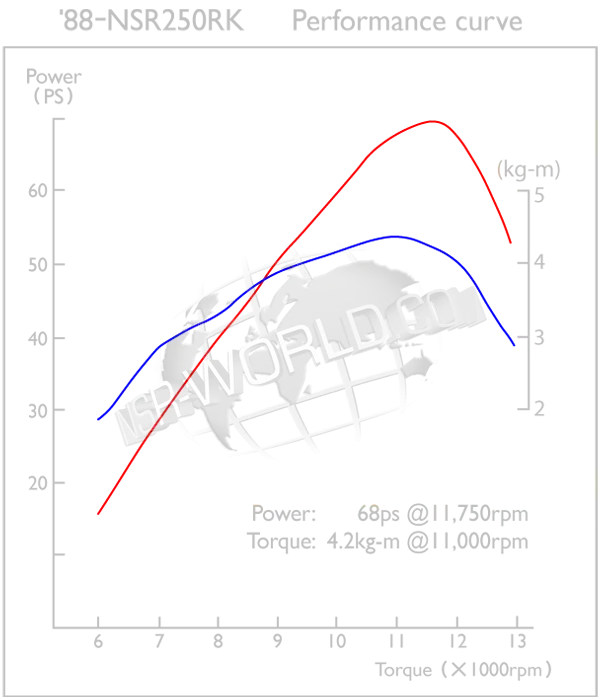
A new crank, crankcases, barrels with revised porting & refined RC Valves, heads [with centrally located spark plugs] and larger carburettors saw the ’88s power rise to 68PS at the rear wheel, an increase of 3PS over the ’87 MC16. As with the MC16RK, ignition was handled by an RS250R system.
Wheels remained 17″ & 18″ front & rear respectively, however optional fronts were made available in 3.25″ & 3.5″.
The MC18 was fitted with larger 276mm rotors and 4-piston calipers as standard. HRC supplied stainless steel braided brake lines in the race kit, and NH3 damper cartridges & springs finished off the front-end.
A special NH3 frame and swingarm was produced, both braced for additional torsional rigidity. The frame also featured welded mounting points for HRC RS250R coils and “anti foam” carburettor stays.
At the rear, a new aluminium fully adjustable shock with remote reservoir was fitted, and the package finished off with a pair of revised high-exit expansion chambers reminiscent of the ’87 NSR250 NV1C.
A new crank, crankcases, barrels with revised porting & refined RC Valves, heads [with centrally located spark plugs] and larger carburettors saw the ’88s power rise to 68PS at the rear wheel, an increase of 3PS over the ’87 MC16. As with the MC16RK, ignition was handled by an RS250R system.
Wheels remained 17″ & 18″ front & rear respectively, however optional fronts were made available in 3.25″ & 3.5″.
The MC18 was fitted with larger 276mm rotors and 4-piston calipers as standard. HRC supplied stainless steel braided brake lines in the race kit, and NH3 damper cartridges & springs finished off the front-end.
A special NH3 frame and swingarm was produced, both braced for additional torsional rigidity. The frame also featured welded mounting points for HRC RS250R coils and “anti foam” carburettor stays.
At the rear, a new aluminium fully adjustable shock with remote reservoir was fitted, and the package finished off with a pair of revised high-exit expansion chambers reminiscent of the ’87 NSR250 NV1C.
SPEC: 1988
NSR250RK MC18-I [NH3B]
Power: Over 68PS @11,750rpm
Torque: 4.2kgf-m @11,000rpm
Weight: 110kg
1988 Model Overview
250cc

NSR500 [NV0G]
NSR250 [NV1D]
RS250R [NF5B]
NSR250RK [NH3B]
NSR250R [MC18-I]
4 Comments
Awesome – loving the read and still plenty more to go
Thank you, Nick. Glad you’re enjoying it.
Not a detail missed amazing content Andy
Still more to add, James, as you well know! Just need to find more time, and ways to present the information!