NSR-WORLD.COM

NSR-WORLD.COM
Honda were quick to capitalise on the success of Freddie Spencer and the NS500 in the '83 World Grand Prix championship, and released the all-new NS250R MC11 in May 1984.
The NS250R was a dramatic departure from the MVX250F MC09, with true race-replica styling and race-bred design cues.
1984 NS250R [MC11]
Despite selling almost 20,000 units, the MVX250F was nowhere near as successful as its rivals, so in 1984 the NS250R was developed from the RS250R ND5 race bike.
In an epic battle with Kenny Roberts, Spencer eventually took the title with the NS500 NS2B, winning by just two championship points. The close racing had thrust the NS500 into the limelight, and keen to cash in of the exposure, the NS250R MC11 was unveiled to the Japanese market.
At the heart of the NS was an all-new 249cc 90° V-twin motor, a variation of which was also used in the RS250R ND5A, featuring the ATAC system as seen on the works grand prix bikes. More Grand prix technology came in the form of the “Nikasil” [nickel/silicone carbide] plating inside the cylinders, which contrary to urban legend, is not* where the NS got its name from!
The 1982 NS500 [NS2A-1X] GP motor originally used a hard chrome plating on the cylinder bores, as used on the works RC motocross bikes. It wasn’t until mid ’82 that Mahle’s Nikasil coating was adopted, therefore the designation “NS” was applied by HRC before Nikasil was utilised.

Click to enlarge
Info:
The “NS” in NS250R and NS400R is often claimed to originate from the Nikasil cylinder bores. In fact, Honda even use “NS Cylinder” in their marketing. However, the name is actually a reflection of the NS500 GP bikes, named by HRC as “New Sports”, which itself was the successor to the NR500, short for “New Racing”.
The first works NS500 racer in 1982, utilised a hard chrome on the cylinder bores, as used on the works RC motocross bikes of the era, thus the NS moniker pre-dates the first implementation of Mahle’s Nikasil technology.
’78~’81 | NR = New Racing
’82~’83 | NS = New Sports
’84~’02 | NSR = New Sports Racing
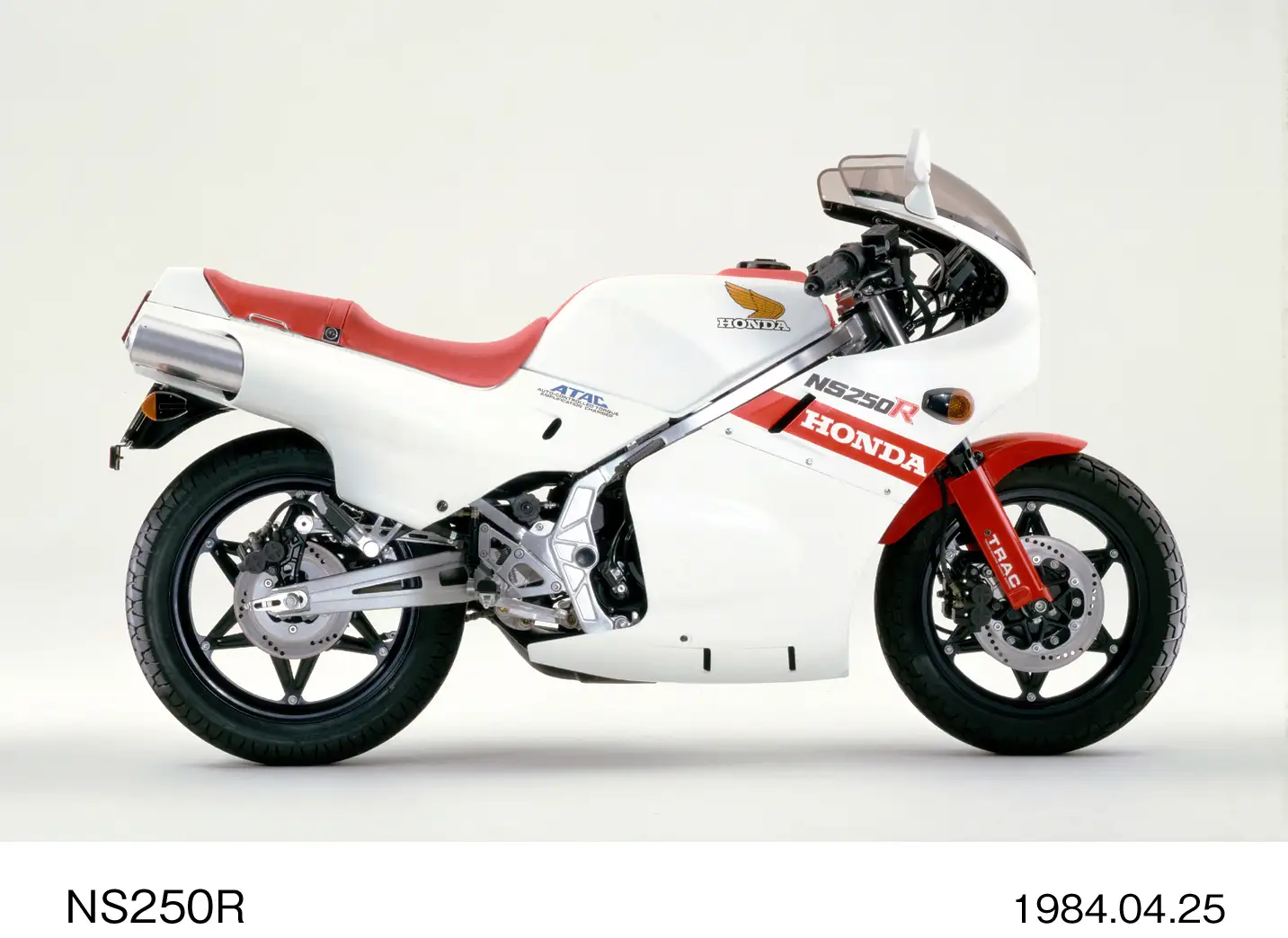
Two MC11 models were released, the fully faired NS250R race replica, and a lower-spec "naked" NS250F version.
Equipped with Comstar “lattice-type” wheels based on those used on the NR500 & NS500 Grand Prix bikes, air-assisted front suspension with preload adjustment & TRAC anti-dive, and Pro-Link rear tied to a braced aluminium swingarm, the R-model looked every part the racer-for-the-street.




Click to see more…
While looking similar, the naked NS250F chassis differed significantly from the faired model. The under-braced swingarm is the obvious difference, but not immediately apparent is the steel twin cradle frame, as opposed to the alloy framed NS250R. The braced swingarm was also of steel construction. Despite the steel frame and swingarm however, the NS250F was only 1kg heavier than the NS250R in standard trim.
The F-model’s wheels were the “boomerang” style, as seen on the previous 1983 MVX250F MC09, although now having black spokes and twin conventional discs, as opposed to the single inboard disc of the MC09.
SPEC: '84-'86
NS250R/NS250F [MC11]
Engine type: 90-degree V-type two-cylinder
Capacity: 249cc
Bore x Stroke: 56.0 x 50.6mm
Power: 45PS @9,000rpm
Torque: 3.6kg-m @8,500rpm
Weight: 144kg (Dry)
Price: ¥539,000/¥429,000 (1984)
SPEC: 84-86
NS250R/NS250F [MC11]
Engine type: 90-degree V-type two-cylinder
Capacity: 249cc
Bore x Stroke: 56.0 x 50.6mm
Power: 45PS @9,000rpm
Torque: 3.6kg-m @8,500rpm
Weight: 144kg (Dry)
Price: ¥539,000/¥429,000 (1984)
SPEC: 84-86
NS250R/NS250F [MC11]
Engine type: 90° V-type 2-cylinder
Capacity: 249cc
Bore x Stroke: 56.0 x 50.6mm
Power: 45PS @9,000rpm
Torque: 3.6kg-m @8,500rpm
Weight: 144kg (Dry)
Price: ¥539,000/¥429,000