NSR-WORLD.COM
NSR-WORLD.COM
First & foremost, NSR-WORLD.COM is a big proponent of making your NSR250R stop before trying to extract more horsepower!
Unlike other resources you may find elsewhere, we think primary consideration should be given to the braking system, so it's the first page of our guides.
NSR250R Brakes Overview
Although very competent for a road bike, the NSR250R's brakes are often overlooked!
During model evolution, apart from the increased front rotor diameter and change to 4-pot calipers for the 1988 MC18 R2/4J, the braking system was the only area Honda never deemed it necessary to significantly update.
The OEM brakes are great for the majority of rides and use cases, and indeed, it wasn’t until the 1990 HRC TT-FIII kit was introduced, that larger 296mm discs were utilised. From 1993 however, the SP racing class dictated original equipment only, and once again, even for professional competition use, 276mm discs and standard calipers were the order of the day.
With the above in mind, the number one consideration should be on the condition of the standard brakes. Ensure all fittings are corrosion and leak free, the hoses and pads are in good condition, with plenty of remaining friction material, and both the front brake lever & rear pedal operate/return smoothly. Finally, check the discs for [even] wear and ensure there are no cracks or warping. Refer to our Honda approved English Service Manuals for tolerances and service limits.
Info:
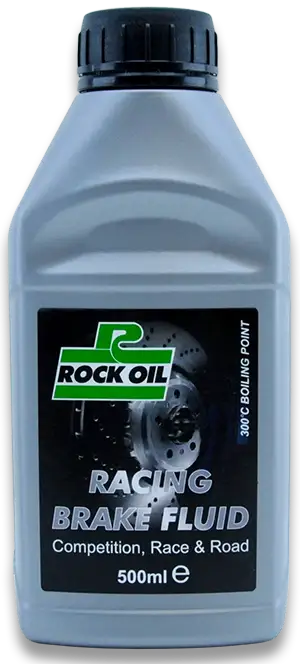
For the braking system, we recommend Rock-Oil Dot 4 Racing Brake Fluid.
Brake fluid is hygroscopic, and absorbs moisture over time. Always use fluid from a new sealed container to be sure of its integrity.
- Dot 3 fluid absorbs moisture more slowly than Dot 4 fluid, so can have longer service intervals.
- Dot 4 fluid has both a higher dry & wet boiling point than Dot 3 fluid, but needs more regular maintainace.
WARNING:
DO NOT use Dot 5 fluid in the NSR250R braking system.
Dot 5 fluid has been known to cause the caliper seals to swell, resulting in the brakes binding, and possible brake failure.
Dot 5.1 is listed as compatible with Dot 3 and Dot 4 fluids, but NSR-WORLD.COM and Honda only recommends Dot 4.
DO NOT use Dot 5 fluid in the NSR250R braking system.
Dot 5 fluid has been known to cause the caliper seals to swell, resulting in the brakes binding, and possible brake failure.
Dot 5.1 is listed as compatible with Dot 3 and Dot 4 fluids, but NSR-WORLD.COM & Honda only recommends Dot 4.
Stainless steel brake lines

All models will benefit from the fitting of stainless steel braided brake lines, and these have been part of the HRC kit since the NSR's inception.
At best, the newest original NSR250R brake lines will now be 30 years old.
Manufacturers recommend replacing the OEM rubber brake hoses every 4-6 years. Exchanging them for stainless steel covered PTFE lines is not only a performance boost, but also dramatically improves service life. Be aware however, that not all stainless steel braided lines are equal, so ensure only the best quality named brands are used.
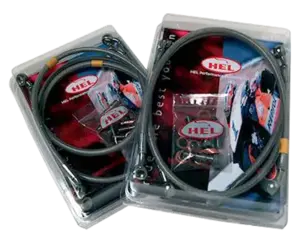
NSR-WORLD.COM uses and recommends HEL Performance stainless steel brake lines. HEL offers a lifetime warranty on all brake lines, use only stainless steel fittings, and manufactures all the stainless components in-house in the UK.
HEL brake line kits are certified for street use worldwide.
For period originality, HRC TT-FIII (’87~’90) and NKD-SP (’91~’96) braided lines are available, however they have no warranty, and are not certified for street use.
Info:
NSR-WORLD.COM recommends HEL Performance products.
All models will benefit from replacing the 30-year-old+ OEM rubber brake hoses with stainless steel braided brake lines.
HEL Peformance brake line kits are available at a special discounted rate for all NSR-WORLD.COM Members via our Discussion Forums.
Tip:
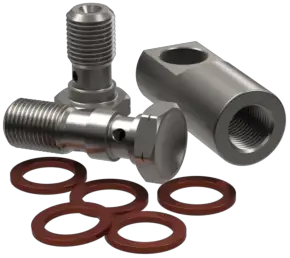
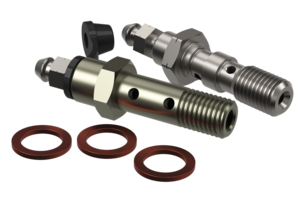
Banjo bleed bolts can often make it significantly easier to bleed the brake system, particularly when using the traditional axial front master cylinder, that can sometimes be notoriously difficult to build pressure with.
HRC part 45530-NX5-000 [M10x1.125]
HEL part H161-32BNC [Use H161-31BNC for Brembo M/C]
Brake pads
The MC16 was equipped with twin piston sliding calipers and semi-floating 256mm discs, but after the change to 4-piston calipers and 276mm discs in 1988, mimicking that year's RS250R NF5B, all subsequent model's brakes remained largely unchanged.
The ’88~’93 calipers are are based on the 1987 VFR750R RC30 castings, and the “updated” MC28 calipers are found across a wide range of late ’90s and early 2000s models such as the CBR900RR and Firestorm. Despite the difference in castings and their mounting type, all models share the same physical shape of brake pad, giving a wide range of both OEM and aftermarket options.
Genuine Honda NISSIN pads have arguably the greatest compatibility with the disc material, being designed specifically for the application. The CBR900RR variant includes a stainless steel plate on the back of the brake pads, designed to reduce heat transfer into the bike’s hydraulics, helping to maintain optimal braking performance and prevent brake fade.
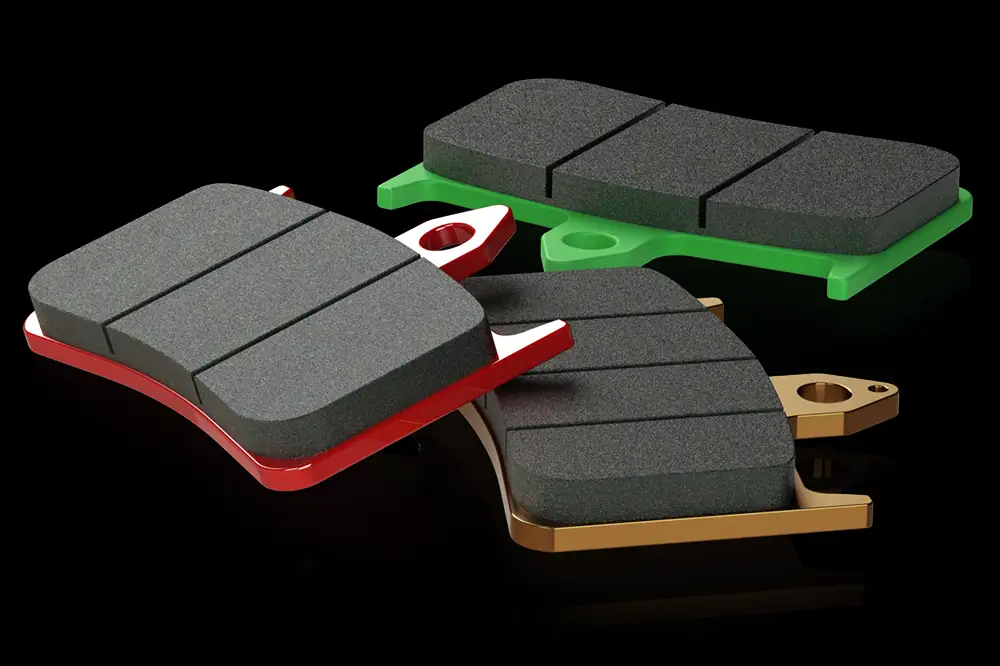
Numerous aftermarket brands are available, and personal choice is subjective, however NSR-WORLD.COM recommends the use of a sintered pad, such as Brembo’s 07-HO28-07, for street use.
Note:
Be aware that aftermarket sintered pads generally cause greater/faster wear to the OEM discs than the genuine NISSIN pads.
Info:
HRC pad part numbers:
45105-MR7-612 [TT-FIII – RC30 part]
45105-NKD-970 [Sprint]
45105-MN8-006 [Endurance]
MC16
Aside high quality sintered pads, the most simple upgrade for the MC16 comes from British manufacturer, EBC.
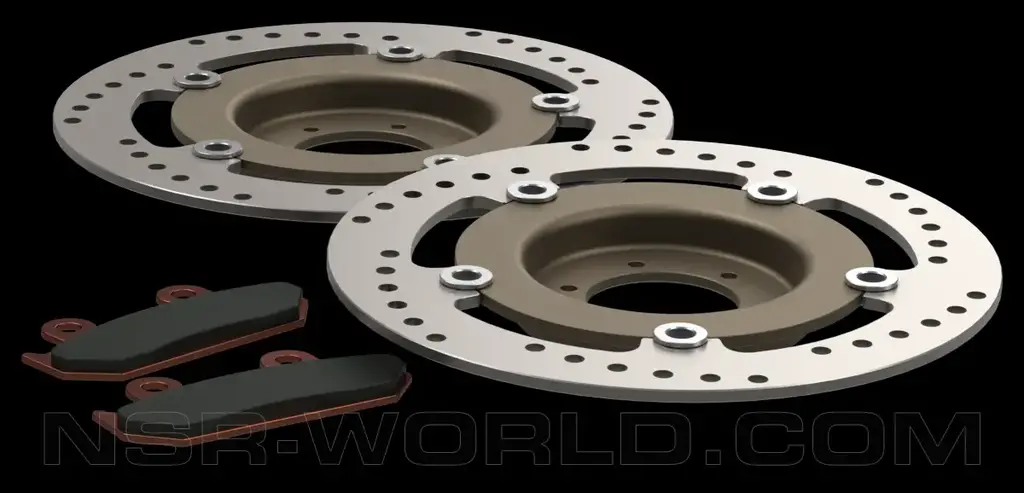
EBC offer direct replacements for the 256mm OEM discs, part# MD1129LS & MC1129RS. Combined with their matching sintered brake pads FA121HH, the setup gives a noticeable improvement over stock.
The finishing touch for the MC16 is a set of stainless steel braided brake lines from HEL Performance. Two kits are available; a 2F/1R kit [part# HBF2869], with twin full-length “race” style front lines (as per the HRC TT-F3 setup), or an OEM replacement kit [part# HBF2868] with 3 front lines (and matching rear).
As mentioned in the previous Suspension Tuning section, a complete front-end swap of the ’87 MC16 parts for 1988 or later, will also have a huge benefit in the braking department, increasing the rotor size to 276mm, and updating the early ’80s twin-piston sliding calipers to more powerful 4-pots.
MC18 & MC21
HRC updated the RS250R NF5B discs and calipers in 1988, and the NSR250R MC18 was treated accordingly.
The 1987 RS250R brakes were a derivative of the previous generation ND5B. Although 276mm in diameter, as opposed to the ’87 MC16’s 256mm items, the rotors were solid, with three clearance grooves machined into the friction pad surface.
Both the RS discs and calipers were updated in 1988. Disc diameter remained the same, but the rotors were now cross-drilled to improve performance and save weight, and mounting points to the carrier were increased to eight, for greater stiffness.
The 1988 RS250R rotors and carriers were also fitted to the ’88 NSR250R MC18, however the NSR assemblies were riveted together and semi-floating.
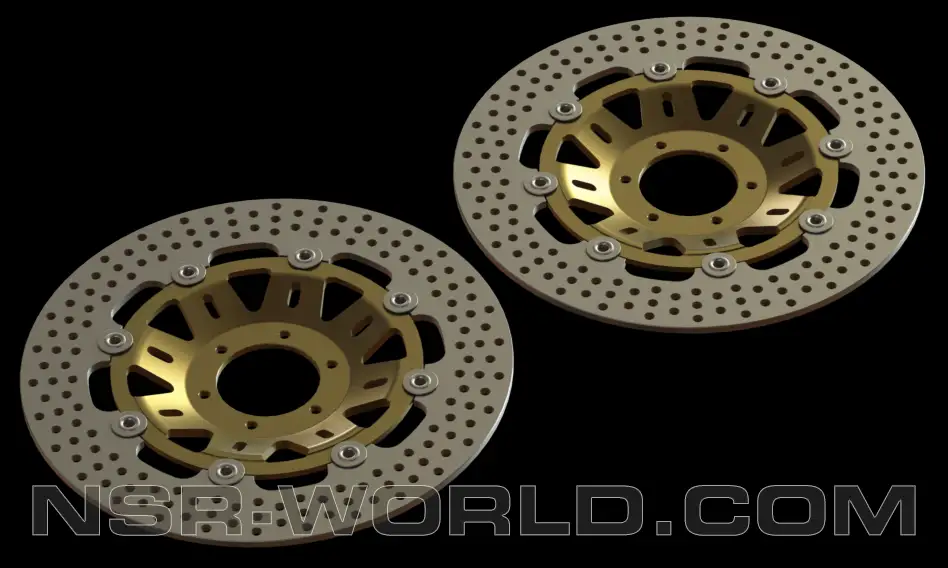
The ’88~’93 NSR250R calipers were also based on those of the 1988 RS, but featured conventional pad pins instead of the quick release items of the NF5 and RC30. Both ’88~ NF5 and RC30 calipers are a direct fit upgrade for ’88~’93 NSRs, as are the 1988 [only] RS250R fully-floating discs. While not so easy to find now, this does open up the possibility of using cast iron, fully floating discs on all post-1988 models, without any need for further modification. 1988 RS250R NF5B discs can sometimes be found on Yahoo! Auctions.
Note:
From 1989, the RS250R NF5 disc diameter was increased to 296mm. While still having the same offset and being a direct fit to the NSR250R wheel, they cannot be used without either NC30 or HRC [NH3/NF5] forks/lowers, or custom caliper brackets.
MC28
The 1994 MC28 was fitted with the new generation of NISSIN axial calipers, as used on the RVF750 RC45 and CBR900RR.
A common “upgrade” for the ’94~’96 NSR250R MC28 is the fitment of VTR1000F Firestorm calipers. While essentially the same caliper as the NSR’s, they come in a flashy gold colour!
Disc offset, diameter, and PCD all remained the same as the MC18 and MC21. Aesthetic design changed a little, but discs are fully interchangeable. As previously mentioned, the MC28 calipers use the same brake pads as the ’88~’93 models too.
Adaptor brackets
Adaptor brackets are available for MC18~MC28 models, allowing the use of alternative calipers and/or discs.
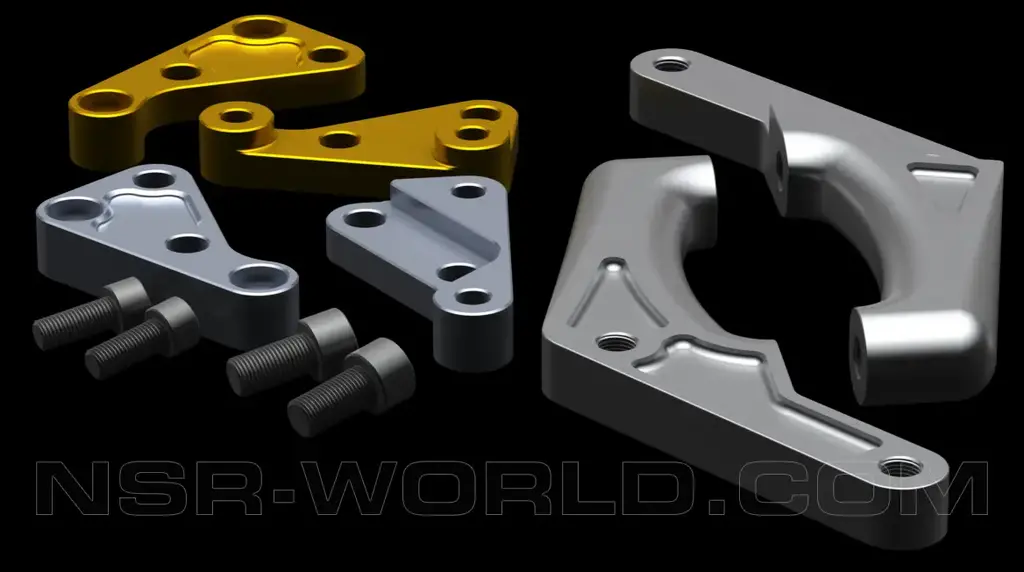
A common replacement for the OEM NISSIN calipers are the gold Brembo P4 calipers in both 40mm and 65mm pitch.
More recently, several manufacturers have also started producing adaptor brackets to allow the fitment of radial calipers too. While possibly considered unconventional-looking on a late ’80s/early ’90s bike, a radial conversion does give the option to easily use a larger 296mm diameter disc, such as those used on the VTR1000F Firestorm, VFR400R NC30, or RS250R NF5.
Rear adaptor brackets are also available from companies such as T2Racing and TYGA Performance, to fit small underslung calipers. T2Racing even produce quite a unique bracket enabling the use of two calipers!
Master cylinders
A radial master cylinder is an excellent way to improve the braking system of any NSR250R.
A radial master cylinder gives the rider far greater feel, and therefore control, over the OEM NSR250R axial unit. Highly recommended for and OEM factory look is a CBR1000RR item, however many opt for a Brembo or HEL Performance master cylinder.
NSR-WORLD.COM has used each of these master cylinders, and the final choice comes down entirely to personal preference. The upgrade is highly recommended though.
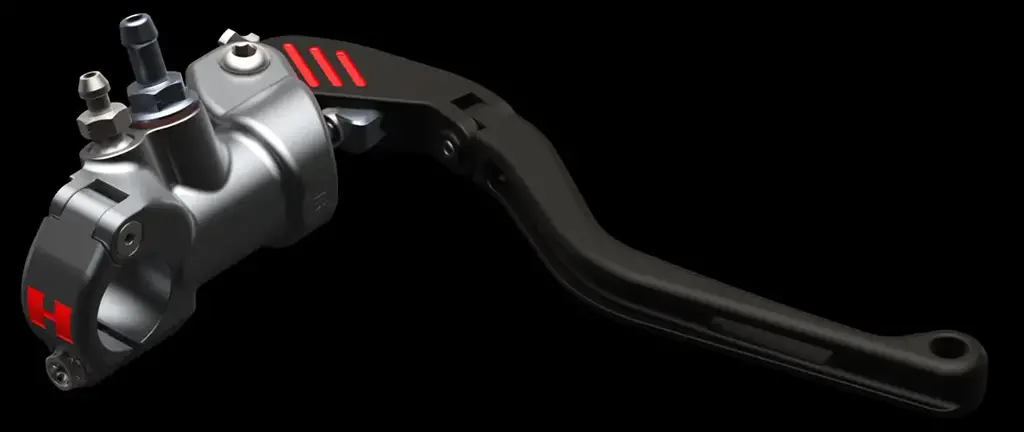
The 2025 HEL Performance radial master cylinder features a span adjuster suitable for use with a direct-fit remote adjuster.
Note:
Be aware that an change or master cylinder will require new brake lines, due to the repositioning of the fluid outlet port on the underside of the body, at approximately 90° to the axial version.
HEL Performance offer a CFA-1 radial master cylinder adaptor kit that can sometimes be used instead of purchasing new brake lines, but of course every setup varies.