NSR-WORLD.COM

NSR-WORLD.COM
The exhaust system is usually the first major item on any owners shopping list. Purely on aesthetics alone, shiny new expansion chambers rank as the number one upgrade!
It is impractical to tune the standard exhaust system. However, the stock MC18 and MC21 exhaust systems actually perform rather well, even on a modified bike.
The stock MC18 and MC21 expansion chambers are easily capable of handling in excess of 60hp, and give excellent mid-range, but make peak power lower than a dedicated race exhaust.
The graph to the right shows a delimited 1990 MC21R with standard expansion chambers, NSR-WORLD modified airbox, and Swarbrick Racing carbon silencers, and illustrates just how capable the stock exhausts are. However, peak power is close to 11,000rpm, with very little over-rev capability.

The standard MC28 expansion chambers have an additional restriction by way of a “washer” welded into the headers. The OEM silencers, like the expansion chambers, are also very restrictive.
Grinding the welds inside the downpipes & knocking out the washers, and replacing the silencers with some free-flowing aftermarket items will help liberate a few additional horsepower, but without race expansion chambers, it is very difficult to see past 50rwhp.
Generally, if tuning beyond 60hp or racing, a complete replacement system is required.
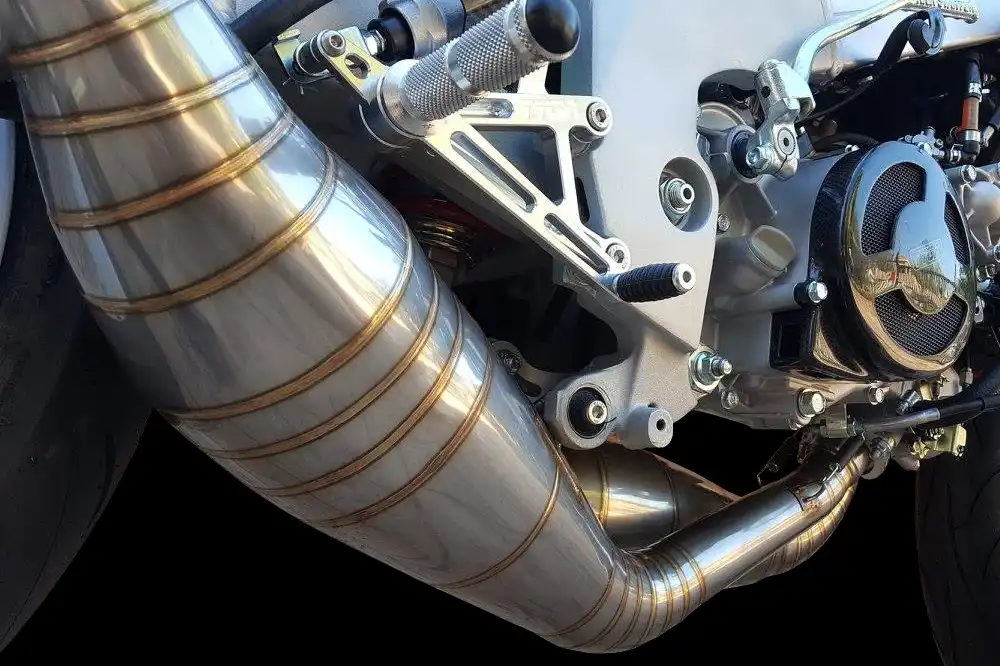
Brand new systems are available from T2Racing and DogFight Racing in Japan, and TYGA Performance either direct from their factory in Thailand, or from a number of official dealers worldwide.
Used systems can always be found on Yahoo! Auctions in Japan, and often on eBay and our own Classifieds section on our forums.
Most systems will give increased ground clearance, but often require race rearsets or adaptors for the standard controls to be used, and spacing of the OEM lower fairings to accommodate the usually wider body of race chambers. This is more prevalent on the MC21 and MC28. Finally, a race system will save several kg over the OEM exhausts, particularly the MC21/MC28 titanium systems sold by T2Racing.
An aftermarket exhaust system will effectively “move” the power higher up the rev-range, usually peaking around 11,500-11,700rpm, theoretically allowing a higher top speed when geared accordingly.
CAUTION
Although each system can look very similar in design, each will require the jetting optimised to suit their particular application. Even swapping pipes from the same manufacturer, say from Jha’s 500V to their SP type or vice versa, the jetting must always be reassessed!
Fitting the system

Most aftermarket systems will come with separate manifolds and springs to hold the various components in position. Bear in mind that some sytems will use silencers that are solid mounted to the chambers with M6 cap screws, while other manufacturers secure the silencers with springs, so if you are buying aftermarket silencers to bolt to your standard chambers with a view to upgrading the chambers later, it’s unlikely those silencers will fit the aftermarket system.
It’s common to find that the bolt pattern on aftermarket systems either differ in PCD to standard silencers, or are “upside down”!
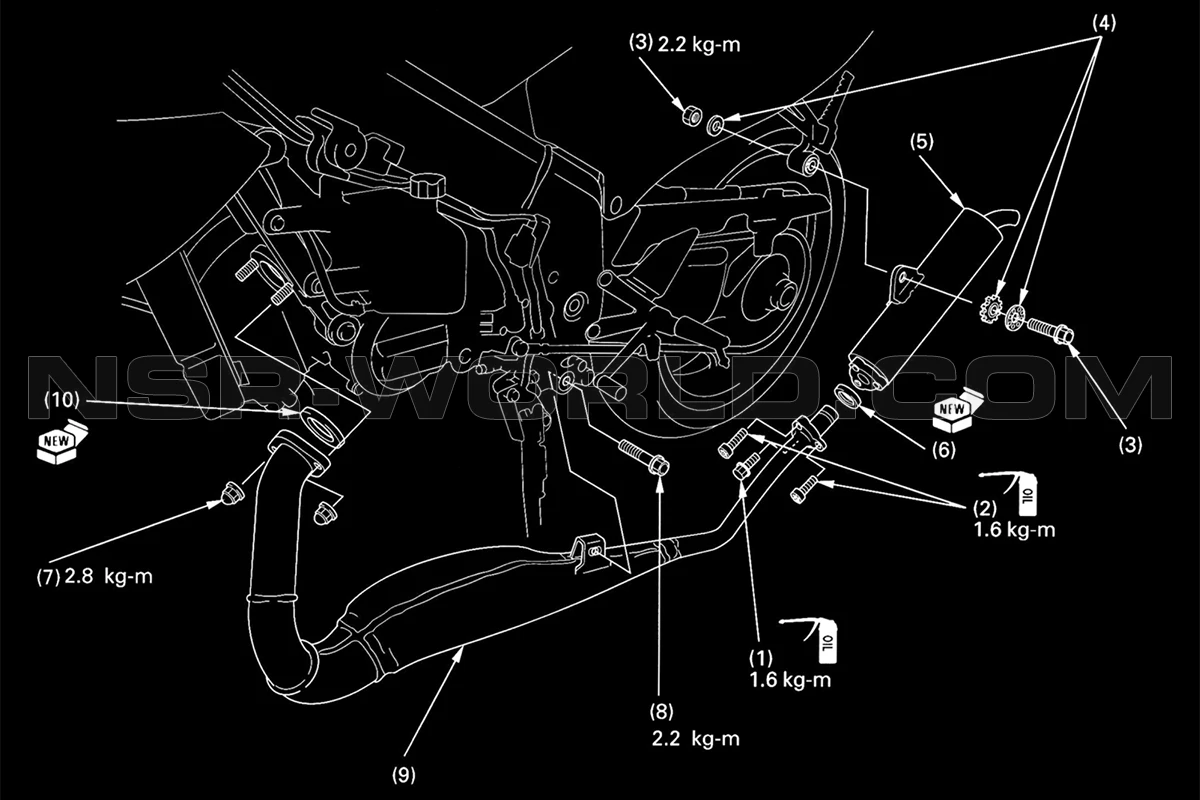
Our illustration shows how a typical aftermarket race manifold and chamber mounts to the barrel. Some manifolds come with grooves for O-rings (as shown) to assist sealing, whereas others are a simple “slip” fit, and may benefit from a light smear of high temperature RTV sealant.
INFO
When fitting the race system, for best results, ensure you use new genuine Honda exhaust gaskets, and use the correct torque for the manifolds.
[2.8 kg-m | 27.4 Nm | 1.8 lb-ft]