NSR-WORLD.COM

NSR-WORLD.COM
Honda NSR250R Top Speed:
How Fast Does an NSR250R Really Go?
The definitive guide to the 1987–1996 Honda NSR250R's restricted, derestricted, and tuned top speed.
Context - Before the NSR
In the early ’80s, Honda produced two 250cc two-strokes: the MVX250F (MC09) and the NS250F/R (MC11). Both were primarily JDM models, with very little exposure in the rest of the world (RoW)*, and consequently offer little useful comparative data. Therefore, as our initial benchmark, we turn to what can arguably be regarded as the king of 250cc two-strokes at the time: the Yamaha RD.
The mid-to-late ’70s were the RD250’s air-cooled era, with 1980 ushering in the significantly upgraded liquid-cooled RD250LC. These unrestricted bikes produced 30–32hp and 36hp respectively, providing a useful indication of the typical power output of the time. Official and road-test top-speed figures of 152km/h for the air-cooled model and around 160–165km/h for the LC illustrate that the engines of the era simply did not produce enough power to break through Japan’s 180km/h speed restriction. The bikes were not capable of going that fast.
Similar performance can be expected from the 40PS [triple-cylinder] MVX250F and, to a degree, the NS250F/R, although the latter’s technology had moved on somewhat and Honda officially rated it at 45PS in 1984.
*The MVX250F was sold in very small number through official Honda dealerships in Australia/NZ, and Switzerland.
The era of the NSR250R
The Honda NSR250R has always attracted an almost mythical reputation for performance and speed.
On paper, however, the numbers don’t initially seem extraordinary. Honda’s Japanese-market-only NSR250R was officially rated at around 45 PS for the MC18 and MC21 generations, and the final MC28 was officially rated at just 40 PS. Honda’s 1989 specification, for example, lists 45 PS at 9,500 rpm from the 249cc 90-degree V-twin. [Honda Japan]
Yet these lightweight two-strokes are capable of considerably more than their official figures suggest.
So, how fast does an NSR250R really go?
The short answer is:
A standard NSR250R is restricted to approximately 180 kmh (112 mph), while a properly derestricted machine will typically achieve around 195–200 kmh (121–124 mph). A well-prepared, tuned NSR250R with approximately 65 hp can exceed 210 km/h (130 mph).
But there is considerably more to the story than those numbers suggest.
The 180 km/h Japanese speed restriction
All Japanese-market NSR250Rs from 1987 through the end of production in 1996 were subject to the Japanese manufacturers’ 180 km/h speed restriction. It’s tempting to think of this as simply an electronic speed limiter. It isn’t.
Honda used a combination of final drive gearing, intake restriction, RC-Valve control, ignition control, and later, exhaust restriction, with the exact combination changing as the NSR evolved. This is one of the most interesting aspects of the NSR250R’s development. Honda progressively added layers of restriction as the motorcycle became more powerful and sophisticated.
The result was that a motorcycle capable of considerably more performance could still be delivered as a Japanese-market road bike that stopped at approximately 180 km/h.
1987 MC16 — approximately 190 km/h
The first NSR250R, the 1987 MC16, is somewhat different from the later bikes. Its “restriction” is nothing like what came later. The MC16 does not have the sophisticated ignition-based speed limitation found on later NSRs, but instead, its ultimate speed is largely determined by its available power and standard gearing.
Honda’s official output figure was 45 PS, although a healthy standard MC16 will often produce slightly more than Honda’s quoted figure when tested on a modern dyno. The combination of relatively modest power and standard gearing is sufficient to keep the MC16 close to the 180 km/h target.
In perfect condition, however, a standard MC16 can realistically achieve closer to 190 km/h (118 mph)
This is an important distinction.
The MC16 isn’t necessarily being electronically stopped at 180 km/h. Rather, its power and gearing naturally bring it close to that figure. In other words, the first NSR250R’s 180 km/h restriction is much less sophisticated than those found on the later machines. This becomes most apparent when looking at the 1987 HRC SP racing specifications, which unlike the TT-FIII kit, utilises most of the standard MC16 components.
1988 MC18 R2J/R4J — Three layers of restriction
For 1988, Honda moved to the MC18 R2J/R4J. The MC18 was considerably more sophisticated, and Honda subsequently introduced a more effective combination of restrictions.
The 1988 machine is principally limited by:
- Final-drive gearing
- Restricted RC Valve operation
- Restricted airbox intake area
Unlike the following year’s machine, the 1988 MC18 does not use the later ignition-assisted speed-limiting strategy.
The restricted airbox is particularly significant. Reducing the available intake area limits the engine’s ability to breathe at high rpm, while the RC valve is prevented from delivering its full unrestricted high-rpm opening. Combined with the standard gearing, these restrictions are remarkably effective.
The result is a motorcycle that runs into the familiar 180 km/h (112 mph) region, despite having considerably more potential when freed from its restrictions.
1989 MC18 R5K/R6K — Four layers of restriction
The beginning of serious electronic restriction
The 1989 MC18 R5K/R6K represents a significant change in Honda’s approach to restricting the NSR250R.
By this point, Honda was taking the 180 km/h Japanese-market speed limit considerably more seriously. The 1989 machine retained restrictions through its final-drive gearing, RC-valve operation and airbox, but for the first time the ignition system itself became part of the speed-restriction strategy.
The principal restrictions on the R5/6K can therefore be considered:
- Final-drive gearing
- Restricted RC-valve operation
- Restricted airbox
- PGM-II ignition limitation
The 1989 model also received a revised exhaust and silencer system, but this needs some clarification.
Honda redesigned the exhaust system primarily to address noise, rather than to impose a significant additional power restriction. The new MC18 adopted oval-section expansion chambers, while the silencers were shortened by 20 mm and incorporated an angled internal pipe. Honda specifically stated that the design was intended to minimise any reduction in exhaust efficiency while increasing silencing performance. Resonators were also added to the chamber and tailpipe assembly, reducing full-throttle exhaust noise by approximately 4 dB(A) compared with the 1988 model.
Consequently, while the 1989 exhaust system is undoubtedly somewhat more restrictive than the 1988 system as a result of its noise-reduction measures, it is not a major power restriction. A healthy MC18 R5/6K can achieve full power with its original expansion chambers and silencers; there is no requirement to replace the standard exhaust system with aftermarket chambers simply to realise the engine’s unrestricted potential.
This is an important distinction when discussing the later NSR250Rs. The 1989 exhaust should not be placed in the same category as the substantially more restrictive exhaust arrangement introduced on the MC28, where restrictions in the expansion-chamber downpipes and silencers materially limit the engine’s power output.
The major development for 1989 was therefore the PGM-II system. Honda integrated the PGM carburettor, PGM ignition and PGM-RC valve systems into a much more sophisticated electronic control strategy. The RC valve was now mapped according to both throttle position and engine speed, while the PGM-II ignition system independently calculated ignition timing for the front and rear cylinders.
This gave Honda considerably greater control over the engine’s behaviour—and, importantly for the NSR250R, provided the means to incorporate ignition-based restriction into the motorcycle’s overall 180 km/h limitation.
Honda’s published specification remained 45 PS at 9,500 rpm, with a 131 kg dry weight and a 1.173:1 sixth-gear ratio.
So although the 1989 motorcycle gained a revised exhaust system, the exhaust itself should not be regarded as one of the primary mechanisms responsible for limiting the R5/6K to 180 km/h. The real step forward in restriction was electronic.
That distinction becomes particularly important when comparing the R5/6K with the later MC21 and MC28, because the exhaust systems on those machines play progressively different roles in determining the engine’s ultimate power output.
1990–1993 MC21 — Five layers of restriction
1990–1993 MC21 —
Five layers of restriction
From 1990, the restriction strategy became even more comprehensive.
The ’90-’93 MC21 carries forward the previous restrictions and adds another notable limitation through the exhaust system.
The five principal restriction areas are therefore:
- Final-drive gearing
- RC Valve operation
- Airbox restriction
- PGM [ECU] ignition control
- Exhaust silencers
This combination is extremely effective.
Honda’s PGM-III system was particularly sophisticated, especially for the period. The company’s documentation describes the RC Valve as being mapped according to throttle opening, engine speed, and gear position, allowing Honda to control exhaust-port timing across the entire operating range. The PGM system was developed through extensive bench testing and real-world testing, with ignition timing, RC Valve position and fuelling continually refined to produce the desired combination of power, response and rideability. That level of integration is important when considering what happens when an MC21 is derestricted.
The important thing to understand is that the restrictions don’t simply prevent the motorcycle from accelerating beyond 180 km/h. They work together to prevent the engine from producing the power it would otherwise require to continue accelerating at high speed.
Remove one restriction and another may still be limiting the engine. Remove several and the character of the motorcycle can change dramatically.
1994–1996 MC28 — Six layers of restriction
1994–1996 MC28 —
Six layers of restriction
The final generation of NSR250R, the MC28, takes things even further.
Honda’s final NSR250R was officially rated at just 40 PS at 9,000 rpm, despite being fundamentally the same 249cc 90-degree V-twin concept. Contemporary specification data also lists the MC28 at approximately 134 kg dry for the standard R model.
The MC28 has all of the previous restrictions, but adds another.
The six principal restriction areas are:
- Final-drive gearing
- RC-valve operation
- Airbox restriction
- PGM-IV ignition limitation
- Expansion-chamber/downpipe restriction
- Silencer restriction
The last of these is particularly significant. The MC28’s expansion chambers contain a steel reduction collar welded into the exhaust downpipe/header. The silencers are also more heavily restricted. This means the MC28 is fundamentally different from the 1989 MC18 and 1990–1993 MC21 in one important respect: The stock MC28 exhaust system itself prevents the engine from making its unrestricted potential power.
However, simply removing the downpipe collars does not transform the MC28 into a 60 hp engine. The remaining exhaust restrictions, together with the PGM-IV ignition and other restrictions, continue to limit output.
A derestricted MC28 running its standard expansion chambers will typically produce closer to 55 hp, while achieving approximately 60 hp generally requires the use of suitable aftermarket race chambers. Removing the welded collars in the downpipes, and using aftermarket silencers will normally free up a additional 1.5-2 hp.
Where the MC18s and MC21 can readily break the 60hp barrier with standard components, the MC28 usually won’t, and will also require the HRC jet kit (primarily, the needles and air correctors) to exceed 60hp.
So, what is the real top speed of a derestricted MC28?
Again, gearing is critical.
A properly derestricted MC28 with sensible gearing can be expected to fall broadly into the 195-200 km/h region.
It is important not to confuse engine rpm capability with actual aerodynamic top speed. A motorcycle can have enough gearing to theoretically reach 220 km/h, but if its engine doesn’t have enough power to overcome aerodynamic drag at that speed, it simply won’t get there. Conversely, gearing that is too tall can actually reduce top speed because the engine falls outside its effective power band.
For an NSR250R, gearing is therefore a compromise between: engine power × rpm × aerodynamic drag × final-drive ratio × rider position.
And at the end of the day, 60hp for a street bike really isn’t about ultimate top speed. If you want to go fast, buy a CBR600/1000RR! (Other models are available, but we are Honda nuts!)
What does a derestricted NSR250R actually produce?
This is an area where there is a great deal of anecdotal information surrounding the NSR250R, and consequently a great deal of misinformation.
At NSR-WORLD.COM, our conclusions aren’t based on a handful of dyno runs or a single exceptionally powerful engine.
Over more than three decades of NSR250R maintenance, testing, and development, we have run every generation of NSR250R, in a huge range of specifications—from completely standard road bikes through progressively modified engines, and ultimately to full HRC TT-FII specification. [Both UL and AVGAS spec.]
But our reference point doesn’t stop with the NSR250R.
We’ve also tested and documented HRC RS250Rs, including the NF5, NX5 and NXA, as well as the NSR500V NX6. Alongside this, we have an extensive catalogue of dyno runs from other manufacturers’ 250cc two-strokes, including Aprilia, Suzuki and Yamaha.
That gives us an unusually broad database against which to compare the NSR250R—not simply between different NSR generations, but across different manufacturers, engine configurations, states of tune and levels of development.
In other words, when we say that a particular level of power is realistic for a derestricted MC21, it isn’t based on what we think a 250cc two-stroke should produce.
It is based on a very large body of measured data.
60 hp is realistic. 100 mph more is not.
60 hp is realistic.
100 mph more is not.
A properly derestricted NSR250R is capable of producing 60hp or more, depending upon engine condition, specification, calibration and dyno. That additional power transforms the motorcycle. But it doesn’t transform its top speed by the same proportion. This is where many claims surrounding NSR250R top speed become unrealistic.
A standard MC21 is restricted to approximately 180 km/h (112 mph), but simply removing the electronic and mechanical restrictions does not mean that the motorcycle will suddenly achieve 220 km/h. The reason is simple: top speed is increasingly governed by aerodynamic drag, not simply engine power. The additional 1,000–2,000 rpm available from a derestricted engine certainly helps, but if the standard final-drive gearing is retained, much of the engine’s additional potential cannot be converted into additional road speed. To make proper use of the extra power, the final-drive gearing needs to be optimised.
With an appropriately geared, healthy derestricted MC21, our experience indicates that approximately 195–200 km/h (121–124 mph) is a realistic top-speed range.
This is a very different proposition from simply quoting the theoretical speed calculated from gearing and maximum rpm. A gearing calculation can tell you what speed a motorcycle could achieve at a particular engine speed. It cannot tell you whether the engine has sufficient power to overcome the aerodynamic drag required to actually reach that speed. And this distinction becomes increasingly important beyond 200 km/h.
Why 200 km/h is close to the limit for a 60 hp NSR
Once an NSR is producing around 55–60hp, the motorcycle is already approaching the point where aerodynamic drag becomes the dominant factor in determining its ultimate speed.
The NSR is remarkably light, but its light weight doesn’t eliminate aerodynamic drag. In fact, at these speeds, the rider and motorcycle together present a substantial aerodynamic load. This is why we consider 195–200 km/h to be a realistic upper range for an ordinary derestricted 55–60 hp NSR250R with suitable gearing.
Could an individual machine show more? Certainly.
A particularly strong engine, favourable conditions, an exceptionally tucked-in rider, favourable wind and differences in tyre circumference or speed measurement, even tyre pressures, can all influence the result. But there is a significant difference between briefly seeing a particular number on a speedometer and demonstrating that a motorcycle can genuinely accelerate through that speed under controlled conditions. Our extensive experience with 250cc two-strokes from multiple manufacturers gives us a useful reality check here.
We’ve had the opportunity to see what these engines can actually do—from mildly modified road bikes right through to HRC-developed racing machinery. That makes claims of enormous top speeds from relatively modestly powered road engines much easier to put into context.
The NSR250R is fast for a 250cc road bike, but it isn’t exempt from physics!
What happens when you tune an NSR250R?
This is where the NSR250R really starts to show what it is capable of.
The dyno graph accompanying this article is from a well-prepared, lightly tuned MC21 with race expansion chambers, tested with optimised gearing.†
The result is approximately: 65–66 hp / 210 kp/h [130mph]
That’s a substantial increase over a typical derestricted road-going machine.
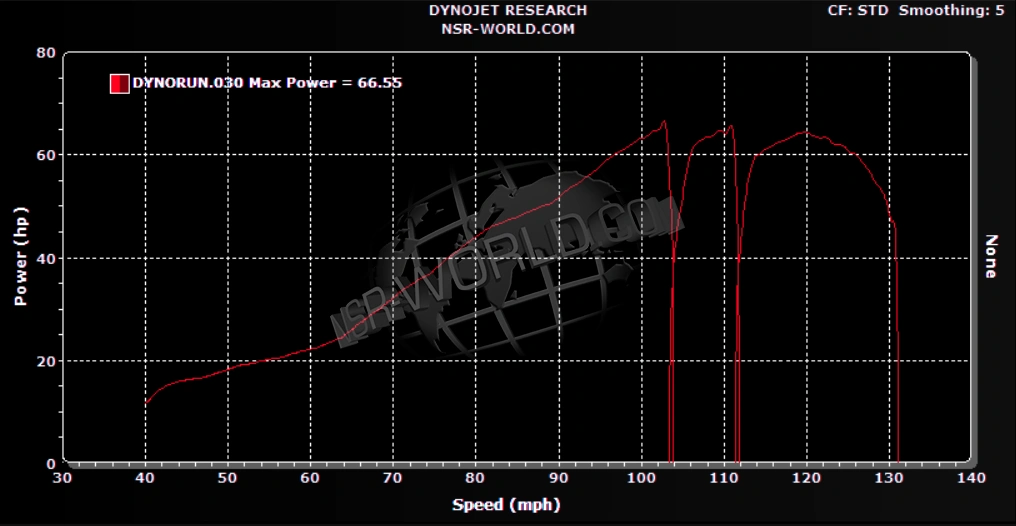
And unlike some highly tuned two-strokes, this particular engine doesn’t achieve that figure by sacrificing the entire bottom end. The power curve is remarkably broad, retaining useful low- and mid-range performance while continuing to produce approximately 65 hp at the top end.
With the gearing specifically revised to make the most of that additional power, this level of output is sufficient to push the NSR250R beyond 210 km/h (130 mph). But the particular example shown here demonstrates something else that is often overlooked: even with the gearing altered to suit the engine’s increased output, the motorcycle is still ultimately being limited by its gearing.‡
The engine reaches approximately 12,400 rpm in sixth gear.
In other words, even with 65–66 hp available, there is no magic 220 km/h figure waiting to be unlocked simply by adding another few thousand rpm. The gearing would have to be changed again to convert that additional engine speed into additional road speed.
† The example MC21 retains standard port timing and compression. It is merely optimised.
‡ Bear in mind that the above speed run was made under controlled conditions, with no aerodynamic drag or weight to carry. A dyno measures the engine’s output under static conditions; it does not account for the aerodynamic drag that ultimately determines how much power is required to achieve a given road speed. Also, while the MC21 is quite capable of making well in excess of 60hp with standard exhausts, unlike the race chambers used in this example, they do limit RPM, and consequently ultimate top speed.
NSR250R top speed: The numbers
NSR250R top speed:
The numbers
| Model | Std./Restricted | Delimited/Optimised | Typical Power Potential |
|---|---|---|---|
| 1987 MC16 | 180-190 km/h | -- | 45-55hp |
| 1988 MC18 R2/4J | 180 km/h | 195-200 km/h | 60+ hp |
| 1989 MC18 R5/6K | 180 km/h | 195-200 km/h | 60+ hp |
| '90-'93 MC21 | 180 km/h | 195-200 km/h | 60+ hp |
| '94-'96 MC28 | 180 km/h | 195-200 km/h | 60+ hp |
| Example - Tuned MC21 | -- | 210+ km/h | 130+ mph | 65-66 hp |
The 180 km/h NSR250R myth
The 180 km/h NSR myth
The most important thing to take away from all of this is that 180 km/h was never really the NSR250R’s natural top speed. It was the product of deliberate engineering. Honda progressively developed a remarkably sophisticated system of restrictions:
MC16
Power + gearing
↓
MC18 R2J/R4J
Gearing + RC valve + airbox
↓
MC18 R5K/R6K
Gearing + RC valve + airbox + ignition
↓
MC21
Gearing + RC valve + airbox + ignition + exhaust [silencers]
↓
MC28
Gearing + RC valve + airbox + PGM-IV ignition + expansion chambers + silencer restrictions
The NSR250R therefore tells an interesting story about the evolution of Japanese performance motorcycles during the late ’80s and early ’90s. As the engines became more powerful, Honda didn’t simply add a single speed limiter. They engineered the entire motorcycle around the restriction. And once those restrictions are removed, the difference can be dramatic. A healthy NSR250R can go from a motorcycle that struggles to exceed 180 km/h to one capable of approximately 200 km/h, while a properly prepared MC21 producing 65–66 hp can push beyond 210 km/h.
That is the real story behind the NSR250R’s top speed.
The bottom line
If someone asks, “How fast does an NSR250R go?”, the honest answer depends entirely upon which NSR250R they’re talking about.
- Standard Japanese-market bike: ~180 km/h / 112 mph
- Excellent standard MC16: ~190 km/h / 118 mph
- Properly derestricted 1988–1996 NSR: ~195–200 km/h / 121–124 mph
- Well-prepared 65–66 hp MC21: 210+ km/h / 130+ mph
And that’s before entering the world of serious engine tuning, porting, compression changes and specialist race fuels.
The NSR250R was never really about outright top speed.
It was about how much performance Honda could extract from 249 cc, 135 kg or so of motorcycle, two cylinders and two strokes — and then finding increasingly clever ways of putting that performance behind a 180 km/h wall.
A note on the evidence
The technical detail above combines NSR-WORLD.COM‘s long-term real-world dyno and owner data with Honda’s original period documentation. Honda’s own material confirms the progression of the PGM systems and the increasingly sophisticated electronic control of ignition and RC Valve operation. For example, Honda’s 1989 documentation explicitly describes the PGM-RC Valve as being controlled according to throttle opening and engine speed, while PGM-II independently calculates ignition timing for the front and rear cylinders. [Honda Japan]
Honda also documented the 1989 MC18’s 249cc engine, 45 PS output, 131 kg dry weight and transmission ratios, providing useful primary-source context for understanding why gearing is so important when discussing NSR top speed. [Honda Japan]
The MC21 in context
The example MC21 is an excellent illustration of the NSR250R’s enormous performance potential.
- Restricted: approximately 180 km/h
- Derestricted: 55–60 hp
- Tuned: around 65 hp:210+ km/h
And these figures are not derived from theoretical gearing calculations or isolated internet claims. They come from decades of measured NSR250R data, supported by direct experience with everything from standard road bikes to HRC-specification machines and other highly developed 250cc two-strokes.
That breadth of experience is important.
The NSR250R exists within a much wider family of 250cc two-stroke technology, and having tested comparable machines from Honda, Aprilia, Suzuki and Yamaha—as well as HRC’s dedicated RS250R and NSR500V race machinery—provides a valuable benchmark for determining what is genuinely achievable.
When it comes to NSR250R performance, the numbers have to stand up against the dyno.
All have been tested by the same operator, on the same dyno, for consistency. And after more than 30 years of testing them, we’ve accumulated a lot of numbers!
Info:
Join the conversation today on our forum, and become part of the world’s largest online Honda NSR250R community.