NSR-WORLD.COM

NSR-WORLD.COM
In a last-minute shock move off-season, Eddie Lawson took the reigns of the NSR500 in 1989!
Background image
© Shigeo Kibiki
1989 NSR500 [NV0H]
Eddie Lawson won his fourth world title in 1989, and in doing so was the first rider to take back-to-back championships on two different marques.
There was some animosity in the HRC camp as Wayne Gardner felt Honda had lost faith in him, but the reality was Yamaha team politics meant Eddie Lawson forced their hand with a proposed switch to Rothmans Honda, and by the time they realised, it was a done deal.
Rumours were that Giacomo Agostini claimed Yamaha had cut the team budget, and required Lawson to take a pay cut, but he queried this with Yamaha who informed him the budget had actually been doubled! Lawson put two and two together, and made the deal with Honda before Yamaha had a chance to resolve the contract problems.
It was a major coup for Honda, to have two 500cc world champions on board the NSR, which would greatly increase devolpment potential and their likelihood of another championship.
A sensational win at his home Australian Grand Prix in front of 100,000 people, demonstrated Gardner wasn’t finished just yet, Eddie Lawson however, really got to grips with the bike, and the more consistent results showed it.
Eddie Lawson also had the benefit of revered tuner Erv Kanemoto on his side, and the luxury of total flexibilty with chassis changes, whereas Wayne Gardner was at the mercy of the HRC engineers’ stubborness.

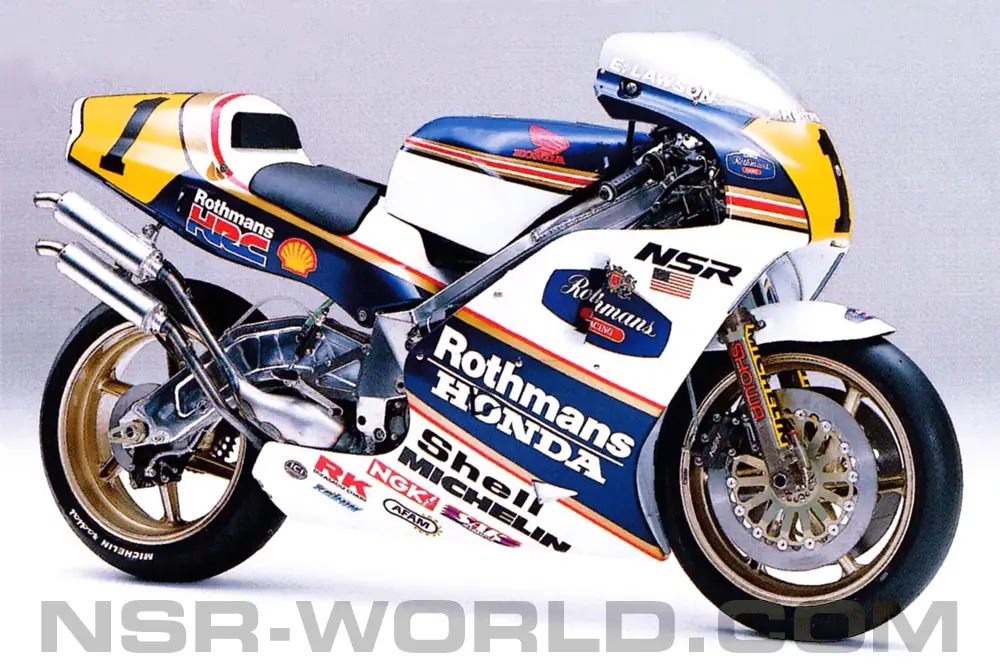
1989 NSR500 [NV0H]
Although both riding Rothmans sponsored bikes, Eddie Lawson and Wayne Gardner actually rode for two different teams in 1989. Gardner rode the official HRC machine, and Lawson for Kanemoto Racing.
Despite the regulation allowable minimum weight limit being just 115kg, Gardner’s NSR weighed in at 128.9kg, and Lawson’s , with all the additional bracing added by Kanemoto, a heafty 129.6kg!
Ultimately, feedback from two different perspectives would lead to a change within HRC from their “one bike fits all” policy in subsequent years to one of supplying more tailored packages to suit individual riders.
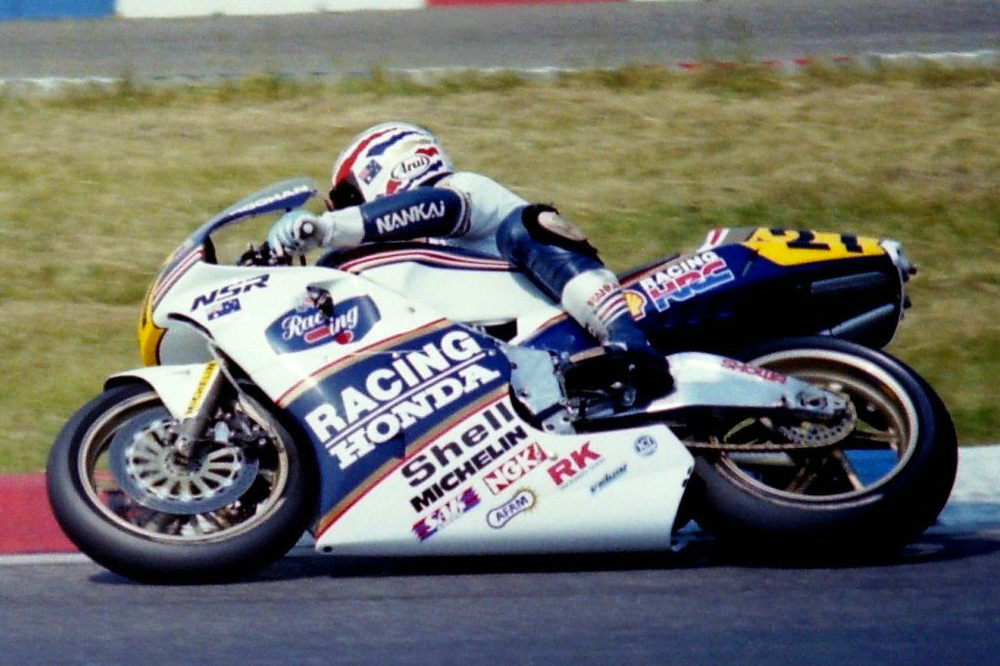
Mick Doohan
1989 was the future 5-times world champion Mick Doohan’s first season, riding for HRC Rothmans Honda alongside Wayne Gardner.
Nine top ten finishes, with a best of third in Germany, saw him finish the season in 9th place, 14 points ahead of Gardner in 10th.
Although both Eddie Lawson and Wayne Gardner were riding Rothmans Hondas, the two bikes differed significantly.
Wayne would effectively have to ride the bike he was given, but Lawson & Kanemoto made numerous changes over the season, adding over half a kilo of bracing to the NV0H frame [making it a heafty 9kg!], and boring the carburettor bodies to 36mm [from 35mm], resulting in a much more flexible and friendly package.
Additional improvements came from increasing the mass of the crankshaft, and a change in how the RC Valves were activated in relation to throttle opening rather than relative to RPM.
Lawson also complained of a lack of feel from the gearshift mechanism, so changes were made to the transmission that would also be carried over on every model thereafter.
The improvements weren’t substantial, but made a marked difference to Gardner’s bike, and in conjuction with his prowess, were enough to power Lawson to 13 podium finishes, of which four were on the top step, and ultimately take the championship title.
Despite Wayne Gardner's five pole positions, four wins, and a string of 2nd place finishes on the NSR500, once again arch rival "Steady" Eddie Lawson took the championship on the more balanced YZR500.
SPEC: 1989
NSR500 [NV0H]
Power: 165PS @12,000rpm
Torque: 9.8kgm @12,000rpm
Weight: 129.6kg
NSR500 Big Bang
Due to the nature of their configurations, given they were both using twin crank motors, both Yamaha and Suzuki were already using a 180 degree firing order.
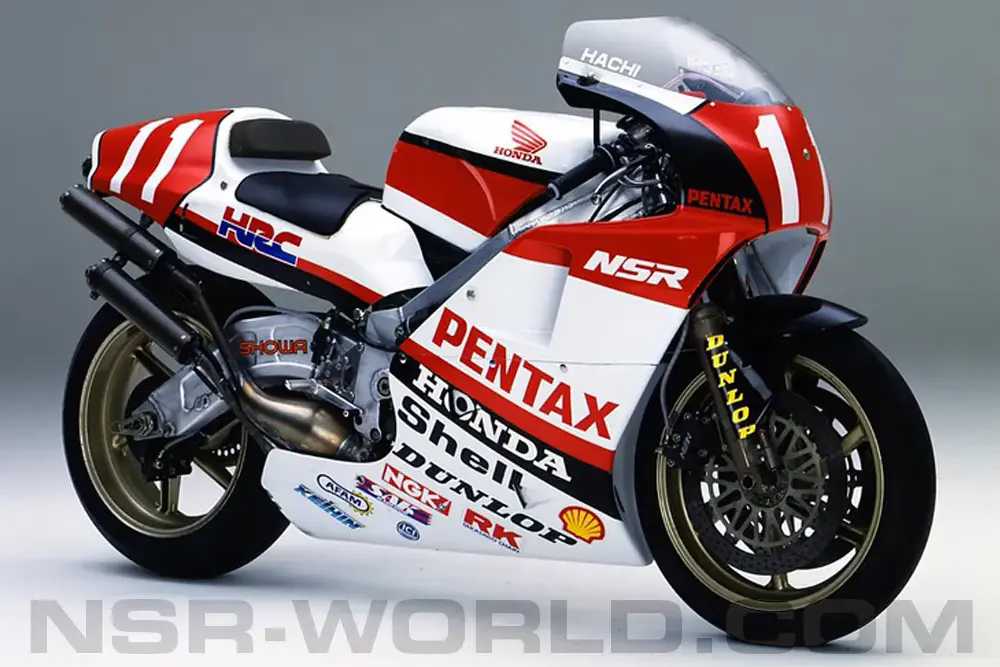
1989 NSR500 [NV0H]
Since the early ’80s, upon Honda’s re-entry into the world of 2-stroke Grand Prix machines, they had been using the domestic All Japan Road Racing Championship as a testing ground for WGP.
During the 10th All Japan round at Sugo, Shunji Yatsushiro debuted the very first “bang version” of the NSR500.
Little attention was paid to HRCs tinkering with the NSR500 in the domestic series in 1989, and Noirihiko Fujiwara took the title on the Yamaha YZR500, with Yatsushiro finishing in second place.
Honda’s competitors would certainly sit up and take notice upon its arrival in 1990 though!
Since day one though, being a single-crank motor [and the only true V4*], Honda had been using an “equally spaced” 90° firing order, known as a “screamer”. The motor however, was starting to generate too much power, and was overwhelming the ’80s tyre technology.
While the 180° firing order was considerd the most natural [mechanically balanced] configuration for the YZR500 and RGV500, HRC looked to the 180° not from a practical point-of-view, but from a traction point-of-view, something it seems at the time, hadn’t occurred to their rivals. (Presumably because they weren’t experiencing the same power delivery issues as HRC’s 90° screamer.)
Therefore, during the 1989 All-Japan 500cc Road Racing Championship, running under the Pentax Honda banner, but fully factory supported by HRC, Shunji Yatsushiro was secretly developing HRC’s first big-bang motor, away from the prying eyes of the world stage. The big bang NSRs first ever appearance was during round 10 at Sugo.
Outwardly, there was nothing to distinguish the “big bang” motor. It retained the NV0Hs 112° bank angle and crankcases, but featured a new crankshaft and ignition, firing the left bank cylinders of 1 & 2 together, then at 180°, the right bank 3 & 4 cylinders. This effectively give a power delivery more akin to that of a big V-twin, something that HRC would experiment even more with in later years.
Yatsushiro qualified in second place, 0.4s behind pole sitter Shinichi Ito on the NV0H screamer, and finished the race in third, 7 seconds behind Ito.
1989 All Japan 500cc Road Racing Championship
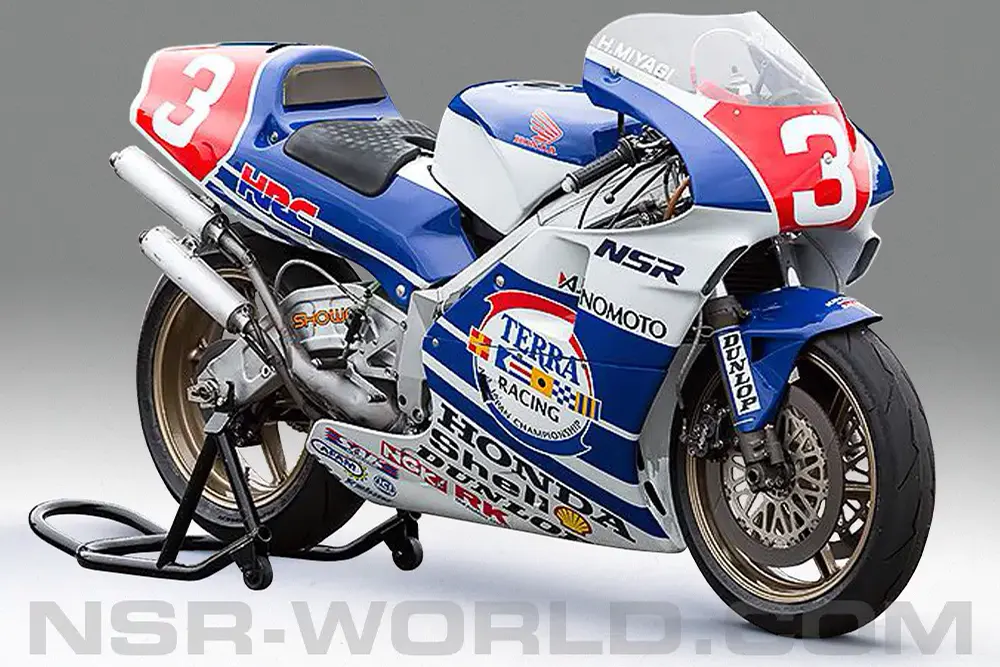

Hikaru Miyagi
Hikaru Miyagi’s iconic Ajinomoto Terra Racing livery was the inspiration for both the blue and red versions of the 1989 NSR250R MC18-R5K-II.
Miyagi placed fourth in the 1989 All Japan 500cc Road Racing Championship.
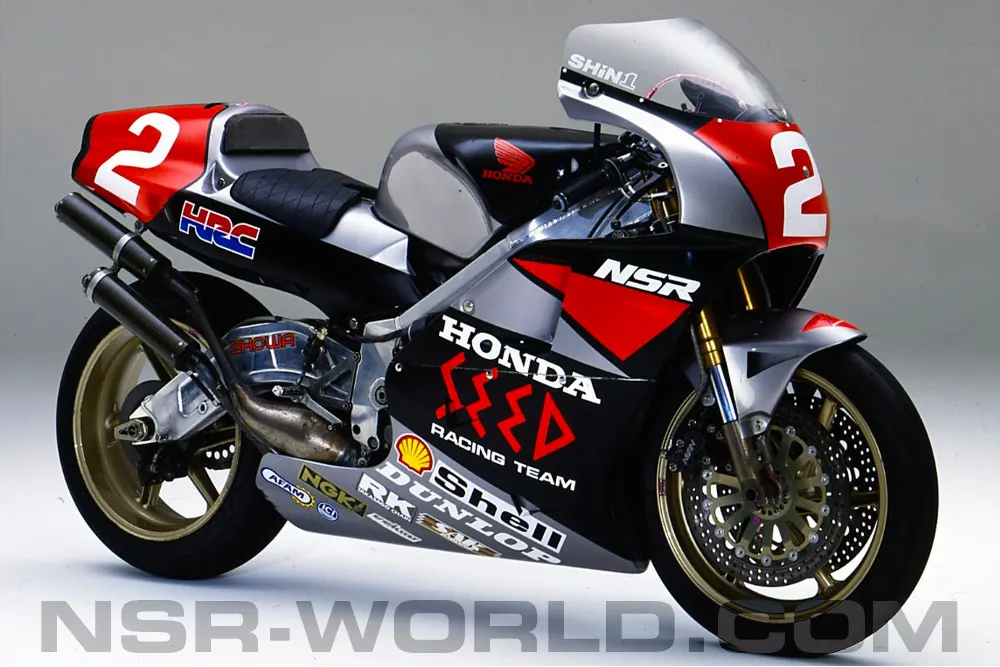

Shinichi Itoh
Shinichi Itoh’s 1989 SEED Racing NV0H as run in the All Japan 500cc Road Racing championship was the inspiration for 1989 NSR250R MC18-R5K colour scheme.
Itoh would finish the 1989 All Japan Championship in sixth position.
1989 NSR250 [NV1G]
Sito Pons claimed a consecutive 250cc championship in 1989 on the Campsa sponsored NSR250, dominating the rest of the field.
NSR250s also took the following three positions, in another Honda HRC whitewash of the 250cc World Championship.
The 1989 NSR250 was first model for 2 seasons that was more than just an evolution. The most significant changes were made to the chassis, with the introduction of the “Gull-Arm” swingarm, allowing for a more efficient, straighter right hand side expansion chamber to be tucked in tighter and higher to the chassis, a strengthened frame with a new cross-sectional profile, & stiffened headstock with revised geometry.
The wheelbase was once again lengthened, by a quite significant 22mm, to 1347mm, due to stability issues the year before. Only Sito Pons was really able to get to grips with the challenging handling of the NV1D, but despite a lot of conflicting feedback from multiple factory teams in ’88, HRC had managed to develop the ’89 NV1G into a real weapon that was user friendly to all who rode it. However, once again feedback from a large number of HRC teams sometimes meant development went in the wrong direction, and Pon’s claimed that HRC provided a number of different frames during the season, which simply didn’t work.
The front suspension was also tweeked, and the magnesium legs increased in diameter to 52mm to provide a stiffer and more robust platform to mount the the magnesium 4-pot Nissin calipers, which now grabbed larger 290mm discs.
At Laguna Seca HRC ran special downdraught carbs, but [Pons recalled] they didn’t work so well, so were only used for that one round.
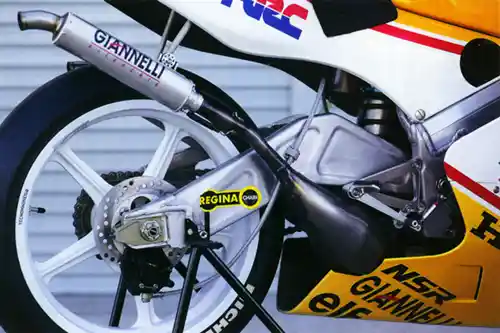
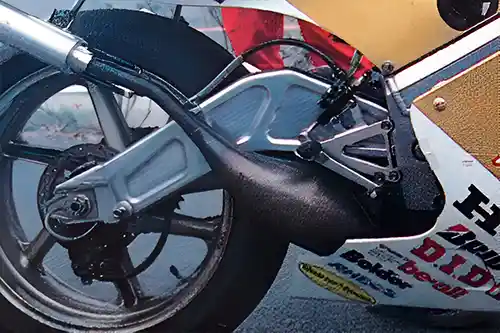
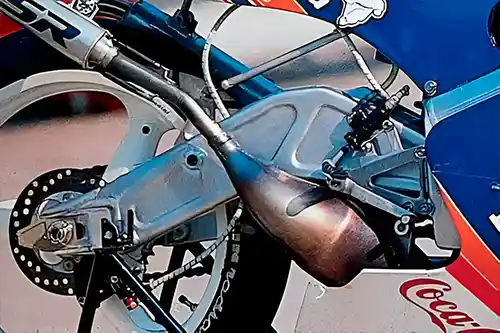
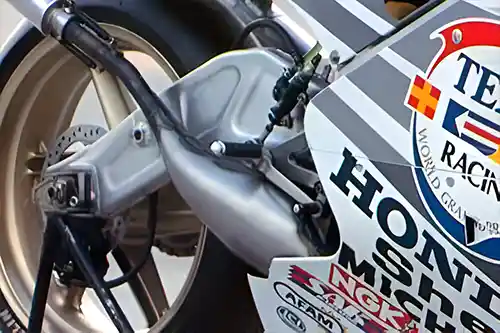
The aforementioned swingarm was significantly stiffer [& consequently over 600g heavier] than the ’88 model, but despite it’s sturdier appearance, the new frame was slighly lighter than before. However, it all added up to an overall 2kg weight increase over the NV1D.
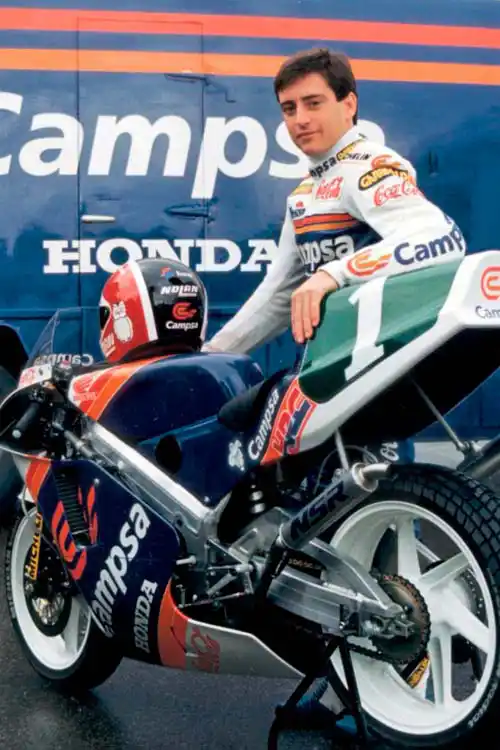
Sito Pons: P1
Sito Pons was on devastating form in 1989, winning seven of the fifteen rounds, and coming second four times.
He won the championship by a margin of 70 points over Reinhold Roth, also on an NSR250.
Unlike the GP dominating NSR250 NV1D, the RS250R NF5B wasn’t particularly successful, and was overshadowed by the ’88 Yamaha TZ250U “reverse cylinder”, particularly in AMA, where John Kocinski won the title in convincing fashion. In the European championships, Aprilia were dominant with their AF1, and it was only really the British national championships where the NF5 saw particular success. In the All Japan Championship the RS250R NF5B of Yohinan Hori finished in 3rd overall, behind the YZR250 of Toshihiko Homma [1st] and NSR250 of Masaru Kobayashi.
Reinhold Roth, Jacques Cornu, and Carlos Cardús rounded out the top four places for HRC and the NSR250, with Masahiru Shimizu and Helmut Bradl also finishing inside the top ten on NSRs.
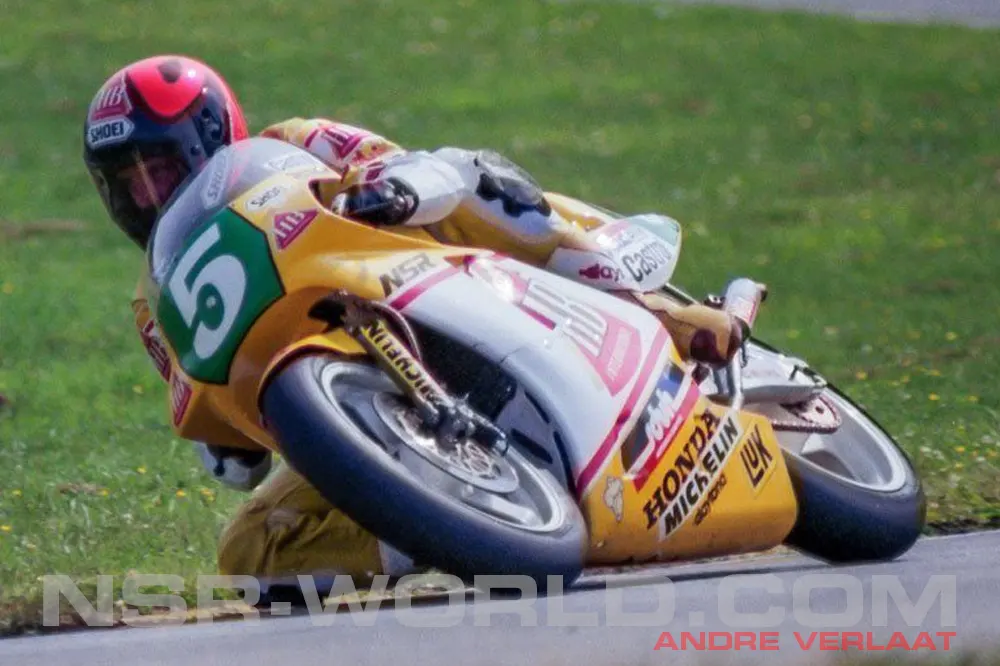
Reinhold Roth
NSR250 [NV1G]
P2
HB Römer-Honda
©Andre Verlaat
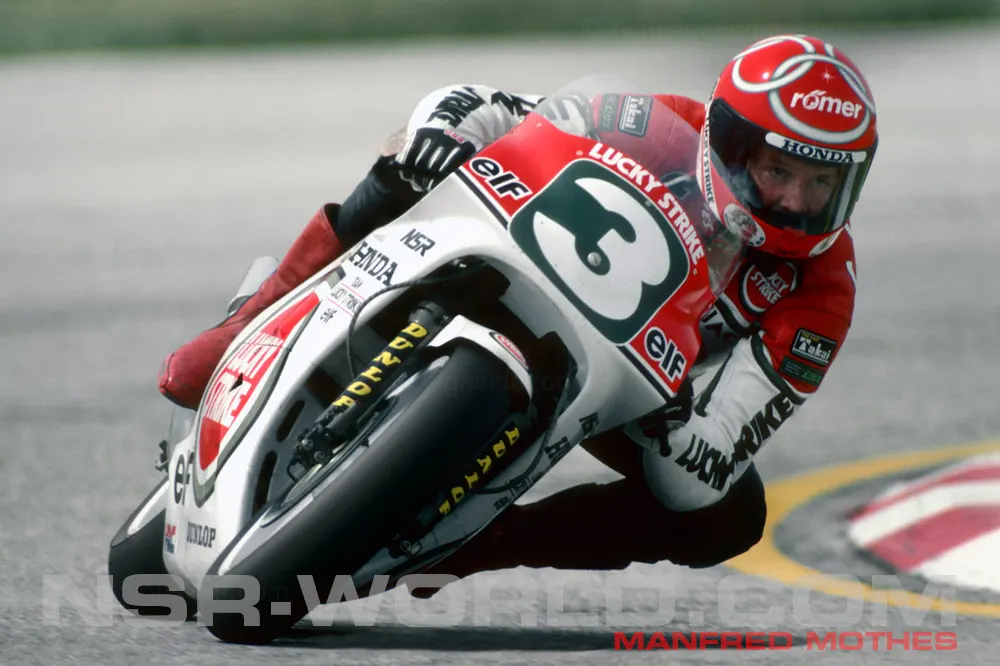
Jaques Cornu
NSR250 [NV1G]
P3
Parisienne-Elf Honda
© Manfred Mothes
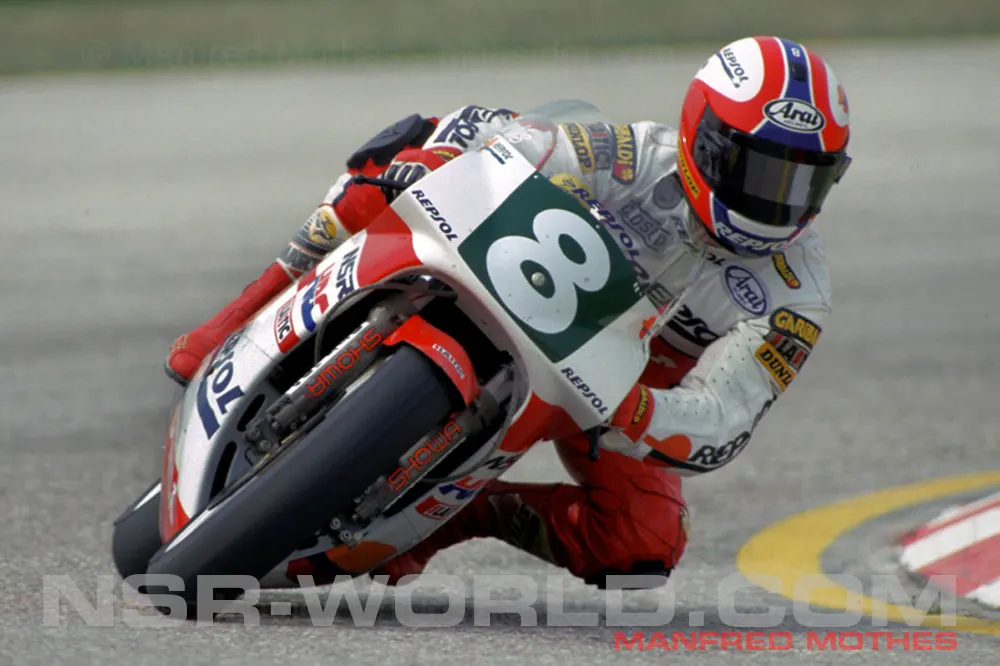
Carlos Cardús
NSR250 [NV1G]
P4
Repsol Honda
© Manfred Mothes
SPEC: 1989
NSR250 [NV1G]
Power: 85.2PS @12,000rpm
Torque: 5.08kgm @12,000rpm
Weight: 95.6kg
1989 Model Overview
500cc
250cc
250cc
NSR500 [NV0H]
NSR250 [NV1G]
RS250R [NF5C]
NSR250RK [NH3C]
NSR250R-SP [NKD]
NSR250R [MC18-II]